The North Carolina Education Innovation Lab 2023 | Teacher Pay in North Carolina

Every student deserves access to a great teacher.

Unfortunately, too many North Carolina students are deprived of that access because of a leaky teacher pipeline that fails to recruit, support, and retain enough high-quality educators for our public schools. One key contributor to this leaky pipeline is the outdated way we pay teachers.

The good news is that North Carolina is at the forefront of a national movement to change how teachers are paid, with programs like Advanced Teaching Roles and strategies like Front-Loaded Pay. But there’s only so much that strategic investments can help when the salary structure that they’re layered on is so outdated. During the 2023 North Carolina Education Innovation Lab, stakeholders from across the state examined the past, present, and reimagined future of teacher compensation in our state, diving deep into recommendations from BEST NC’s recent report Teacher Pay in North Carolina: A Smart Investment in Student Achievement.

Find everything from the Lab, including recordings and pictures of the day’s panels and presentations, downloadable slide decks, and additional resources to help you continue your work long after the Innovation Lab has ended.


Proin efficitur ornare nunc, et suscipit risus malesuada faucibus. Sed quis justo quis sapien vehicula pretium.

Jessica Charles

Lorem ipsum dolor sit amet, consectetur adipiscing elit. Nunc a mi efficitur est condimentum eleifend. Curabitur nisi nulla, faucibus vitae tempor id, pretium in ante. Pellentesque fermentum convallis tellus, ac dignissim justo sagittis sed. Duis lorem eros, egestas quis nulla vel, fermentum ultricies lectus. Vestibulum laoreet tellus vel tristique ullamcorper. Aliquam ut nunc varius, pharetra purus non, placerat orci. Nunc pulvinar leo at arcu tincidu lorem ipsum dolor.

Jessica Charles

Lorem ipsum dolor sit amet, consectetur adipiscing elit. Nunc a mi efficitur est condimentum eleifend. Curabitur nisi nulla, faucibus vitae tempor id, pretium in ante. Pellentesque fermentum convallis tellus, ac dignissim justo sagittis sed. Duis lorem eros, egestas quis nulla vel, fermentum ultricies lectus. Vestibulum laoreet tellus vel tristique ullamcorper. Aliquam ut nunc varius, pharetra purus non, placerat orci. Nunc pulvinar leo at arcu tincidu lorem ipsum dolor.

Proin efficitur ornare nunc, et suscipit risus malesuada faucibus. Sed quis justo quis sapien vehicula pretium.

  • orem ipsum dolor sit amet, consectetur adipiscing elit.
  • Integer lobortis libero sed metus imperdiet, eget dignissim odio dictum.
  • Fusce vitae risus volutpat, finibus velit nec, ultrices odio.
  • Nullam condimentum ex in felis iaculis, et molestie ex dignissim.
  • Etiam rutrum velit eu odio dapibus tristique.
  • Curabitur id sapien tristique, egestas justo non, ultrices nibh.
  • In aliquam nisl lacinia scelerisque elementum.
  • Proin sed turpis sodales, rhoncus purus tincidunt, tristique lorem.
  • Integer auctor felis a malesuada euismod.
  • Phasellus tincidunt justo vel dictum lacinia.
  • Curabitur facilisis libero blandit lobortis tincidunt.
  • Sed dignissim ipsum egestas, convallis dolor vitae, molestie magna.
  • Pellentesque facilisis nulla id sodales scelerisque.
  • Integer faucibus ligula rutrum fringilla porttitor.
  • Phasellus egestas risus sit amet scelerisque imperdiet.
  • Nunc vitae velit eleifend nulla pharetra feugiat feugiat non ligula.
  • Donec posuere odio ut augue elementum, nec iaculis metus egestas.
  • Fusce ac ipsum at enim dignissim congue a bibendum erat.
  • Curabitur eleifend justo quis viverra blandit.
  • Morbi vitae ligula pharetra, interdum nunc sed, convallis neque.

Meet the planning Team

The North Carolina Education Innovation Lab represents the collected time, effort, and perspectives of professionals from across North Carolina’s education, workforce, legislative, and business communities.

AGENDA

9:00 am     Welcome & Opening Remarks

Walter McDowell   |   Chairman, BEST NC

Leah Sutton   |   Vice President of Policy & Engagement, BEST NC


9:20 am     From Conversation to Action: Why Tailored Learning, Why Now?

Brenda Berg   |   President & CEO, BEST NC 


10:45 am     National Perspectives Panel: The Promise and Practical Reality of Tailored Learning

This panel provides a national, research-based foundation for the day, clarifying what tailored learning is — and what it is not. Drawing on decades of work in competency-based education, participants will define the distinctions and overlaps among CBE, mastery-based learning, and personalized learning, emphasizing that tailored learning is a system of redesign, not a curriculum or instructional add-on.

The keynote will examine why traditional, summative assessment models provide only static snapshots of learning and fail to diagnose specific gaps or readiness for acceleration. In contrast, the session will highlight how formative, performance-based, and adaptive assessments enable real-time instructional decision-making. This session will also examine common implementation pitfalls — such as starting with report cards instead of competencies — and outline the conditions required for scale and equity.

Virgel Hammonds   |   Co-CEO, FullScale

Lisa McIntyre-Hite, Ph.D   |   Executive Vice President and Chief Operating Officer, Competency-Based Education Network

Moderator: Brenda Berg   |   BEST NC


11:00 am     Building the Foundation for Tailored Learning: Structures, Culture, and Policy Alignment

This panel explores the foundational shifts required to move from time-based schooling to mastery-based progression. Panelists will describe how tailored learning reshapes grading practices, pacing, instructional roles, and school structures — and why these changes are often most viable in high-need contexts willing to rethink traditional models.

This conversation will address cultural and technical barriers, including community understanding of grading, teacher collaboration time, and calibration of mastery expectations. Panelists will also clarify where policy flexibility exists today in North Carolina and what statutory or regulatory changes may be needed to support broader adoption. The session is designed to help participants understand that successful tailored learning depends on aligned systems, not isolated innovation.

Kayla Siler   |   CBE Partnership, RTI International

Angela Whitford-Narine   |   CEO, Second Mile Education Schools

Rachel Wright Junio   |   Golden LEAF Project Lead, North Carolina Department of Public Instruction (NC DPI)

Moderator: Rupen Fofaria   |   Director, North Carolina State Board of Education


12:00 pm     Remarks by the Honorable Josh Stein, Governor of North Carolina

12:45 pm     Networking Lunch

1:00 pm     Breakout Sessions: Round 1

EBC 7: Classroom Practice and Instructional Design

This breakout makes tailored learning concrete by focusing on instructional practice inside real classrooms. Facilitators will highlight how many educators already use formative assessment, flexible grouping, and differentiated pathways — often without labeling them as competency-based practices. Participants will examine how clearer learning targets, better assessment design, and emerging AI-enabled tools can help teachers understand precisely what students know and do not know. The session emphasizes how tailored learning can support both remediation and acceleration without stigma, while reducing — not increasing — teacher workload when implemented thoughtfully.

Facilitators:

Jessica Avery     |     AVID District Director, Pitt County Schools

Rachel Candaso     |     2025 North Carolina Teacher of the Year, Pitt County Schools

Matt Daniels     |     Assistant Principal at Pactolous Global School, Pitt County Schools

EBC 8: Leadership, Systems, and Policy Conditions

This session synthesizes the day’s learning to identify what must change outside the classroom to support tailored learning at scale. Participants will consider implications for state guidance, accountability systems, reporting structures, and cross-sector alignment with higher education and workforce pathways.

The focus is on translating insight into action, clarifying near-term priorities, roles, and decision points for state agencies, districts, philanthropy, and intermediaries.

Facilitator:

Maureen Stover     |     Vice President of Research & Engagement, BEST NC


EBC 9: Scaling Tailored Learning Across North Carolina

This breakout focuses on how tailored learning could scale responsibly across North Carolina. Participants will examine policy tools such as pilot grants, phased implementation models, and networked learning communities, drawing lessons from SB 580, the Golden LEAF PCBE cohort, and SparkNC.

Groups will discuss how to balance innovation with coherence, identify capacity-building needs, and design pilots that inform long-term policy rather than remain isolated experiments.

Facilitators:

Dr. Lynn Moody     |     President, SparkNC

Rachel Wright Junio     |     NC DPI


1:20 pm     Breakout Sessions: Round 2

EBC 7: Classroom Practice and Instructional Design

This breakout makes tailored learning concrete by focusing on instructional practice inside real classrooms. Facilitators will highlight how many educators already use formative assessment, flexible grouping, and differentiated pathways — often without labeling them as competency-based practices. Participants will examine how clearer learning targets, better assessment design, and emerging AI-enabled tools can help teachers understand precisely what students know and do not know. The session emphasizes how tailored learning can support both remediation and acceleration without stigma, while reducing — not increasing — teacher workload when implemented thoughtfully.

Facilitators:

Jessica Avery     |     AVID District Director, Pitt County Schools

Rachel Candaso     |     2025 North Carolina Teacher of the Year, Pitt County Schools

Matt Daniels     |     Assistant Principal at Pactolous Global School, Pitt County Schools


EBC 8: Enabling Conditions and Next Steps

This session synthesizes the day’s learning to identify what must change outside the classroom to support tailored learning at scale. Participants will consider implications for state guidance, accountability systems, reporting structures, and cross-sector alignment with higher education and workforce pathways.

The focus is on translating insight into action, clarifying near-term priorities, roles, and decision points for state agencies, districts, philanthropy, and intermediaries.

Facilitator:

Maureen Stover     |     Vice President of Research & Engagement, BEST NC


EBC 9: Scaling Tailored Learning Across North Carolina

This breakout focuses on how tailored learning could scale responsibly across North Carolina. Participants will examine policy tools such as pilot grants, phased implementation models, and networked learning communities, drawing lessons from SB 580, the Golden LEAF PCBE cohort, and SparkNC.

Groups will discuss how to balance innovation with coherence, identify capacity-building needs, and design pilots that inform long-term policy rather than remain isolated experiments.

Facilitators:

Dr. Lynn Moody     |     President, SparkNC

Rachel Wright Junio     |     NC DPI


2:15 pm     Measuring What Matters: Assessment & Accountability

This panel addresses one of the most persistent challenges in tailored learning: how to measure mastery, growth, and readiness fairly and transparently. Panelists will examine the limitations of traditional summative assessments and the promise of formative, adoptive, and competency-aligned approaches.

The discussion will include North Carolina’s current assessment landscape — particularly NC Check-Ins 2.0, and how it could evolve to support real-time instructional insight without abandoning accountability. Equity considerations will be central, with attention to calibration, grading consistency, and avoiding new forms of gatekeeping. The session reinforces that assessment is not a technical detail, but a core design choice that shapes instructional culture.

Leah Carper   |   Director of Stakeholder Engagement, Guilford County Schools

Nicholas Munyan-Penney   |   Assistant Director of P-12 Policy, Ed Trust

Moderator: Brenda Berg   |   BEST NC


2:55 pm     Closing Remarks

Brenda Berg   |   BEST NC

  • orem ipsum dolor sit amet, consectetur adipiscing elit.
  • Integer lobortis libero sed metus imperdiet, eget dignissim odio dictum.
  • Fusce vitae risus volutpat, finibus velit nec, ultrices odio.
  • Nullam condimentum ex in felis iaculis, et molestie ex dignissim.
  • Etiam rutrum velit eu odio dapibus tristique.
  • Curabitur id sapien tristique, egestas justo non, ultrices nibh.
  • In aliquam nisl lacinia scelerisque elementum.
  • Proin sed turpis sodales, rhoncus purus tincidunt, tristique lorem.
  • Integer auctor felis a malesuada euismod.
  • Phasellus tincidunt justo vel dictum lacinia.
  • Curabitur facilisis libero blandit lobortis tincidunt.
  • Sed dignissim ipsum egestas, convallis dolor vitae, molestie magna.
  • Pellentesque facilisis nulla id sodales scelerisque.
  • Integer faucibus ligula rutrum fringilla porttitor.
  • Phasellus egestas risus sit amet scelerisque imperdiet.
  • Nunc vitae velit eleifend nulla pharetra feugiat feugiat non ligula.
  • Donec posuere odio ut augue elementum, nec iaculis metus egestas.
  • Fusce ac ipsum at enim dignissim congue a bibendum erat.
  • Curabitur eleifend justo quis viverra blandit.
  • Morbi vitae ligula pharetra, interdum nunc sed, convallis neque.

OVERVIEW

Teacher Pay Data Guide

Challenge: Competitive Starting Pay

Starting Teacher Pay is Not Competitive with Surrounding States, Making it Difficult to Attract Top Candidates and Compete for Talent in Our Region

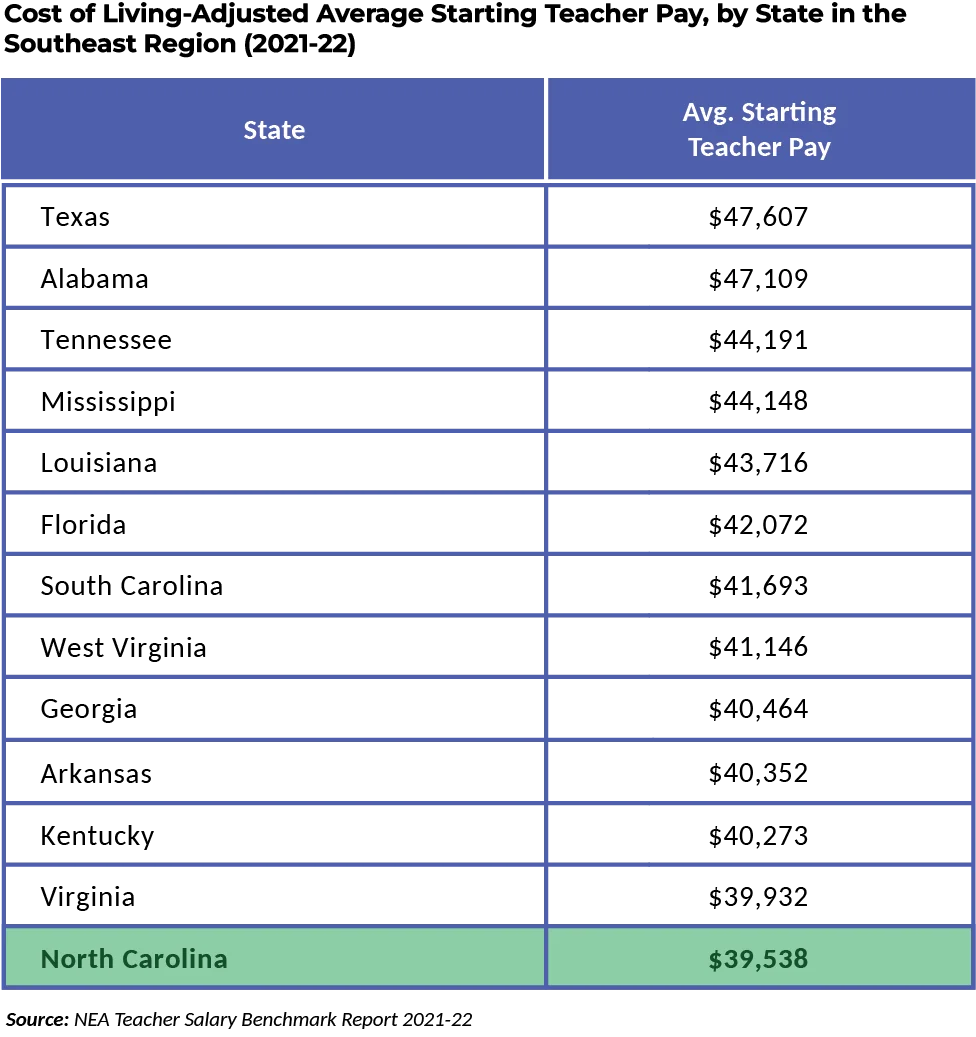
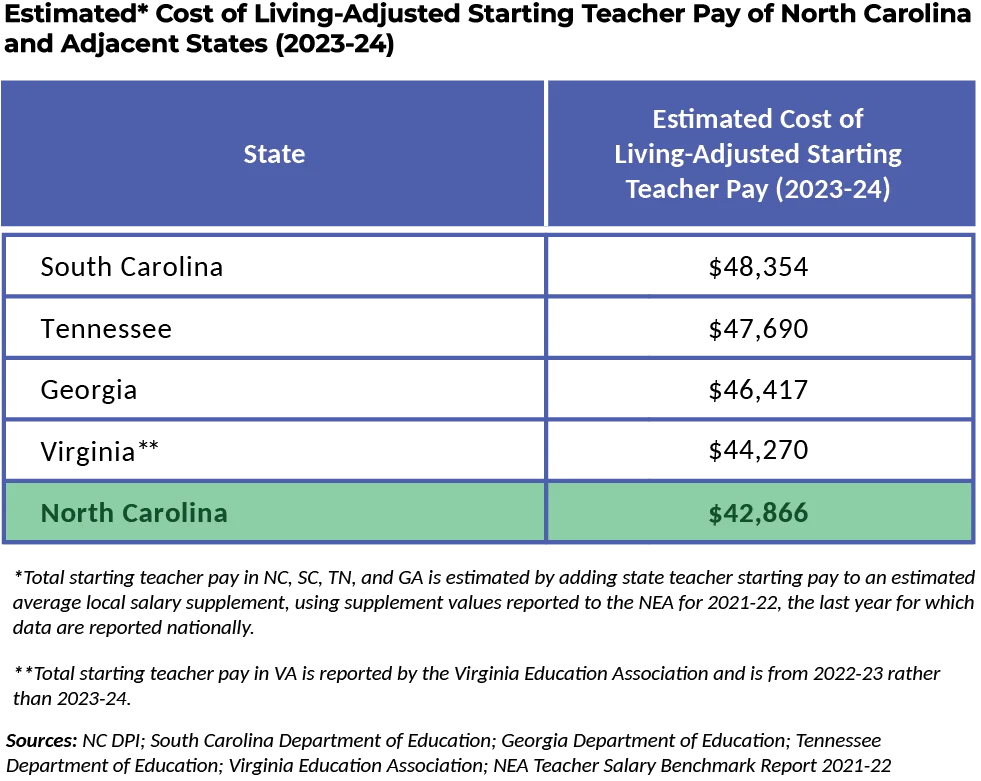
Cost of living-adjusted starting teacher pay in North Carolina ranks last in the Southeast region.

Estimated Cost of Living Adjusted Starting Pay of NC and Adjacent States 2023-24

A 2020 DPI analysis found nearly a quarter (23%) of educator prep program graduates were not employed in NC schools within two years of graduation. Between 2017 and 2022, beginning-teacher attrition was 12%, versus 7% for fully licensed teachers.

Challenge: Living Wage

Under the Existing Salary Schedule, North Carolina Teachers Must Wait Too Long Before Their Salaries Provide a Living Wage that Can Support a Family

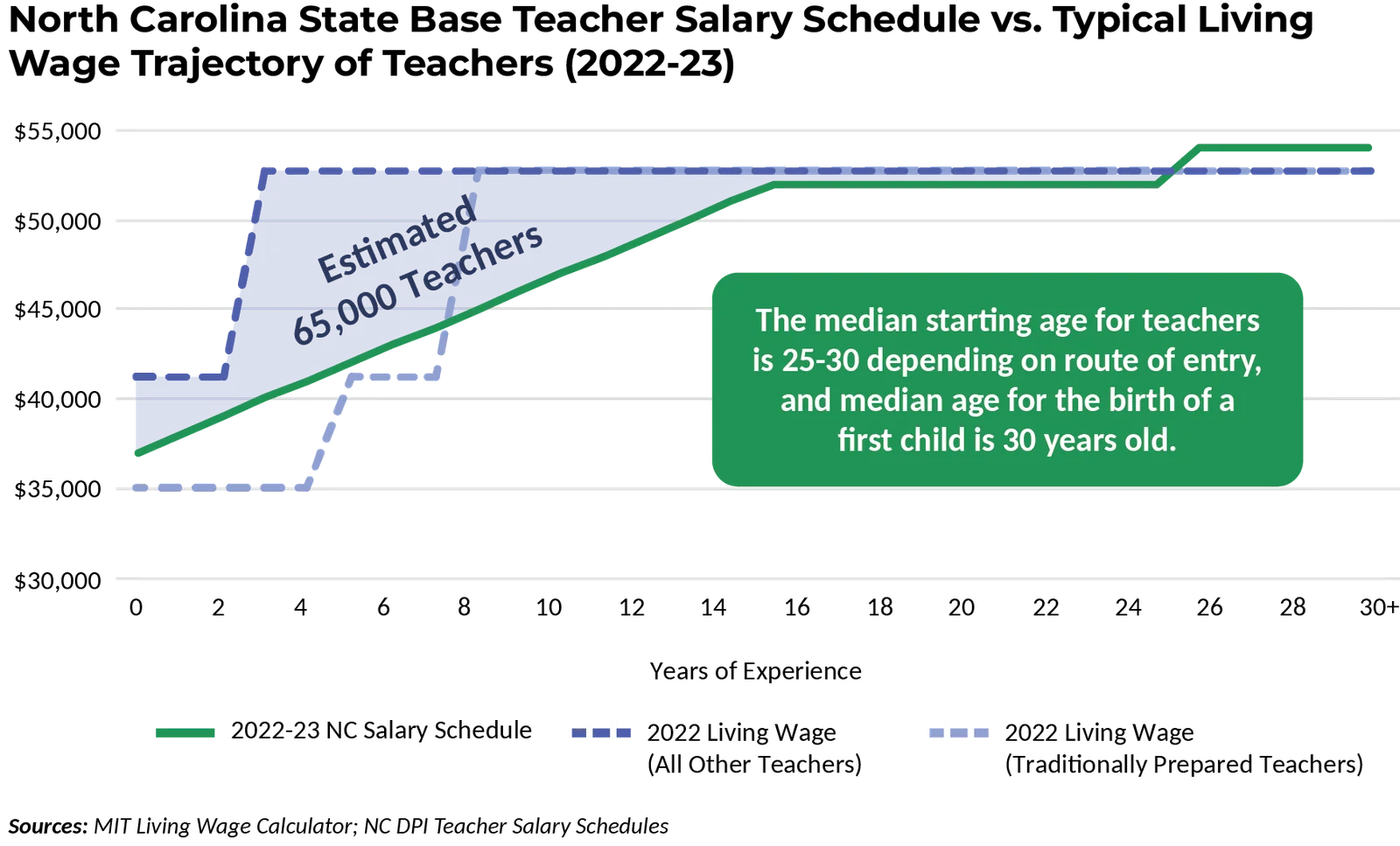
In 2022-23, nearly two thirds of North Carolina teachers’ state base pay fell below a living wage. State base pay does not include local salary supplements or bonuses. Living wage gaps are largest in the first ten years of a teacher’s career, when most teachers choose to start their families.

NC Base Teacher Pay Schedule vs Typical Living Wage Trajectory

This salary structure conflicts with research showing the largest gains in teacher effectiveness occur in the first five years of a teacher’s career.

Average EVAAS Scores of Teachers by Years of Experience

Challenge: Attracting Top Talent

The Traditional Teacher Compensation Model Does Not Provide Meaningful Professional Promotions that Attract Top Talent and Keep Effective Educators in the Classroom

Nations that perform at the top on international assessments recruit 100% of teachers from the top-third of college graduating classes. In the United States, that number is 23%, and 14% in high-poverty schools.

Perceptions of Teaching vs Preferred Occupation for Top-Third Students

In North Carolina, Advanced Teaching Roles (ATR) provides meaningful career advancement, allowing effective teachers to extend their reach in exchange for higher pay — revamping outdated staffing structures and delivering positive impacts on student performance.

Comparison of Current vs Proposed Teacher State Base Salary Schedule

In many of the 24 districts implementing ATR, teachers earn additional pay on top of their ATR supplement for working in hard-to-staff schools — mirroring advancement opportunities found in private-sector careers.

Challenge: Hard-to-Staff Positions

Existing Pay Structures are not Designed to Fill Hard-to-Staff Subject Area Positions and Schools, Leading to Persistent, Critical Vacancies and Disparities in Student Access to Effective Educators

In North Carolina, students in high-poverty schools are more likely to be taught by less experienced, less qualified teachers than students who attend more affluent schools — restricting student access to high-quality teachers.

Percent National Board Certified and Beginning Teachers by School Poverty Quartile

In high-demand fields like STEM, average teacher pay significantly trails average wages for UNC System graduates in those majors — likely contributing to markedly higher vacancy rates in these subject areas.

Average Wages of UNC System Graduates vs Percentage of Schools with Difficulty Filling Vacancies by Subject

Speakers

Proin efficitur ornare nunc, et suscipit risus malesuada faucibus. Sed quis justo quis sapien vehicula pretium.

Related Resources & Programs

Select one of the options below to learn more about that resource, program or initiative.

EDUCATION POLICY & LEADERSHIP

Be One of the BEST

North Carolina’s students and educators rely on private citizens and community leaders that actively participate in improving the state’s education system. Business leaders that join BEST NC are investing in the lives of North Carolinians for generations to come.