
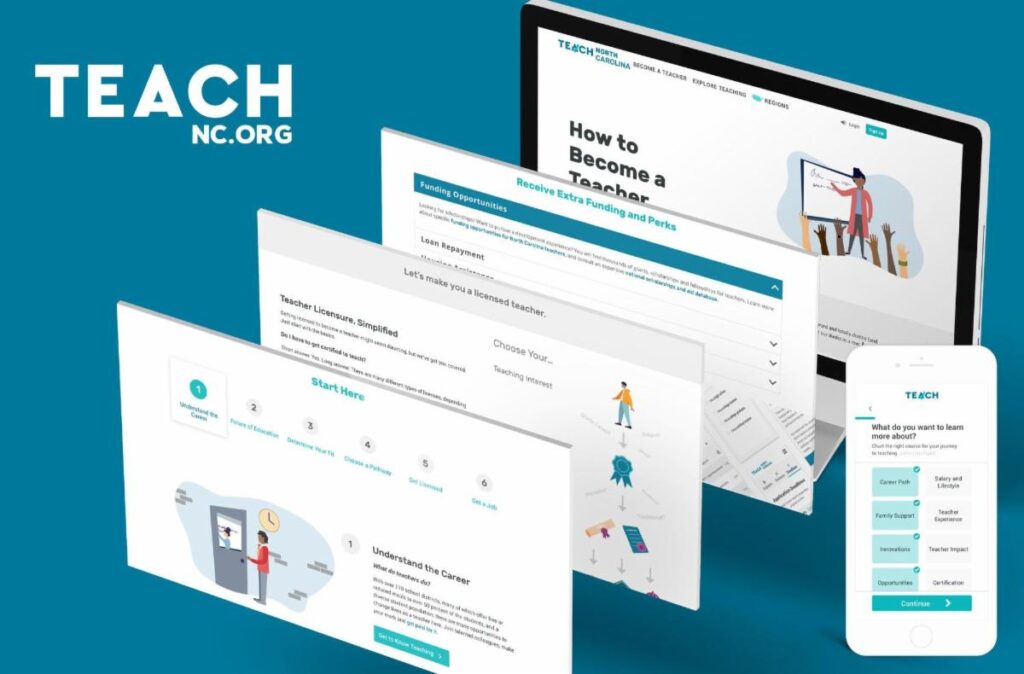
Announcing TeachNC: The One-Stop Resource for Becoming a Teacher in North Carolina We are thrilled to share that, for the first time ever, North Carolina has a unified, statewide teacher recruitment initiative that elevates the teaching profession and seeks to fill critical vacancies! At the August 14th meeting of the North Carolina Education Cabinet, education leaders and stakeholders gathered to celebrate the launch of TeachNC. Aligning with BEST NC’s longstanding commitment to improving the educator pipeline, we have collaborated with the North Carolina Department of Public Instruction and TEACH.org to create this statewide teacher recruitment initiative. TeachNC employs both a broad media campaign and a robust web platform to support teacher candidates in their quest to become a teacher in North Carolina. Members of the NC Education Cabinet stand in support of TeachNC. Why TeachNC? Every student deserves a quality education — that’s a given. What you might not know is that teacher quality is the #1 in-school factor for guaranteeing students’ long-term success. Since educators play a crucial role in the lives of our students, TeachNC is designed to inspire teaching candidates to pursue the career and remove barriers that stand in their way. The Audience The TeachNC initiative seeks to provide accurate and compelling information about the teaching profession that will be useful to both potential candidates and the general public. TeachNC targets students who are just beginning to think about their career options all the way to mid-career professionals who may be considering a career change. The Campaign TeachNC’s media campaign, “Teachers Have Better Work Stories,” highlights the ways in which teaching profession is challenging, fulfilling, and constantly evolving. These career qualities are particularly appealing to Millennials and Generation Z as they seek fulfilling professions. TeachNC’s first public service announcement can be viewed below. TeachNC will also be curating Better Work Stories from real North Carolina teachers. To view the stories collected so far, click here. If you are a teacher or know of one who should share their Better Work Story, please share it here. The Website TeachNC.org is an interactive digital recruitment platform that centralizes all of the information and resources needed to become a teacher: Licensure Understanding licensure is the first step to becoming a teacher. TeachNC outlines licensure requirements and pathways for all candidates, from beginning college students to mid-career professionals. Programs To help candidates choose an educator preparation program (EPP) that will qualify them for licensure, TeachNC provides a database of North Carolina’s EPPs, criteria to help candidates compare options, and advisors to provide 1-on-1 support. Affordability To help candidates understand affordability, TeachNC provides a finance guide with best practices, local and national scholarship listings, and cost-saving strategies. TeachNC also offsets candidates application costs through a $100 reimbursement scholarship. Applications Understanding licensure is the first step to becoming a teacher. TeachNC outlines licensure requirements and pathways for all candidates, from beginning college students to mid-career professionals. More to Come, and What YOU Can Do: Over the next months and years, TeachNC will continue to expand its resources with district landing pages and updated information as licensure requirements change. In the meantime, here is what you can do to help: If you know someone who is thinking about becoming a teacher, please share www.TeachNC.org and encourage them to register to get (free) resources. If you are a teacher and want to share your Better Work Story, take just a minute to film with your phone and upload it here. If you have any ideas or questions, reach out to the TeachNC Director, Princess Brown at Princess@TeachNC.org. TeachNC Partners TeachNC Funders
Growth and Achievement in North Carolina
Growth and Achievement: you have probably heard these terms in conversations about education. But what are they? How do they differ, and what do they tell us about North Carolina’s students and teachers? Our new video “Growth and Achievement in North Carolina” explores some of these questions. Find out more at www.best-nc.org/growthandachievement.
Don Curtis Interview with Brenda Berg – Carolina Newsmakers
Classroom Teacher Allotments North Carolina Public Schools

Note: This blog post features a brief from page 22 of our 2018 Facts & Figures publication, contextualizing North Carolina education data with a short description of an historical feature or a critical issue in North Carolina. Read more at www.NCEdFacts.org. In North Carolina, the state allots teaching positions to each school district based on the number of students in each grade, according to specific ratios set by the General Assembly. The classroom teacher allotment is by far the largest single state allotment; salary and benefits for teaching positions represent approximately 55% of total state support for education. Over the past seven years, the state changed allotment ratios four times, generally decreasing student to teacher ratios in the lower grades, and increasing them in grades 4 through 12. Source: NC DPI Highlights of the Public School Budget In 2016, the General Assembly enacted legislation requiring actual average student to teacher ratios in grades K-3 not to exceed the allotment ratios starting in the 2018-19 academic year. This has sparked considerable debate, in part because for the first time since the development of the state’s Basic Educational Program, districts will be required to use the state’s full position allotment to fund classroom teachers. Currently, there is no separate allotment for elementary school art, music, physical education, and world language teachers.
North Carolina Teachers and State Employee Retirement System and Health Benefits

Note: This blog post features a brief from page 26 of our 2018 Facts & Figures publication, contextualizing North Carolina education data with a short description of an historical feature or a critical issue in North Carolina. Read more and find further information at www.NCEdFacts.org. All full-time employees in North Carolina public schools participate in the state’s Teachers and State Employees Retirement System (TSERS). TSERS provides qualifying employees a guaranteed salary and individual health benefits upon retirement from state government. In North Carolina, employees vest in TSERS after five years of service. Employees may retire with unreduced benefits after 30 years at any age, after 25 years of service at age 60 or older, or after five years at age 65 or older. Teachers contribute 6% of their pre-tax salary to TSERS, a rate that has been consistent since 1975. Nearly all states maintain a defined benefit (pension) plan for teachers and other state employees; in North Carolina and 29 other states, all teachers also participate in social security. TSERS is roughly comparable to the national median state plan and significantly more generous than the private sector average. Retiree health benefits in North Carolina are significantly more generous than the national median state plan and the private sector. Active state employee premiums for individual health care coverage are more generous than most other state plans and the private sector, but less generous than average for family plans. Source: North Carolina TSERS Handbook, NCGA Fiscal Research Division – Comparison of the Value of Employee Benefits
North Carolina’s New Approach to Teacher Recruitment

The new North Carolina Teaching Fellows program is due to officially launch this month – and it’s a big deal. It’s an exciting opportunity for future teachers, for the students they will serve, and for North Carolina.
Don Flow: North Carolina should invest in principals- The Winston-Salem Journal

Over the past few years, North Carolina teachers have seen significant pay increases. Signals from Gov. Roy Cooper and last week’s Senate budget proposal indicate that the next few years will see even more increases. This commitment by our legislative leaders is extremely important for the future of our state. The growth of our state is directly tied to the educational outcomes of our students.
Don Flow: Time to Pay School Principals as Executives – Triangle Business Journal
Over the past few years, North Carolina teachers have seen significant pay increases. Signals from Gov. Roy Coo per and last wee k ‘s Senate budget proposal indicate that the next few years will see even more increases. This commitment by our legislative leaders is extremely important for the future of our state.
Don Flow: Paying School Principals as Executives- The Herald-Sun
Over the past few years, North Carolina teachers have seen significant pay increases. Signals from Gov. Roy Cooper and this month’s Senate budget proposal indicate that the next few years will see even more increases. This commitment by our legislative leaders is extremely important for the future of our state. The growth of our state is directly tied to the educational outcomes of our students.
ADVISORY: Rhee, Parker, BEST NC to hold media availability Tuesday
DVISORY: Rhee, Parker, BEST NC to hold media availability Tuesday. Cary, NC – BEST NC will host a media availability Tuesday featuring unlikely education reform allies Michelle Rhee and George Parker, who will discuss their work to improve education in Washington, DC.