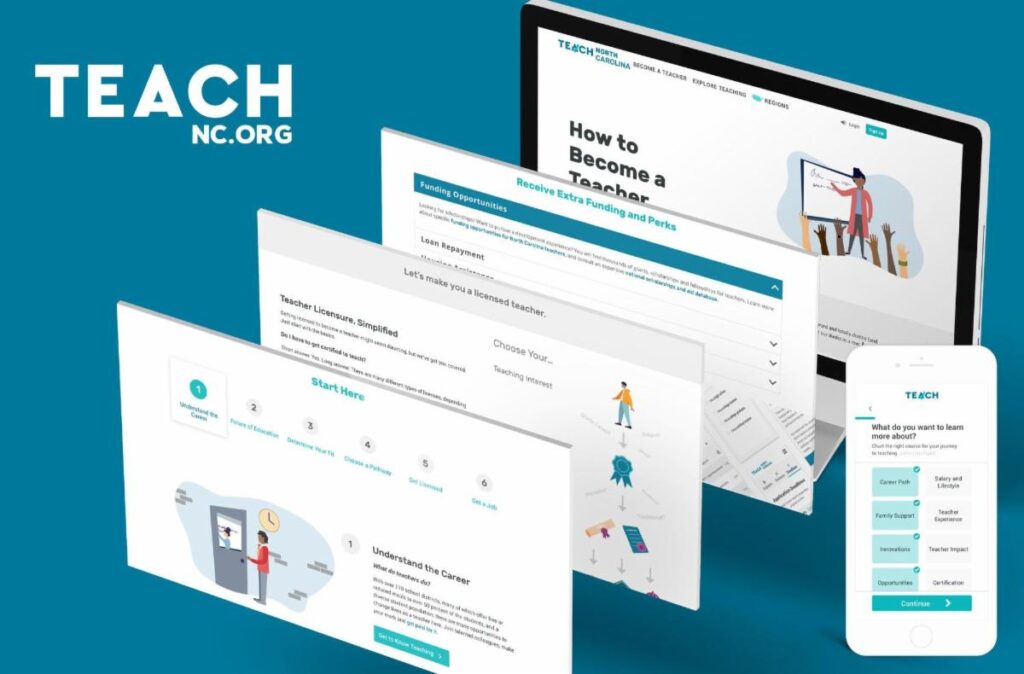
Announcing TeachNC: The One-Stop Resource for Becoming a Teacher in North Carolina We are thrilled to share that, for the first time ever, North Carolina has a unified, statewide teacher recruitment initiative that elevates the teaching profession and seeks to fill critical vacancies! At the August 14th meeting of the North Carolina Education Cabinet, education leaders and stakeholders gathered to celebrate the launch of TeachNC. Aligning with BEST NC’s longstanding commitment to improving the educator pipeline, we have collaborated with the North Carolina Department of Public Instruction and TEACH.org to create this statewide teacher recruitment initiative. TeachNC employs both a broad media campaign and a robust web platform to support teacher candidates in their quest to become a teacher in North Carolina. Members of the NC Education Cabinet stand in support of TeachNC. Why TeachNC? Every student deserves a quality education — that’s a given. What you might not know is that teacher quality is the #1 in-school factor for guaranteeing students’ long-term success. Since educators play a crucial role in the lives of our students, TeachNC is designed to inspire teaching candidates to pursue the career and remove barriers that stand in their way. The Audience The TeachNC initiative seeks to provide accurate and compelling information about the teaching profession that will be useful to both potential candidates and the general public. TeachNC targets students who are just beginning to think about their career options all the way to mid-career professionals who may be considering a career change. The Campaign TeachNC’s media campaign, “Teachers Have Better Work Stories,” highlights the ways in which teaching profession is challenging, fulfilling, and constantly evolving. These career qualities are particularly appealing to Millennials and Generation Z as they seek fulfilling professions. TeachNC’s first public service announcement can be viewed below. TeachNC will also be curating Better Work Stories from real North Carolina teachers. To view the stories collected so far, click here. If you are a teacher or know of one who should share their Better Work Story, please share it here. The Website TeachNC.org is an interactive digital recruitment platform that centralizes all of the information and resources needed to become a teacher: Licensure Understanding licensure is the first step to becoming a teacher. TeachNC outlines licensure requirements and pathways for all candidates, from beginning college students to mid-career professionals. Programs To help candidates choose an educator preparation program (EPP) that will qualify them for licensure, TeachNC provides a database of North Carolina’s EPPs, criteria to help candidates compare options, and advisors to provide 1-on-1 support. Affordability To help candidates understand affordability, TeachNC provides a finance guide with best practices, local and national scholarship listings, and cost-saving strategies. TeachNC also offsets candidates application costs through a $100 reimbursement scholarship. Applications Understanding licensure is the first step to becoming a teacher. TeachNC outlines licensure requirements and pathways for all candidates, from beginning college students to mid-career professionals. More to Come, and What YOU Can Do: Over the next months and years, TeachNC will continue to expand its resources with district landing pages and updated information as licensure requirements change. In the meantime, here is what you can do to help: If you know someone who is thinking about becoming a teacher, please share www.TeachNC.org and encourage them to register to get (free) resources. If you are a teacher and want to share your Better Work Story, take just a minute to film with your phone and upload it here. If you have any ideas or questions, reach out to the TeachNC Director, Princess Brown at Princess@TeachNC.org. TeachNC Partners TeachNC Funders
Spotlight On: Advanced Teaching Roles Initiative
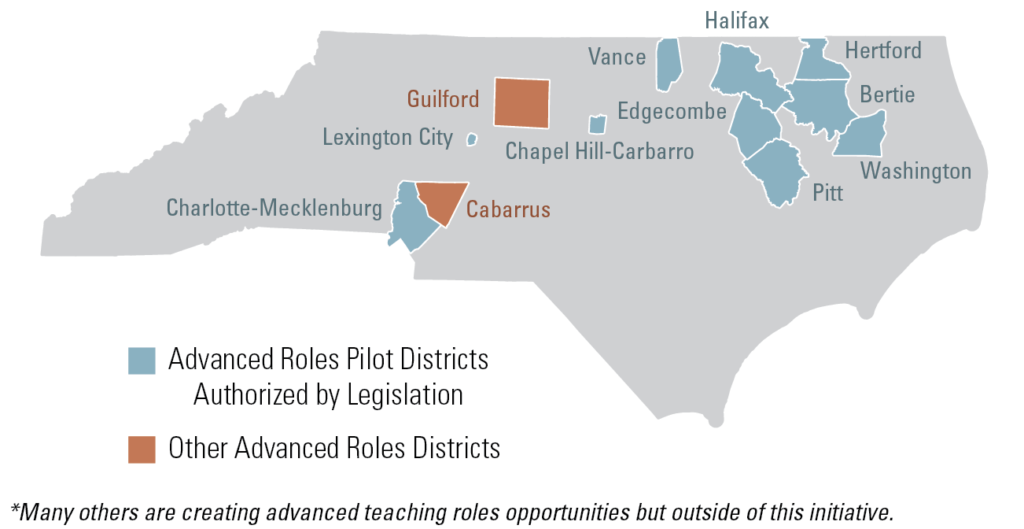
Spotlight On: Advanced Teaching Roles Initiative In 2016, North Carolina created the Advanced Teaching Roles Initiative. This legislation establishes a school leadership re-design model that empowers districts and educators to design new teaching roles that provide advancement opportunities, improved professional development, and greater support for student achievement. Advanced Teaching Roles enables highly-effective teachers to advance their careers, extend their positive impact on student achievement, and increase their compensation. The best part: they get to stay in the classroom! In effective models, developing teachers also benefit by having access to real-time professional development, relieving some of the pressures of principals who are traditionally the primary source of instructional leadership in the school. Today, ten districts are taking part in the Advanced Roles Initiative. Success by Design Program Created in 2013 and inspired by lessons learned from the Opportunity Culture model in Project LIFT schools, Success by Design is an official Advanced Roles program in Charlotte-Mecklenburg Schools (CMS). This approach is being phased in strategically over time. During the 2018-19 school year, Success by Design was implemented in 50 schools. Success by Design advanced roles teachers can earn up to $20,000 on top of their base salary, while increasing their impact on student achievement. Early results from the CMS program suggest that this model helps the district recruit and retain top talent, resulting in significant student achievement gains. During the 2017-18 school year, 58% of Success by Design schools exceeded growth, compared with 27% of all schools statewide. Also, a recent study published by the CALDER Center finds that students’ academic gains increased when taught by advanced roles teachers, with significant achievement gains in math. For more information visit www.BEST-NC.org/advancedroles.
School reform requires strong leaders

My father was Darth Vader. No, that doesn’t make me a Jedi Knight. My father was also Boss Hogg and a range of other bad guys. During his nearly two decades as principal of North Carolina’s largest elementary school, located in the Mecklenburg County community of Matthews.
BEST NC Delivers a Little Guide, Chock-full of Education Data
BEST NC releases the 2017 Facts & Figures: Education in North Carolina guide, a composite of current education data from cradle through career.
The State of Teaching

Assessing Education in North Carolina

In Depth: Time Warner Cable Interview
State has a big math problem
If North Carolina were to secede from the union and become an independent country — no, conspiracy theorists, I’m not actually proposing this as a reasonable response to recent political events — how would our education system rank among the other developed nations of the world? There’s no need for a speculative answer to this hypothetical question. Last year, the Organization for Economic Cooperation and Development (OECD) administered its latest round of math, reading, and science tests to more than half a million 15-year-olds across dozens of countries. Known as the Program for International Student Assessment (PISA), these exams give policymakers one way of assessing their schools’ relative performance as well as some useful insights about what policies or factors tend to be associated with high student achievement. For the 2015 tests, both North Carolina and Massachusetts had enough of their students tested to allow for independent comparisons of their performance to that of other nations, rather than just as part of the nationwide sample. The United States is best described as a middling performer in reading and science. In both cases, its mean scores are within a few points of the OECD average, and about as many countries ranked above it as below it. In math, unfortunately, American students are much worse off, ranking significantly below those of most other OECD countries. North Carolina, it turns out, is fairly representative of America’seducational standing. We also rank about in the middle in reading and science, with North Carolinians faring a little worse in reading and a little better in science than other American kids. Our weakest point, again, is math. Only four OECD countries — Chile, Mexico, Greece, and Turkey — rank below North Carolina in that subject. (The other state participant, Massachusetts, is a high achiever in all three subjects.) Julie Kowal, vice president of policy and research at the education nonprofit BEST NC, describes these gaps in the following terms: “In the highest-performing OECD countries, 90 percent of students meet basic proficiency levels – meaning they demonstrate knowledge and skills that enable them to participate actively in relevant life situations. In North Carolina and the U.S. as a whole, roughly 80 percent of students attain basic proficiency in reading and science on PISA; 70 percent of students attain basic proficiency in math.” Raising by 10 to 20 points the share of our students possessing basic skills is a challenge, but hardly an impossible one. How can North Carolina do it? While I’m not against spending money on our highest priorities, don’t assume that variations in test scores simply reflect variations in expenditure. Indeed, many high-performing countries spend less per pupil than North Carolina does. And the 2015 PISA report observed that for most OECD countries, “factors other than the level of investment in education are better predictors of student performance” and that the relationship between student performance and teachers’ salaries relative to per-capita national income “is not statistically significant.” Teacher quality is, of course, paramount. But it’s about more than pay. PISA findings suggest that effective programs to keep teachers learning throughout their careers show strong relationships to student success, as do strategies for encouraging teacher collaboration. Conservatives will be pleased to learn that the extent of competition among schools is associated with higher scores, although not in all the participating countries. Progressives will be pleased to learn that prior enrollment in preschool is also associated with higher scores. The PISA data are consistent with more carefully designed studies that show how important it is to build proper incentive structures for school governance and accountability. For example, school principals should be given more authority over their employees, budgets, and school policies, but only if they are properly trained to exercise it. Although North Carolinians may disagree about education policies and priorities, there is little debate about the benefits of school reform. We know that the competitiveness of our economy, the strength of our families and communities, and the health of our republic depend on getting it right. John Hood is chairman of the John Locke Foundation and appears on the talk show “NC SPIN.” You can follow him @JohnHoodNC. Click here to view State has big math problem PDF
North Carolina Teens Behind International Peers In Math
[vc_row][vc_column width=”1/1″][vc_hidrop] Teens in North Carolina lag behind many of their international peers in math. That’s according to the most recent results of the Program of International School Assessment, which measures math, reading and literacy among 15- year-olds. Students in more than 70 cities and countries around the world took the test last year, the frstthat North Carolina participated. Those scores were posted last month and put the state behind 36 locations in math. In a statement, Brenda Berg, president of business advocacy group BEST NC, called the state’s math results “alarming.” Scores here were roughly comparable with those in Lithuania, Hungary and Croatia, and behind those in Korea, Ireland and Vietnam. “But this PISA analysis is helpful and tells us that equitable access to high-quality educators is important,” Berg said. “To improve our standing in the country and the world, North Carolina must prioritize teacher and principal talent, especially for hard-to- staff subjects like math; and also for high-needs schools and students.” North Carolina’s science and reading scores were on par with those in the United Kingdom, Denmark and Sweden and exceeded results in 40 other regions. Singapore was the top performer in all three subjects tested. North Carolina State Superintendent June Atkinson said in a statement that she is heartened that local students scored roughly in line with national averages on the math, science and reading portions of the test. Massachusetts and Puerto Rico were the only other American regions that participated. “This information will help us as we review content standards and set expectations for the future,” Atkinson said. Click here to view North Carolina Teens Behind International Peers PDF [/vc_hidrop][/vc_column][/vc_row]
Addressing the Early Conundrum
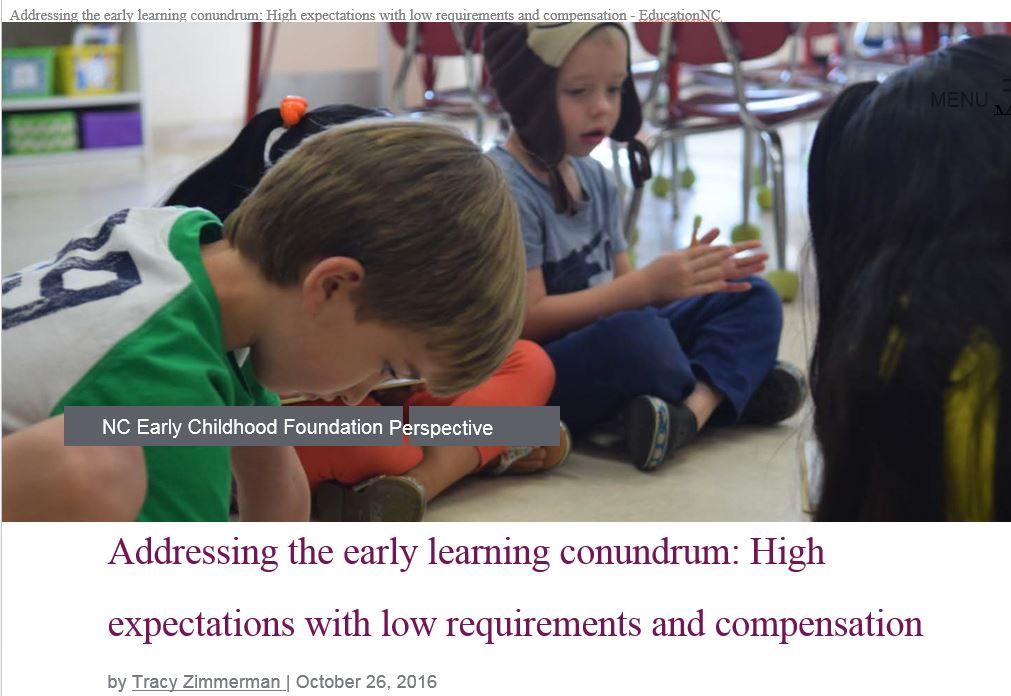
[vc_row][vc_column width=”1/1″][vc_hidrop] The expectations on the early learning workforce are high. By the time children transition to kindergarten, they ideally will – according to North Carolina’s definition of school readiness—have skills that range from being able to resolve conflict positively and problem-solve, to recognizing the relationship between letters and sounds and identifying basic shapes.[1][2] Early learning educators, in partnership with parents, play a decisive role in preparing children to succeed in school. The stakes are high – approximately 75 percent of children who begin kindergarten behind will never catch up to their classmates.[3] At the same time, North Carolina has low minimal requirements to become an early learning educator – a high school diploma and one basic course in early childhood education. At a median wage of approximately $10.50 per hour, the pay is low enough that 42 percent of North Carolina child care worker families must participate in one or more public support programs like Medicaid and SNAP (Food Stamps) to make ends meet – at a cost of millions of dollars.[4] This juxtaposition of high expectations and low requirements and pay is not limited to North Carolina. In 2016, recognizing that the early childhood workforce system needed to advance to reflect the latest scientific knowledge of how children develop, the Institute of Medicine (IOM) and the National Research Council released Transforming the Workforce for Children Birth Through Age 8: A Unifying Foundation.[5] The report reflects on how much we have learned about children’s development in recent years. Brain scientists have discovered that during children’s earliest years, their experiences are built into their bodies – shaping the brain’s architecture and impacting how biological systems develop. Positive early experiences build a strong foundation for learning and future health. The interactions between parents and caregivers and children shape the developing brain. As pediatrician Jack Shonkoff says, “Brains are built, not born.” While much is known about how children learn and develop, what professionals need to know and be able to do, and what professional learning supports they need, this knowledge is not reflected in “the current capacities and practices of the workforce, the settings in which they work, the policies and infrastructure that set qualifications and provide professional learning, and the government and other funders who support and oversee these systems.”[6] The report outlines 13 recommendations to ensure that all children’s development and early learning is supported by high-quality teachers and settings. Included among the recommendations is that states transition to a minimum bachelor’s degree qualification requirement, with specialized knowledge and competencies, for all lead educators working with children from birth through age eight. In North Carolina, despite our low requirement, the state has made progress on increasing education levels. North Carolina’s star-rated license includes incentives to increase teachers’ education. The T.E.A.C.H. Early Childhood® scholarship program supports early educators in the costs of obtaining higher education. And early education degree programs are available in every North Carolina Community College and in the majority of four-year higher education institutions. As a result, by 2015, 63 percent of all early childhood teachers had already obtained an Associate’s degree or higher, and 37 percent of those teachers had obtained a Bachelor’s degree. The issue of increased education requirements for early childhood teachers is gaining additional attention from stakeholders across North Carolina. BEST NC, a business-led advocacy group focused on North Carolina education from preschool through post-graduate, convened education leaders from across sectors this fall to focus on elevating the early childhood workforce. In addition, the NC Child Care Coalition, a coalition of more than 100 state, local and regional organizations across the state, is recommending increasing the requirements for lead teachers. They are proposing that the General Assembly require that by 2020: Increasing compensation for early educators goes hand-in-hand with increasing education requirements. The IOM report points out that transforming the early learning workforce to achieve the outcomes demanded from it also means “making substantial improvements in working conditions, well-being, compensation, and perceived status or prestige.” In North Carolina, more than half of early learning teachers have family incomes below $30,000 per year.[7] As a result, our teachers often face the same daily stresses around paying for food, transportation, and doctor visits as the families of the children in their care, which can impact their ability to support children’s optimal development. WAGE$® is a tool that that has been used effectively in North Carolina and other states. The program provides education-based salary supplements to early learning teachers, directors and family child care providers. It has successfully supported increased education levels, reduced turnover and increased teacher retention.[8] In fiscal year 2016-17, WAGE$® is only available in 53 counties in North Carolina through support from local Smart Start Partnerships for Children at their discretion. In fiscal year 2015, 3,800 early childhood teachers—only 14 percent of the total early education teaching workforce—received WAGE$® salary supplements.[9] The members of BEST NC’s Working Group on Early Childhood Educators explored the issue of early childhood compensation, as well. To begin to address compensation, the NC Child Care Coalition recommends that the General Assembly develop a state-level salary supplement program based on the current Child Care WAGE Program. To support children’s optimal development, early learning professionals need a core set of skills and competencies. As the IOM report concludes, “Persisting with the status quo for the professionals who do this important, complex work . . . will result in inadequate learning and development, especially among America’s most vulnerable families and communities.” About the Author: Tracy Zimmerman is the executive director of the NC EarlyChildhood Foundation. Click here to view Addressing the early learning conundrum PDF [/vc_hidrop][/vc_column][/vc_row]