
Principal Pay and School Performance

North Carolina Teens Behind International Peers In Math
[vc_row][vc_column width=”1/1″][vc_hidrop] Teens in North Carolina lag behind many of their international peers in math. That’s according to the most recent results of the Program of International School Assessment, which measures math, reading and literacy among 15- year-olds. Students in more than 70 cities and countries around the world took the test last year, the frstthat North Carolina participated. Those scores were posted last month and put the state behind 36 locations in math. In a statement, Brenda Berg, president of business advocacy group BEST NC, called the state’s math results “alarming.” Scores here were roughly comparable with those in Lithuania, Hungary and Croatia, and behind those in Korea, Ireland and Vietnam. “But this PISA analysis is helpful and tells us that equitable access to high-quality educators is important,” Berg said. “To improve our standing in the country and the world, North Carolina must prioritize teacher and principal talent, especially for hard-to- staff subjects like math; and also for high-needs schools and students.” North Carolina’s science and reading scores were on par with those in the United Kingdom, Denmark and Sweden and exceeded results in 40 other regions. Singapore was the top performer in all three subjects tested. North Carolina State Superintendent June Atkinson said in a statement that she is heartened that local students scored roughly in line with national averages on the math, science and reading portions of the test. Massachusetts and Puerto Rico were the only other American regions that participated. “This information will help us as we review content standards and set expectations for the future,” Atkinson said. Click here to view North Carolina Teens Behind International Peers PDF [/vc_hidrop][/vc_column][/vc_row]
Lagging Math Scores Hurt North Carolina’s Global Ranking
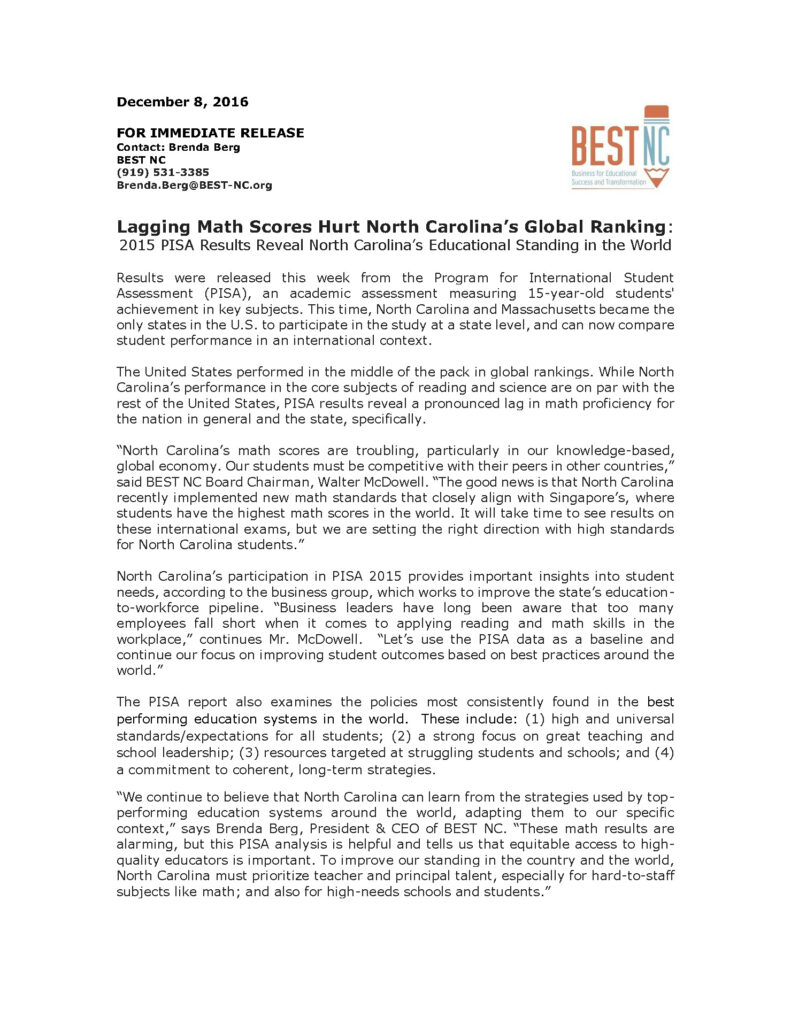
Results were released this week from the Program for International Student Assessment (PISA), an academic assessment measuring 15-year-old students’ achievement in key subjects. This time, North Carolina and Massachusetts became the only states in the U.S. top anticipate in the study at a state level, and can now compare student performance in an international context.
WCPSS Seeking to Add More ‘Charter-Like’ Schools

[vc_row][vc_column width=”1/1″][vc_hidrop] WCPSS Seeking to Add More ‘Charter-Like’ Schools The “restart” model for high-needs schools will expand to 10 more WCPSS schools next year. Last week, the state Board of Education approved the application submitted by WCPSS to restart five more elementary schools and five middle schools. All of which are schools that need to improve their test scores. The school system “relaunched” Walnut Creek and Barwell Road elementary schools last year under the state’s restart program, bringing “charter-like” flexibility in school start and end times, calendar, budgeting and hiring. WCPSS retains full control of the schools, however, and all teachers must still be actively certified to teach. The restart model was so well received at those two schools, the WCPSS staff decided to add 10 more schools for next school year. This is different than the Renaissance School Program implemented under former Superintendent Tony Tata. That model focused on human resource incentives such as offering signing and performance bonuses, hiring additional teachers, and adding more professional development all funded partly by federal Race Top The Top grant money. WCPSS ended that program two years ago when the grant money ran out. The restart model gives principals, teachers, and parents the room todevelop creative, data-driven solutions to the issues raised by the data at each school. The school system also gains flexibility for converting funds to pay for additional staff, and the schools offer and extended school day one day a week, parent academies, and additional family services that aren’t typically offered inschools. To qualify, a school must be designated as “recurring, low performing” by the state based on its test scores in two of the last three years on a rolling basis. Walnut Creek and Barwell are part of the 12-school Elementary Support Model group overseen by Area Superintendent James Overman. All 12 schools would qualify for restart status, but not all ESM schools are part of Wake’s application this time. The school system submitted requests for a combination of elementary and middle schools, many of them magnet schools. Bugg Elementary School Carroll Magnet Middle School East Garner Elementary School East Garner Magnet Middle School East Millbrook Middle School East Wake Middle School Fox Road Magnet Elementary School Millbrook Elementary School Poe GT/AIG Basics Magnet Elementary School Wendell Middle School Now that the State Board of Education approved the application for all 10 schools, each school will develop plans which may include extending the school day, extending the school year, changing the school calendar, adding family support services. Many changes will need to be approved by the WCPSS School Board. Click here to view State School Funding Overhaul, Principal_AP Pay Plan PDF [/vc_hidrop][/vc_column][/vc_row]
Brenda Berg speaks at a Joint Legislative Study Committee on School-Based Administrator Pay

[vc_row][vc_column width=”1/1″][vc_hidrop] WATCH BEST NC’S TESTIMONY [/vc_hidrop][/vc_column][/vc_row][vc_row][vc_column width=”1/1″][vc_hidrop] [/vc_hidrop][/vc_column][/vc_row]
Ranked 49th in principal pay
[vc_row][vc_column width=”1/1″][vc_hidrop] School administrator pay in North Carolina is dismal, says Frank Till Jr., superintendent of Cumberland County Schools, but a new legislative call to alleviate the problem by completely nixing the state’s principal salary scale could be disastrous. “Without a salary schedule, it means we’d have to negotiate every single principal’s salary,” complains Till. “It would lead to inequities. You would open yourself up to a variety of things.” That includes, according to Till and other critics, yawning pay gaps between rich and poor counties and uncertainty for school district leaders now tasked with negotiating scores of The proposal, which emerged in a legislative study group meeting this week, is intended to reform a much-denigrated system of administrator pay that, by most accounts, ranks North Carolina among the poorest states in the nation for prospective school principals and vice principals. Since local administrator supplements vary in the state, snapshots of North Carolina principal pay are hard to come by, but 2015 data from the U.S. Department of Labor place the state at a lowly 49th in the nation. The mean administrator pay in North Carolina—about $68,000—trails all of the state’s neighbors in the southeast, according to the federal department. Yet with much of the general public’s focus on teacher pay, it’s perhaps one of the most overlooked crises for North Carolina schools, advocates say. Republican Sen. Jerry Tillman, a former school administrator who represents Randolph and Moore counties in the General Assembly, sponsored legislation in 2015 that would have funneled millions into boosted principal pay and bonuses for high- performing administrators, but that legislation stalled. And this year, GOP lawmakers once again opted out of raises for school administrators, but they did commission a study group co- chaired by Tillman to suggest fxes. The group’s frst solution, unveiled at the study group’s meeting in Raleigh this week, is a multi- pronged proposal that completely axes the state’s oft-maligned principal salary scale, provides so-called “gap funding” for administrators in poorer school districts and creates a pot of money for principal bonuses. Under the proposal, state leaders would provide a set pool of funding for administrator pay, but it would be left to districts to negotiate pay with principals. It’s a concept that received a chilly reception from a panel of school administrative leaders who spoke to the legislative study group this week. In addition, legislators would also look to revamp the scale for assistant principals. Advocates have pointed out that, due to the state’s outdated pay schedule, some assistant principals could earn less than the teachers they oversee. Till is among the most outspoken critics of the new proposal. The Cumberland County Schools chief points out that, in his rural district, offcials would be charged with negotiating contracts for 87 different principals. In larger counties such as Wake and Mecklenburg, which manage hundreds of schools, the burden would be even larger, administrators said. And, across the state, the lack of a state-mandated foor for principal pay could lead to growing inequalities across districts and a spike in employment complaints and lawsuits. “Board members could suddenly start negotiating salaries with their friends,” Till told Policy Watch this week. “It would be about who you know and what you know. It’s just a slippery slope that you don’t want to go down.” GOP lawmakers have yet to commit to any course of action, but Tillman told study group members this week that he expects final proposals for the legislature to be readied by the end of the year. Katherine Joyce is executive director of the N.C. Association of School Administrators, an organization of school chiefs representing administrators in Raleigh. This week, Joyce said lawmakers are right to be concerned about the state’s dysfunctional system of administrator pay. “There needs to be adequate incentive to get teachers to leave the classroom if they want to take on more responsibility,” said Joyce. After all, administrators are vital to the success of a school, Joyce points out. Research suggests that effective classroom teachers and strong administrators are the top two drivers of student success, Joyce says, but without ample incentive, quality administrators are likely to fock out of the state for employment. “They have to go hand in hand. If we’re not investing enough in our principals, we have a problem that’s going to trickle down all the way into the classroom and affect student learning. It’s got to be a high priority for the General Assembly.” Joyce says there’s merit to some of the study group’s proposals, namely, reforming assistant principal pay and placing a focus on principal bonuses and “gap funding” for low-income districts priced out of the competition for top administrators. But the proposal lobbed in the legislative study group this week has still earned poor marks from multiple school leaders, including Joyce, chiefy because of the uncertainty created for school districts if the state dissolves its principal pay schedule. The state scale, while badly in need of boosts for long-overlooked administrators, still sets a foor for pay across North Carolina, they “School districts need some stability and a level playing feld between districts so that the bidding war out there for the really effective principals is not exacerbated,” Joyce tells Policy Watch. It’s a legitimate concern, says Till, who adds that the reform could be misleading to the general public. “By doing away with the salary schedule, (the NCGA) can say we raised the administrator pay by 5 percent, 10 percent, but what they don’t say is it’s not across the board.” Rep. Hugh Blackwell, a powerful Republican from Burke County who co-chairs the study group, questioned this week whether state leaders would be better suited to negotiate principal contracts than local leaders. Blackwell did not respond to a request for comment, but at least one defender of the new legislative proposal told Policy Watch this week that some pushback is to be expected. “Because they’re not used to negotiating in this way doesn’t mean it’s necessarily a bad idea,” […]
Fact Check: Does average NC teacher really make $50,000
[vc_row][vc_column width=”1/1″][vc_hidrop] By Mark Binker RALEIGH, N.C. — No single claim has been used more often by more candidates this election season, or been more often questioned by critics and our readers, than the assertion that the average public school teacher in North Carolina will make $50,000 during the current school year. $50,000,” Republican Gov. Pat McCrory says in one of his most recent televisionads. The Carolina Partnership for Reform, a 501(c)(4) nonprofit group that backs Republicans such as Wake County Sens. Tamara Barringer, Chad Barefoot and JohnAlexander, says, “Now, for the first time, our teachers make over $50,000 a year.” Meanwhile, Democrats such as Attorney General Roy Cooper, who is running against McCrory, air spots and send direct mail decrying the state’s lack of teacher funding. THE QUESTION: Will the average North Carolina teacher make $50,000 in the upcoming year? SUMMARY JUDGMENT: That claim doesn’t appear to be a lie or purposeful exaggeration, but it doesn’t get a green light on our fact-checking scalefor two broad reasons. The first is purely a math question. For reasons outlined below, it’s impossible to say definitively whether average teacher pay will actually top $50,000 for the coming school year, according to both state government sources and outside analysts. But even if one assumes lawmakers hit their mark, teacher pay is complex, and the situation varies among the state’s 115 school districts. Just because the average teacher in North Carolina might make $50,000 doesn’t mean your child’s teacher will or that the average teacher in your local school system does. Boiling teacher pay down to one number papers over those important differences. ABOUT THE AVERAGE: The first thing to note about the average McCrory and other Republicans are putting forward is that it is based in part on rankings and methodology by the National EducationAssociation, which bills itself as “the nation’s largest professional employee organization” and is viewed as more sympathetic to Democrats than the GOP. Using the NEA’s methodology, North Carolina’s Department of Public Instruction says average teacher salary was $47,931 in the 2015-16school year. Officials with the department say they won’t be able to calculate an estimated average for the current school year until at least December, when school districts will report a host of data to the state. Certainly, lawmakers have reason to think the average teacher salary will cross the $50,000 mark this year, as they outlined in their budget andrelated announcementsthat touted big raises. But not all teachers, especially those who have been in the profession the longest, will benefit from this year’s round of salary increases. On its website, Carolina Partnership for Reform pegs average teachersalary at a very specific $50,150per year. That number appears to come from the state budget, which says the “expected average salary for educators from all fund sources” will reach over $50,150 in 2016-17. That number is a projection and not a guarantee. Also, there is slight variation between the budget passed by lawmakers and how the administration talks about it. The Office of State Budget and Management says average teacher salaries will be “in excess of $50,000,” rather than $50,150, in its fact sheet on the budget. “We are very confident that teacher pay will get to $50k, taking into account both the teacher universe and teacher turnover,” Andrew Heath, McCrory’s budget director, said in an email. Outside experts suggest the claim is at least close to accurate. “We got pretty darned close to $50,000 when we did the math,” said Brenda Berg, executive director of BEST NC, an education advocacy group backed by large businesses in the state. Although her group’s estimates fell just shy of $50,000, BEST NC’s analyst also cautioned that it wasn’t prudent to make a firm projection until school districts report more information about their workforce, including teacher turnover. TURNOVER: Teacher turnover is an important factor because more experienced teachers make more money. If more senior teachers leave the profession, it will drag down the average salary. As WRAL News reported earlier this year, teacher turnover was close to 15 percent statewide last year. Kris Nordstrom of the liberal North Carolina Justice Center’s Educationand Law Projectand a fact check for WFDD-FM have posited that hitting the pay benchmarks outlined by lawmakers would require zero, or at least very little, teacher turnover. Heath, in an email, said that his office took turnover into account. However, fiscal analysts with the state legislature use a methodology that assumes no turnover, something they’ve done for the past decade or more. The uncertainty brought about by turnover is one big reason the Department of Public Instruction is unable to verify the $50,000 average. SUPPLEMENTS: Whether the average teacher salary turns out to be just over or under $50,000, it wouldn’t be close to that number without help from local taxpayers. In order to compile national figures that can be compared state-to-state, the NEA methodology figure lumps salary paid by the state together with local salary contributions. “You have to do that,” Berg said. “Most other states mainly fund salaries at the local level.” The reason this is an important is obvious to anyone looking at the statewide salary schedule for teachers. For the coming school year, teachers with a bachelor’s degree and no other certification will earn $35,000 per year. Without additional national board certifications or other salary boosters, teachers on the state salary schedule won’t earn more than $50,000 until their 25th year in the profession. That’s where local supplements come in. Chapel Hill-Carrboro City Schools, for example, supplements base payby 16 percent in a teacher’s first 19 yearsand pays a 25 percent supplement to those who have been in the profession 25 years or more. In Wake County, a first-year teacher with a bachelor’s degree earned $41,037.50 last year and, even before the last round of pay raises kickedin, would crest the $50,000 mark in his or her 15th year of teaching. That means there’s a big difference in what teachers in relatively large and wealthy school districts earn and what those in […]
NC teachers see broad raises, more bonus chances
[vc_row opacity=”1.00″ padding_top=”0px” padding_bottom=”0px” padding_left=”0px” padding_right=”0px” margin_bottom=”0px” bg_type=”theme_default” bg_grad=”background: -webkit-gradient(linear, left top, left bottom, color-stop(0%, #FBFBFB), color-stop(50%, #E3E3E3), color-stop(100%, #C2C2C2));background: -moz-linear-gradient(top,#FBFBFB 0%,#E3E3E3 50%,#C2C2C2 100%);background: -webkit-linear-gradient(top,#FBFBFB 0%,#E3E3E3 50%,#C2C2C2 100%);background: -o-linear-gradient(top,#FBFBFB 0%,#E3E3E3 50%,#C2C2C2 100%);background: -ms-linear-gradient(top,#FBFBFB 0%,#E3E3E3 50%,#C2C2C2 100%);background: linear-gradient(top,#FBFBFB 0%,#E3E3E3 50%,#C2C2C2 100%);” parallax_style=”vcpb-default” bg_image_repeat=”no-repeat” bg_image_size=”cover” bg_img_attach=”fixed” parallax_sense=”30″ bg_override=”0″][vc_column width=”1/1″][vc_hidrop] RALEIGH, N.C. (AP) – The North Carolina legislature agreed on broad pay raises for public school teachers for the second time since 2014 and is aiming to jump-start again giving instructors even more when they take on additional responsibilities or their students make academic progress. The $22.3 billion budget on Gov. Pat McCrory’s desk for his expected signature purports to increase state-funded teacher and instructional staff salaries on average by 4.7 percent this fall. Budget-writers predict the adjustments will bring average salaries – when local supplements are added – above $50,000 statewide. The budget approved July 1 also directs bonuses to follow in January for many. Teachers would receive $25 or $50 for each student they taught who scored high this past year on Advanced Placement, International Baccalaureate and technical certification tests, capped at $2,000.Andthird-gradeteachers whose students showed the best growth in reading skills could receive as much as$6,800. Both programs last two years. There also will be a three-year performance-pay program starting in fall 2017 in which 10 districts will be picked to offer teachers salary supplements of up to 30 percent. Similar ideas have been floated or experimented with over the past 30 years. A former statewide bonus program ended due to lack of funds and questions about effectiveness. “We put a heavy emphasis in this budget on training the teachers, offering teachers opportunities to grow, not just because they can earn more money but so they can take on more responsibility,” said Rep. Craig Horn, R-Union, an education budget-writer. Teachers getting raises would see increases from about 2 percent to 13 percent, depending on where they sat on the salary schedule last year. For example, a 10-year teacher making a base salary of $40,000 will make $41,000 this fall. A 19-year teacher making $43,500 will earn $48,000. Up to 2,700 of the 92,000 instructors funded by the state wouldn’t see any raise, according to the Department of Public Instruction. These teachers have worked at least 32 years in the schools and have been paid at rates separate from the salary schedule since 2014, when the schedule got consolidated. These teachers already make more than the schedule’s top rung of 25 years, increasing this fall from $50,000 to $51,000. Still, critics of Republican education policy are emphasizing how some teachers are being left out. “Again, experienced teachers in North Carolina get shortchanged,” North Carolina Association of Educators President Mark Jewell said. Attorney General Roy Cooper, who is running against McCrory this November, and other Democrats argue additional money for public school salaries and supplies instead are being rerouted to corporate tax cuts and for scholarships for more K-12 students to attend private schools. But Republicans say public education spending is at an all- time high and teacher pay is rebounding after the Great “This budget keeps our promises to support our public schools and raise teacher pay above $50,000,” Senate leader Phil Berger said in a release. The pay proposal likely will increase North Carolina’s average pay ranking in the South from ninth out of 12 states to seventh, according to the Public School Forum of North Carolina. This past year North Carolina was ranked 41st nationally at $47,985, according to the National Education Association. “Until we adopt a plan that brings our teachers to the national average in salaries, we’re going to continue hemorrhaging teachers to whoever the competition might be,” Senate Minority Leader Dan Blue, D-Wake. “It takes more than just keeping a campaign promise.” A budget provision says the Legislature wants a salary schedule in fall 2018 that will reduce the number of years teachers work to meet or exceed a $50,000 base salary from 25 years to 15 years. The schedule would still be capped at $51,000. Brenda Berg, president of BEST NC, a business-oriented education advocacy group, said the move toward paying higher salaries sooner reinforces the need for putting performance-based programs in place now to boost their earnings potential. “We need to give them a lot of real big opportunities to make more money,” said Berg. Click here to view N Carolina teachers see broad raises, more bonus chances PDF [/vc_hidrop][/vc_column][/vc_row]
Solutions for low-performing schools

[vc_row][vc_column width=”1/1″][vc_hidrop] The June 20 Focus article “How many failing schools are in NorthCarolina?” spent a full page splitting hairs over whether there are 80 or 135 or 299 or 415 or 500 low-performing schools in North Carolina. In fact, as more people chime in from all sides, the debate still seems to be about the numbers. Why so much debate about the number of low-performing schools in North Carolina? The fact that we have any schools in which students are failing to thrive academically is a tremendous problem both for the students and for the economy of North Carolina. We should spend our time and resources looking for solutions to serve the students in these schools. Whether there are 80 or 500 low-performing schools, the consequence is that thousands of students will either not graduate from high school or will graduate without the “sound, basic education” our state constitution promises, ill-equipped to succeed in work and life. What students in low-performing schools need more than anything else are a great teacher and principal each and every year, high expectations matched by rigorous academic opportunities and caring adults to help them tackle life’s challenges. Unfortunately, far too many students are missing at least one of these keys to success. Students in high-poverty schools are nearly half as likely as their more affluent peers to have access to teachers who are National Board Certified or rated as “highly effective.” Instead, they are nearly twice as likely to have a first-year teacher or a teacher who “needs improvement.” With every educator paid the same, regardless of where they teach or the challenges they help their students overcome, it is no wonder that our highly effective teachers and principals get “promoted out” of low-performing schools and into more affluent schools. Students in low-performing schools also have less access to challenging courses that will inspire them and set a positive course for their future. And all too often, students in low-performing schools lack a parent, coach or mentor who can help navigate their academic and personal challenges. These obstacles may seem insurmountable, but there are schools and programs that provide struggling students with a more equal opportunity to learn through high expectations, wrap-around services and strategic staffing. School systems like Charlotte-Mecklenburg and Winston-Salem Forsyth have found ways to attract some of their best teachers to teach in the schools where they are needed most. Programs such as Communities in Schools, Citizen Schools, Big Brothers/Big Sisters and the YMCA provide students with caring coaches or mentors to help them thrive in and out of the classroom. Rather than debating the numbers, we should focus on finding ways to scale successful initiatives into every low-performing school in the state. So, the question isn’t how many low- performing schools are there in North Carolina? The question is: What are we going to do about it? BRENDA BERG PRESIDENT, CEO BEST NC (BUSINESS FOR EDUCATION SUCCESS AND TRANSFORMATION IN NORTH CAROLINA) Click here to view Solutions for low-performing schools PDF [/vc_hidrop][/vc_column][/vc_row]
Teacher Raises and more under negotiation
[vc_row][vc_column][/vc_column][/vc_row][vc_row][vc_column width=”1/1″][vc_hidrop] BY LYNN BONNER lbonner@newsobserver.com As state House and Senate negotiators prepare to work out a final budget, a lot of attention will be focused on the size of pay raises for teachers. Teacher raises turned into a major sticking point two years ago when the Senate voted for bigger raises than the House. This year, the House proposes average teacher raises of 4.1 percent. The Senate plan would raise teacher salaries an average of 6.5 percent. There’s more going on under the hood beyond the raw numbers. The Senate plan also departs from a change made two years ago when the legislature compressed the teacher salary schedule – creating broad tiers. Under the current system, teachers with 14 years experience make as much as teachers with nine, and teachers with 19 years experience make as much as those with Senate plan goes back to giving teachers more for each year they work, from the third year to the 15th year. At 15 years experience, the Senate pay schedule returns to salary tiers. Gov. Pat McCrory’s proposed salary schedule also would revert to yearly raises for most teachers. His education adviser told the State Board of Education that teachers didn’t like the new tier structure. Although House and Senate plans are different, they both give bigger percentage raises to mid- career teachers. The pay plans shortchange teachers with the most experience, said Mark Jewell, vice president of the N.C. Association of Educators. “Clearly, we are pleased the General Assembly has heard us beat the drum of the teacher shortage crisis and teacher compensation,” Jewell said. “When you look at this, it still falls short for those with the most experience,” he said. Teacher pay reliably appears as a campaign issue every two years. Even with an increase, teachers have plenty of issues to worry about, Jewell said. Schools don’t have enough textbooks, making it hard for parents to help with homework, he said. Teachers who don’t already have advanced degrees won’t get pay bumps for earning them, as they used to, and legislators want to expand the school voucher program. “They see what’s going on, and they don’t like it,” Jewell said. “I don’t think they’re going to be fooled with an election-year ploy like this.” General Roy Cooper in the governor’s race and Democrats in four Council of State races. But Dallas Woodhouse, executive director of the state Republican Party, said pay raises will help GOP candidates going into election season. He described the increases as a result of Republican policies. “The policy of properly compensating teachers is now possible because of the strong economic policies that have turned North Carolina’s economic fortunes around by getting people off unemployment and getting people back to work,” Woodhouse said in a statement. “Teachers and state employees will not only benefit from higher pay but from the broad based middle class tax relief that has made North Carolina’s economic recovery an envy of thesouth.” Plenty of education issues are in the mix for budget negotiations. The House and Senate take different approaches to promoting early childhood literacy, increasing the supply of teachers, and principal training. On literacy The House halts a plan to hire more teachers to reduce first-grade class sizes, which would have cost about $27 million. Instead, the House spends $25 million on literacy coaches for elementary schools in the bottom fifth in performance. The House budget also cuts $10 million from summer reading camps for first- and second-graders who aren’t reading at grade level. The Senate keeps the $27 million for the additional first-grade teachers and adds another $27 million to hire more second-grade teachers to reduce class sizes by one student. The budget has $10 million to pay for a pilot program giving bonuses to top third-grade reading teachers. The legislature has focused on elementary school reading for the past four years. A law called Read to Achieve requires most students read proficiently by the end of third grade or risk retention. These different approaches offer an opportunity for legislators to talk about “which elements are going to affect third-grade literacy the most,” said Brenda Berg, president and CEO of BEST NC, a business group focused on education. Teacher pipeline Enrollment at UNC schools of education has dropped 30 percent in the last five years. Local districts say their problems with teacher recruitment extend from high school math and science down to elementary schools. The House budget includes a $2 million merit scholarship program for college students studying to become teachers in subjects such as math or science, or who plan to work in hard- to-staff schools. The Senate budget has $112,500 to reimburse 25 teacher assistants in five counties studying to become teachers. They would receive up to $4,500 a year. The budget also includes a plan for five lateral entry teacher preparation programs local school boards would administer. Principal preparation The House budget provides an additional $7.5 million to the program for school-leadership development, bringing the total to $8.5 million. The Senate eliminates that program, but would establish lab schools at UNC-system schools that have teacher training programs. The intent is to improve student achievement in districts with low-performing schools, and to provide teacher and principal training in those districts. The budget has $1 million in startup funds. STAFF WRITER COLIN CAMPBELL CONTRIBUTED Lynn Bonner: 919-829-4821, @Lynn_Bonner Click here to view Teacher raises and more under negotiation PDF [/vc_hidrop][/vc_column][/vc_row]