
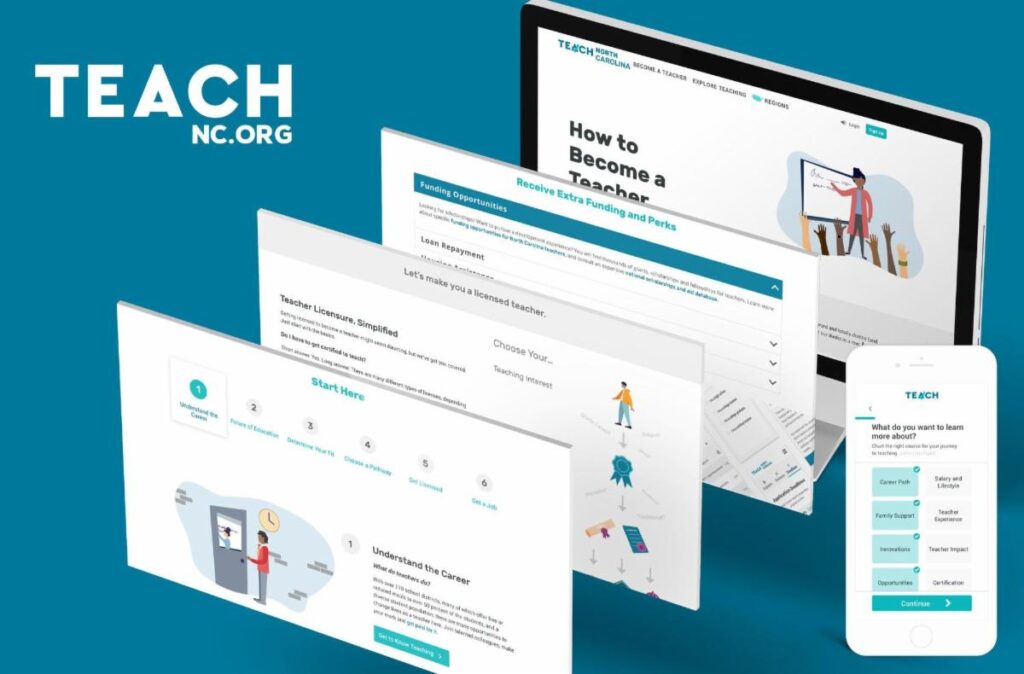
Announcing TeachNC: The One-Stop Resource for Becoming a Teacher in North Carolina We are thrilled to share that, for the first time ever, North Carolina has a unified, statewide teacher recruitment initiative that elevates the teaching profession and seeks to fill critical vacancies! At the August 14th meeting of the North Carolina Education Cabinet, education leaders and stakeholders gathered to celebrate the launch of TeachNC. Aligning with BEST NC’s longstanding commitment to improving the educator pipeline, we have collaborated with the North Carolina Department of Public Instruction and TEACH.org to create this statewide teacher recruitment initiative. TeachNC employs both a broad media campaign and a robust web platform to support teacher candidates in their quest to become a teacher in North Carolina. Members of the NC Education Cabinet stand in support of TeachNC. Why TeachNC? Every student deserves a quality education — that’s a given. What you might not know is that teacher quality is the #1 in-school factor for guaranteeing students’ long-term success. Since educators play a crucial role in the lives of our students, TeachNC is designed to inspire teaching candidates to pursue the career and remove barriers that stand in their way. The Audience The TeachNC initiative seeks to provide accurate and compelling information about the teaching profession that will be useful to both potential candidates and the general public. TeachNC targets students who are just beginning to think about their career options all the way to mid-career professionals who may be considering a career change. The Campaign TeachNC’s media campaign, “Teachers Have Better Work Stories,” highlights the ways in which teaching profession is challenging, fulfilling, and constantly evolving. These career qualities are particularly appealing to Millennials and Generation Z as they seek fulfilling professions. TeachNC’s first public service announcement can be viewed below. TeachNC will also be curating Better Work Stories from real North Carolina teachers. To view the stories collected so far, click here. If you are a teacher or know of one who should share their Better Work Story, please share it here. The Website TeachNC.org is an interactive digital recruitment platform that centralizes all of the information and resources needed to become a teacher: Licensure Understanding licensure is the first step to becoming a teacher. TeachNC outlines licensure requirements and pathways for all candidates, from beginning college students to mid-career professionals. Programs To help candidates choose an educator preparation program (EPP) that will qualify them for licensure, TeachNC provides a database of North Carolina’s EPPs, criteria to help candidates compare options, and advisors to provide 1-on-1 support. Affordability To help candidates understand affordability, TeachNC provides a finance guide with best practices, local and national scholarship listings, and cost-saving strategies. TeachNC also offsets candidates application costs through a $100 reimbursement scholarship. Applications Understanding licensure is the first step to becoming a teacher. TeachNC outlines licensure requirements and pathways for all candidates, from beginning college students to mid-career professionals. More to Come, and What YOU Can Do: Over the next months and years, TeachNC will continue to expand its resources with district landing pages and updated information as licensure requirements change. In the meantime, here is what you can do to help: If you know someone who is thinking about becoming a teacher, please share www.TeachNC.org and encourage them to register to get (free) resources. If you are a teacher and want to share your Better Work Story, take just a minute to film with your phone and upload it here. If you have any ideas or questions, reach out to the TeachNC Director, Princess Brown at Princess@TeachNC.org. TeachNC Partners TeachNC Funders
North Carolina’s New Approach to Teacher Recruitment

The new North Carolina Teaching Fellows program is due to officially launch this month – and it’s a big deal. It’s an exciting opportunity for future teachers, for the students they will serve, and for North Carolina.
Statement from BEST NC on Principal Pay

Cary, NC – This year, North Carolina made the largest investment in state history in principal salaries through an updated salary schedule and bonus opportunities. The impetus was an average principal salary ranking at the bottom of the Southeast and among the lowest in the nation and increasing recognition that that North Carolina’s way of paying principals was outdated and convoluted.
The State of Teaching

Assessing Education in North Carolina

In Depth: Time Warner Cable Interview
State has a big math problem
If North Carolina were to secede from the union and become an independent country — no, conspiracy theorists, I’m not actually proposing this as a reasonable response to recent political events — how would our education system rank among the other developed nations of the world? There’s no need for a speculative answer to this hypothetical question. Last year, the Organization for Economic Cooperation and Development (OECD) administered its latest round of math, reading, and science tests to more than half a million 15-year-olds across dozens of countries. Known as the Program for International Student Assessment (PISA), these exams give policymakers one way of assessing their schools’ relative performance as well as some useful insights about what policies or factors tend to be associated with high student achievement. For the 2015 tests, both North Carolina and Massachusetts had enough of their students tested to allow for independent comparisons of their performance to that of other nations, rather than just as part of the nationwide sample. The United States is best described as a middling performer in reading and science. In both cases, its mean scores are within a few points of the OECD average, and about as many countries ranked above it as below it. In math, unfortunately, American students are much worse off, ranking significantly below those of most other OECD countries. North Carolina, it turns out, is fairly representative of America’seducational standing. We also rank about in the middle in reading and science, with North Carolinians faring a little worse in reading and a little better in science than other American kids. Our weakest point, again, is math. Only four OECD countries — Chile, Mexico, Greece, and Turkey — rank below North Carolina in that subject. (The other state participant, Massachusetts, is a high achiever in all three subjects.) Julie Kowal, vice president of policy and research at the education nonprofit BEST NC, describes these gaps in the following terms: “In the highest-performing OECD countries, 90 percent of students meet basic proficiency levels – meaning they demonstrate knowledge and skills that enable them to participate actively in relevant life situations. In North Carolina and the U.S. as a whole, roughly 80 percent of students attain basic proficiency in reading and science on PISA; 70 percent of students attain basic proficiency in math.” Raising by 10 to 20 points the share of our students possessing basic skills is a challenge, but hardly an impossible one. How can North Carolina do it? While I’m not against spending money on our highest priorities, don’t assume that variations in test scores simply reflect variations in expenditure. Indeed, many high-performing countries spend less per pupil than North Carolina does. And the 2015 PISA report observed that for most OECD countries, “factors other than the level of investment in education are better predictors of student performance” and that the relationship between student performance and teachers’ salaries relative to per-capita national income “is not statistically significant.” Teacher quality is, of course, paramount. But it’s about more than pay. PISA findings suggest that effective programs to keep teachers learning throughout their careers show strong relationships to student success, as do strategies for encouraging teacher collaboration. Conservatives will be pleased to learn that the extent of competition among schools is associated with higher scores, although not in all the participating countries. Progressives will be pleased to learn that prior enrollment in preschool is also associated with higher scores. The PISA data are consistent with more carefully designed studies that show how important it is to build proper incentive structures for school governance and accountability. For example, school principals should be given more authority over their employees, budgets, and school policies, but only if they are properly trained to exercise it. Although North Carolinians may disagree about education policies and priorities, there is little debate about the benefits of school reform. We know that the competitiveness of our economy, the strength of our families and communities, and the health of our republic depend on getting it right. John Hood is chairman of the John Locke Foundation and appears on the talk show “NC SPIN.” You can follow him @JohnHoodNC. Click here to view State has big math problem PDF
Brenda Berg speaks at a Joint Legislative Study Committee on School-Based Administrator Pay

[vc_row][vc_column width=”1/1″][vc_hidrop] WATCH BEST NC’S TESTIMONY [/vc_hidrop][/vc_column][/vc_row][vc_row][vc_column width=”1/1″][vc_hidrop] [/vc_hidrop][/vc_column][/vc_row]
Ranked 49th in principal pay
[vc_row][vc_column width=”1/1″][vc_hidrop] School administrator pay in North Carolina is dismal, says Frank Till Jr., superintendent of Cumberland County Schools, but a new legislative call to alleviate the problem by completely nixing the state’s principal salary scale could be disastrous. “Without a salary schedule, it means we’d have to negotiate every single principal’s salary,” complains Till. “It would lead to inequities. You would open yourself up to a variety of things.” That includes, according to Till and other critics, yawning pay gaps between rich and poor counties and uncertainty for school district leaders now tasked with negotiating scores of The proposal, which emerged in a legislative study group meeting this week, is intended to reform a much-denigrated system of administrator pay that, by most accounts, ranks North Carolina among the poorest states in the nation for prospective school principals and vice principals. Since local administrator supplements vary in the state, snapshots of North Carolina principal pay are hard to come by, but 2015 data from the U.S. Department of Labor place the state at a lowly 49th in the nation. The mean administrator pay in North Carolina—about $68,000—trails all of the state’s neighbors in the southeast, according to the federal department. Yet with much of the general public’s focus on teacher pay, it’s perhaps one of the most overlooked crises for North Carolina schools, advocates say. Republican Sen. Jerry Tillman, a former school administrator who represents Randolph and Moore counties in the General Assembly, sponsored legislation in 2015 that would have funneled millions into boosted principal pay and bonuses for high- performing administrators, but that legislation stalled. And this year, GOP lawmakers once again opted out of raises for school administrators, but they did commission a study group co- chaired by Tillman to suggest fxes. The group’s frst solution, unveiled at the study group’s meeting in Raleigh this week, is a multi- pronged proposal that completely axes the state’s oft-maligned principal salary scale, provides so-called “gap funding” for administrators in poorer school districts and creates a pot of money for principal bonuses. Under the proposal, state leaders would provide a set pool of funding for administrator pay, but it would be left to districts to negotiate pay with principals. It’s a concept that received a chilly reception from a panel of school administrative leaders who spoke to the legislative study group this week. In addition, legislators would also look to revamp the scale for assistant principals. Advocates have pointed out that, due to the state’s outdated pay schedule, some assistant principals could earn less than the teachers they oversee. Till is among the most outspoken critics of the new proposal. The Cumberland County Schools chief points out that, in his rural district, offcials would be charged with negotiating contracts for 87 different principals. In larger counties such as Wake and Mecklenburg, which manage hundreds of schools, the burden would be even larger, administrators said. And, across the state, the lack of a state-mandated foor for principal pay could lead to growing inequalities across districts and a spike in employment complaints and lawsuits. “Board members could suddenly start negotiating salaries with their friends,” Till told Policy Watch this week. “It would be about who you know and what you know. It’s just a slippery slope that you don’t want to go down.” GOP lawmakers have yet to commit to any course of action, but Tillman told study group members this week that he expects final proposals for the legislature to be readied by the end of the year. Katherine Joyce is executive director of the N.C. Association of School Administrators, an organization of school chiefs representing administrators in Raleigh. This week, Joyce said lawmakers are right to be concerned about the state’s dysfunctional system of administrator pay. “There needs to be adequate incentive to get teachers to leave the classroom if they want to take on more responsibility,” said Joyce. After all, administrators are vital to the success of a school, Joyce points out. Research suggests that effective classroom teachers and strong administrators are the top two drivers of student success, Joyce says, but without ample incentive, quality administrators are likely to fock out of the state for employment. “They have to go hand in hand. If we’re not investing enough in our principals, we have a problem that’s going to trickle down all the way into the classroom and affect student learning. It’s got to be a high priority for the General Assembly.” Joyce says there’s merit to some of the study group’s proposals, namely, reforming assistant principal pay and placing a focus on principal bonuses and “gap funding” for low-income districts priced out of the competition for top administrators. But the proposal lobbed in the legislative study group this week has still earned poor marks from multiple school leaders, including Joyce, chiefy because of the uncertainty created for school districts if the state dissolves its principal pay schedule. The state scale, while badly in need of boosts for long-overlooked administrators, still sets a foor for pay across North Carolina, they “School districts need some stability and a level playing feld between districts so that the bidding war out there for the really effective principals is not exacerbated,” Joyce tells Policy Watch. It’s a legitimate concern, says Till, who adds that the reform could be misleading to the general public. “By doing away with the salary schedule, (the NCGA) can say we raised the administrator pay by 5 percent, 10 percent, but what they don’t say is it’s not across the board.” Rep. Hugh Blackwell, a powerful Republican from Burke County who co-chairs the study group, questioned this week whether state leaders would be better suited to negotiate principal contracts than local leaders. Blackwell did not respond to a request for comment, but at least one defender of the new legislative proposal told Policy Watch this week that some pushback is to be expected. “Because they’re not used to negotiating in this way doesn’t mean it’s necessarily a bad idea,” […]
NC teachers see broad raises, more bonus chances
[vc_row opacity=”1.00″ padding_top=”0px” padding_bottom=”0px” padding_left=”0px” padding_right=”0px” margin_bottom=”0px” bg_type=”theme_default” bg_grad=”background: -webkit-gradient(linear, left top, left bottom, color-stop(0%, #FBFBFB), color-stop(50%, #E3E3E3), color-stop(100%, #C2C2C2));background: -moz-linear-gradient(top,#FBFBFB 0%,#E3E3E3 50%,#C2C2C2 100%);background: -webkit-linear-gradient(top,#FBFBFB 0%,#E3E3E3 50%,#C2C2C2 100%);background: -o-linear-gradient(top,#FBFBFB 0%,#E3E3E3 50%,#C2C2C2 100%);background: -ms-linear-gradient(top,#FBFBFB 0%,#E3E3E3 50%,#C2C2C2 100%);background: linear-gradient(top,#FBFBFB 0%,#E3E3E3 50%,#C2C2C2 100%);” parallax_style=”vcpb-default” bg_image_repeat=”no-repeat” bg_image_size=”cover” bg_img_attach=”fixed” parallax_sense=”30″ bg_override=”0″][vc_column width=”1/1″][vc_hidrop] RALEIGH, N.C. (AP) – The North Carolina legislature agreed on broad pay raises for public school teachers for the second time since 2014 and is aiming to jump-start again giving instructors even more when they take on additional responsibilities or their students make academic progress. The $22.3 billion budget on Gov. Pat McCrory’s desk for his expected signature purports to increase state-funded teacher and instructional staff salaries on average by 4.7 percent this fall. Budget-writers predict the adjustments will bring average salaries – when local supplements are added – above $50,000 statewide. The budget approved July 1 also directs bonuses to follow in January for many. Teachers would receive $25 or $50 for each student they taught who scored high this past year on Advanced Placement, International Baccalaureate and technical certification tests, capped at $2,000.Andthird-gradeteachers whose students showed the best growth in reading skills could receive as much as$6,800. Both programs last two years. There also will be a three-year performance-pay program starting in fall 2017 in which 10 districts will be picked to offer teachers salary supplements of up to 30 percent. Similar ideas have been floated or experimented with over the past 30 years. A former statewide bonus program ended due to lack of funds and questions about effectiveness. “We put a heavy emphasis in this budget on training the teachers, offering teachers opportunities to grow, not just because they can earn more money but so they can take on more responsibility,” said Rep. Craig Horn, R-Union, an education budget-writer. Teachers getting raises would see increases from about 2 percent to 13 percent, depending on where they sat on the salary schedule last year. For example, a 10-year teacher making a base salary of $40,000 will make $41,000 this fall. A 19-year teacher making $43,500 will earn $48,000. Up to 2,700 of the 92,000 instructors funded by the state wouldn’t see any raise, according to the Department of Public Instruction. These teachers have worked at least 32 years in the schools and have been paid at rates separate from the salary schedule since 2014, when the schedule got consolidated. These teachers already make more than the schedule’s top rung of 25 years, increasing this fall from $50,000 to $51,000. Still, critics of Republican education policy are emphasizing how some teachers are being left out. “Again, experienced teachers in North Carolina get shortchanged,” North Carolina Association of Educators President Mark Jewell said. Attorney General Roy Cooper, who is running against McCrory this November, and other Democrats argue additional money for public school salaries and supplies instead are being rerouted to corporate tax cuts and for scholarships for more K-12 students to attend private schools. But Republicans say public education spending is at an all- time high and teacher pay is rebounding after the Great “This budget keeps our promises to support our public schools and raise teacher pay above $50,000,” Senate leader Phil Berger said in a release. The pay proposal likely will increase North Carolina’s average pay ranking in the South from ninth out of 12 states to seventh, according to the Public School Forum of North Carolina. This past year North Carolina was ranked 41st nationally at $47,985, according to the National Education Association. “Until we adopt a plan that brings our teachers to the national average in salaries, we’re going to continue hemorrhaging teachers to whoever the competition might be,” Senate Minority Leader Dan Blue, D-Wake. “It takes more than just keeping a campaign promise.” A budget provision says the Legislature wants a salary schedule in fall 2018 that will reduce the number of years teachers work to meet or exceed a $50,000 base salary from 25 years to 15 years. The schedule would still be capped at $51,000. Brenda Berg, president of BEST NC, a business-oriented education advocacy group, said the move toward paying higher salaries sooner reinforces the need for putting performance-based programs in place now to boost their earnings potential. “We need to give them a lot of real big opportunities to make more money,” said Berg. Click here to view N Carolina teachers see broad raises, more bonus chances PDF [/vc_hidrop][/vc_column][/vc_row]