
North Carolina’s Principal Recruitment Supplement Program (PRSP)
Since its launch in 2019, North Carolina’s Principal Recruitment Supplement Program (PRSP) has sought to address one of the most persistent challenges in education, ensuring that the schools facing the greatest academic challenges have access to the strongest leadership. Established in N.C. Session Law 2019-247, the PRSP provides a $30,000 annual salary supplement to qualifying administrators who accept a principal position in a qualifying low-performing school. The supplement is paid monthly if the principal remains employed at the same low-performing school, up to a maximum period of 36 months. In 2026, the North Carolina State Budget expanded the PRSP to grant 3 more years of eligibility for an annual salary supplement of $20,000.
In the districts where this investment has been leveraged, many schools have reported improved student growth scores, higher teacher retention rates, and other positive results.
Why Did North Carolina Transform
Its Previous Principal Pay Strategy?
For years, principals in North Carolina had the lowest pay in the southeast; and among the lowest in the country. And – like most other states – the North Carolina paid principals based on school size, their level of education, and years of experience; with little accounting for the difficulty of the job or their effectiveness in their role. This system rewarded principals for moving to larger schools and lacked a strategy to incentivize high-quality principals to work in to our highest-needs schools. Both the structure and level of principal compensation needed to be improved.
What Problems Does the PRSP Address?
Highly effective principals — identified through supervisor evaluations, teacher survey results, and licensure exam performance — are not evenly distributed across schools. Research consistently shows that experienced, high-performing leaders are less likely to serve in schools with higher concentrations of low-performing students, students from low-income families, and students of color. This inequitable pattern, known as principal sorting, leaves the students who most need strong leadership least likely to have it.
Evidence is clear: Principals with a demonstrated record of turning schools around can produce both immediate academic gains and lasting improvement. Yet one of the greatest barriers to school transformation remains the limited supply of experienced turnaround leaders — making strategic recruitment not just important, but essential.
To address these challenges, the General Assembly created the Principal Recruitment Supplement Program — established in N.C. Session Law 2019-247 — which provides a $30,000 annual salary supplement to a qualifying administrator who accepts a principal position in a qualifying low-performing school. The supplement is paid monthly if the principal remains employed as the same low-performing school, up to a maximum period of 36 months.
In districts that have leveraged this investment, many schools have reported better student growth scores, teacher retention rates, and other positive results.
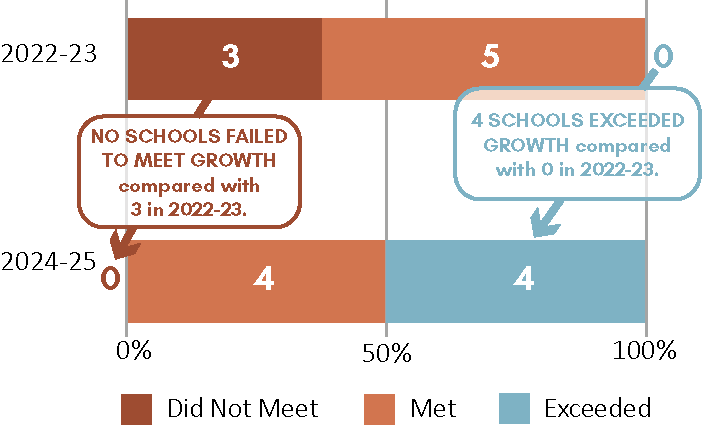
School Growth Scores Before and After Participating in the PRSP (2022-23 and 2024-25)
Timeline of Transformation: The PRSP
The PRSP Is Established
In 2019, North Carolina created an additional incentive for highly effective school leaders to bring their talents to the most challenging positions in their school districts. With an annual recurring investment of $1.3 million, principals who have persistently achieved high growth in their schools can receive a $30,000 annual salary supplement to move to a low-performing school for up to three years (up to a $90,000 total supplement).
2019
Highest Rate of Participation in the PRSP
During the 2023-24 academic year, the PRSP experienced its highest participation rate, serving 20 principals across three separate cohorts – with no schools declining participation.
2024
Program Expansion
In the 2026 North Carolina state budget, the PRSP’s eligibility was expanded to include more schools, allow principals to stay at their school for three more years with a $20,000 supplement, and allow qualifying principals to participate in the program again.
2026
Who Qualifies for the PRSP?
Qualifying Schools
Qualifying schools, as defined in G.S. 115C-105.37, include low-performing schools receiving an overall School Performance Score in the bottom 10% of all schools statewide in the prior school year. Given low utilization (below 50%) of the program over the past five years, the State Board of Education recently recommended expanding the program’s eligibility to include all low-performing schools. The 2026 North Carolina budget did not go that far, but did expand eligibility for the program from the lowest 5% to the lowest 10%.
- State statute defines low-performing schools as schools that earn an overall School Performance Grade of D or F and a School Growth Status of “met expected growth” or “not met expected growth.”
- Eligible schools are announced to districts between January and April. District leaders are encouraged to reach out to the N.C. Department of Public Instruction (DPI) in January to learn if they have qualifying schools in their district.
- Around 120 schools across North Carolina were previously eligible. Under the expanded program, the lowest 236 schools in the state are eligible. Compare the number of districts with qualifying schools using the heat map below.

Qualifying Principals
Qualifying principals include those who are paid on the “Exceeded Growth” column of the Principal Salary Schedule. A principal’s placement on the salary schedule is tied to the performance of their school. If a school exceeds growth for two out of the previous three years, they receive the “Exceeded Growth” payment on the salary schedule.
PRSP Funding & Availability
There is $1.3 million in recurring funds available for this program, enough to support about 40 principals to participate in the program each year. If fully implemented, about 13 new principals would be added each year, with 13 first-year, 13 second-year, and 13 third-year principals utilizing the program at any given time.
However, the program has not been fully utilized since its inception. Low utilization can be attributed to a variety of factors, including district priorities, superintendent awareness, and logistical or cultural challenges in implementing the program.
Only three principals began the program in 2024-25, and eight principals began the program in 2025-26. With eight principals completing their 36-month bonus period this year, 29 slots are estimated to be available for the upcoming 2026-27 school year.
The PRSP Is Improving School and Student Outcomes
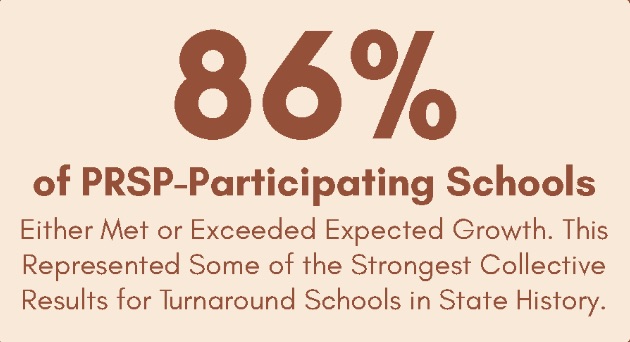
Despite low utilization of the program, the recruitment supplements are producing results: 86% of participating schools have met or exceeded growth — representing some of the strongest collective results for turnaround schools in state history. School performance scores also increased by an average of 16 points for the 2023-24 cohort from their qualifying baseline.
At least 50% of participating schools have exceeded growth, meaning they exit their status as a low-performing school. Among the 2023-24 schools, six schools’ growth scores improved in 2024-25 over the 2022-23 baseline, while two remained at “met growth.”
Participating principals have reported other positive results besides better growth scores, including dismantling long-held assumptions about student potential, shifting belief systems among staff, strengthening community trust, and building a culture of high expectations. Additionally, teacher retention rates increased at these schools, providing necessary stability for their students. Principals also saw increased family and community engagement.
While program participation is currently limited to the very lowest performing schools, its high level of investment in the schools who need it most has proven effective in turning these schools around.
BEST NC's Recommendations to Further Strengthen North Carolina's Innovative Principal Pay Model
Thanks to sustained increases in principal pay, North Carolina is now more regionally competitive. However, continued investment is necessary to ensure we continue to stay competitive with surrounding states:
- Continued investment is necessary to ensure we are competitive with surrounding states.
- BEST NC recommends embedding a school complexity measure in the current pay structure to ensure we are consistently rewarding our best principals for taking on the highest-need schools.
- We also recommend exploring additional measures of principal effectiveness.
RESOURCE LIBRARY
Related Resources & Programs
Below is a curated selection of our catalogue of policy briefs, reports, videos, blogs, interactive data tools, and research around this initiative:

Policy Brief
Principal Pay in North Carolina: Aligning Compensation Strategies with Student Success (2026)

Educator Innovation
The New North Carolina Principal Fellows Program (NCPFP)