
Best Practices in Teacher Pay: Front-Loading Base Pay for Professional Growth

Best Practices in Teacher Pay: Front-Loading Base Pay for Professional Growth A comprehensive, professional compensation plan includes layered pay strategies that build on one another to ensure the recruitment and retention of a high-quality workforce. This is the first in a series of blogs highlighting best practices in teacher pay featured in detail in BEST NC’s report, Teacher Pay in North Carolina: A Smart Investment in Student Achievement. Front-Loading Base Pay for Professional Growth We begin this blog series by examining a key component of any competitive compensation model, a base pay schedule that provides a living wage and builds with professional expertise. We refer to this foundational component as “Front-loaded Base Pay” and will utilize the next four blogs in our series to highlight the many benefits of a front-loaded pay schedule, beginning with Part 1: Front-Loading for Professional Growth. In contrast to pay practices in most professional industries, teacher compensation in North Carolina and across the country is driven by a 100-year-old step-and-lane salary schedule that bases pay solely on years of experience and educational attainment. As discussed in our recent blog, BEST NC Releases Comprehensive Teacher Pay Report – BEST NC, we find that this outdated pay and retention structure fails to recruit and retain the top-tier teaching candidates our students deserve. Exhibit 1, Below, demonstrates the difference between a traditional step-and-lane pay structure like North Carolina’s and a front-loaded pay schedule. Although lifetime income is the same if someone stays in the profession for 30 years, the front-loaded pay schedule allows teachers to reach their maximum base pay earlier in their careers. This aligns with the years in which most teachers demonstrate the greatest amount of professional growth, as well as living wage increases that we will examine in the next post. Note: This graph only represents base pay on top of which teachers should be eligible to receive additional supplements, bonuses, and raises later in their careers, including by taking on Advanced Teaching Roles and extending their reach to more students. Additionally, the entire schedule shifts up over time, typically to address inflation. A front-loaded base pay structure is used in many professional industries and is premised on the fact that pay rises along with employees’ sharp increase in professional skills early in their career. Like these other professions, research that suggests increases in teacher effectiveness are most significant during the first three years of a teacher’s career and level out after year five. This can be visualized by examining student growth data for North Carolina teachers at various points in their careers (see Exhibit 1 below). The most significant gains are seen between 0-2 and 3-5 years of experience and peak, on average, around the eighth year of teaching. A front-loaded teacher pay schedule aligns pay increases to the parts of a teacher’s career in which they are making the largest gains in their ability to positively impact student learning. Increasing early-career teacher pay also has implications for teacher retention. A study of teacher pay and retention in Texas from 1996 to 2012 found that increases in teacher base pay had greater positive impacts on teacher retention during the early parts of a teacher’s career (years 1 to 7) and no effect on the retention of teachers with 12 or more years of experience. Exhibit 3 below shows the number of teachers in North Carolina by years of experience and their attrition rates, affirming that, in the first 20 years of a teacher’ careers, the greatest attrition happens in the first six to eight years of teaching. Increasing and front-loading North Carolina’s teacher salary schedule works to combat these high attrition levels by providing a compensation incentive for more early-career teachers to continue in their careers. UPCOMING: The next blog in our teacher pay series will explore how a front-loaded teacher pay schedule better aligns with one’s need to earn a living wage to support a family.
BEST NC Releases Comprehensive Teacher Pay Report
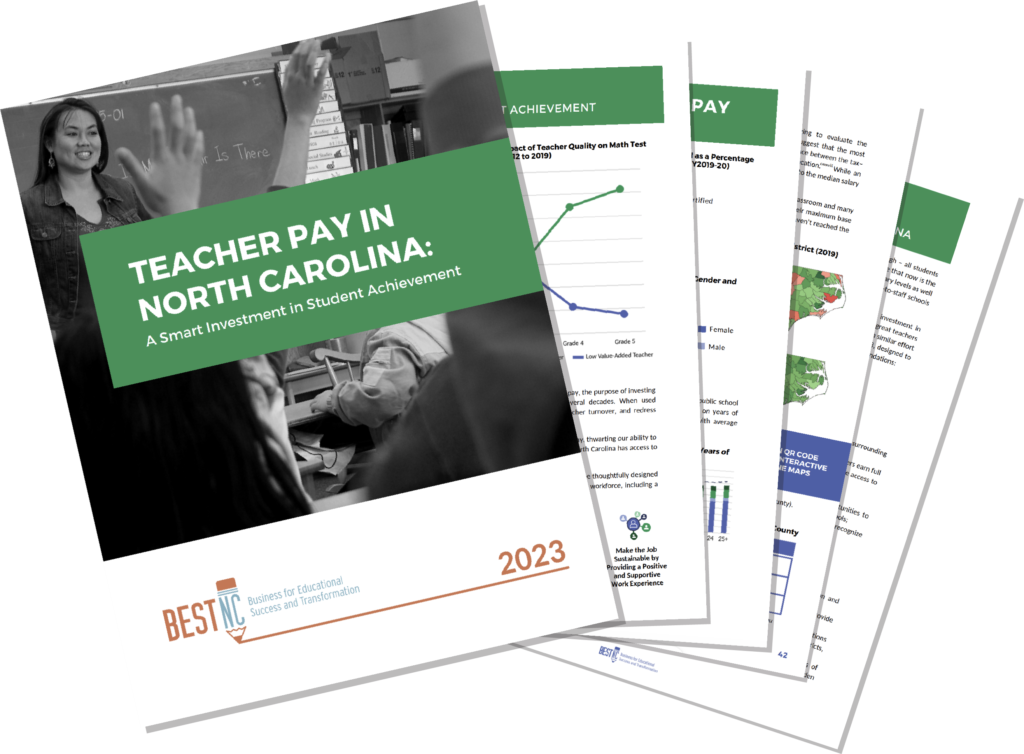
BEST NC Releases Comprehensive Teacher Pay Report In 2023, BEST NC released a new report on teacher pay entitled Teacher Pay in North Carolina: A Smart Investment in Student Achievement. The BEST NC team, along with leading economists and experts from across the country examined the complex issue of teacher pay. In our analysis, we uncovered important new evidence that the existing teacher pay structures in North Carolina, and across the country, fail to address dramatic decades-long shifts in our national workforce and are inadequate for meeting the personal and professional needs of today’s teachers. This teacher pay report offers specific, actionable recommendations for both an increased and transformed teacher salary structure that can help retain exceptional educators and attract the next generation of top-tier talent into North Carolina public schools. You can access the full report and the executive summary here. Below is an overview of the report. This is the first in a series of blogs that will highlight key concepts and recommendations from the report. Background: Why Professional Compensation Matters Research has consistently found that teacher quality is the most important in-school factor for student success, with high-performing teachers producing significantly higher achievement gains than low-performing teachers. Given this reality, it is essential for teacher compensation to attract highly qualified candidates into the profession and to support continued professional growth throughout their career in the classroom. In his NYT best-selling book Drive: The Surprising Truth About What Motivates Us, Daniel Pink contends that professional compensation is fundamentally important to fulfill an individual’s biological need to support oneself and one’s family (compensation must be adequate), and individuals must feel that they are fairly paid for the skills they hold and the work they do (compensation must be equitable). The Teacher Pay in North Carolina report considers Pink’s framing of professional compensation, compared to the current, 100-year-old teacher step-and-lane pay structure that is used in North Carolina and across the country. Through this lens, the report finds that our teacher pay and retention practices are outdated and fail to recruit and retain the top-tier candidates our students deserve. Beyond baseline requirements of adequacy and equitability, Pink finds that high-skilled professionals are motivated to perform at their best when their jobs present the opportunity for mastery, autonomy, and purpose. Current teacher pay practices and organizational structures, in stark contrast, encourage a “one-teacher, one classroom” approach that stifles growth and leaves high-performing teachers with few opportunities for professional advancement. Five Key Challenges of Current Teacher Compensation Models An exploration of research on best practices in teacher compensation revealed five major challenges, each of which is examined closely in the Teacher Pay in North Carolina report. Challenge 1: Teaching is a Mostly Female Workforce, Yet Teacher Pay Has Not Kept Up with Increasing Opportunities and Pay for Female, College-Educated Professionals. Nationally, between 1985 and 2021, median income for women with a bachelor’s degree grew by 22% when adjusted for inflation, compared to just 10% for teachers. Earnings for college-educated women have now eclipsed earnings for teachers. Women still comprise the majority of the teaching workforce, but, as women have more professional opportunities than ever before, teaching is arguably less attractive now than ever before for top-tier female candidates. v Challenge 2: Under the Existing Salary Schedule, North Carolina Teachers Must Wait Far Too Long Before Their Salaries Provide a Living Wage that Can Support a Family. Outside of retirement, teacher attrition is highest in the first five years of a teacher’s career. These years coincide with the time that teachers are starting to build their families. At this crucial juncture, the traditional step-and-lane schedule does not provide a living wage that allows teachers to support a family. The Teacher Pay in North Carolina report uses the Living Wage Calculator from the Massachusetts Institute of Technology, which leverages geographically specific data on living expenses (e.g. housing, health insurance, food, childcare), to estimate that nearly one-third of North Carolina teachers earned less than a living wage for a family of four in 2021-22. Even when compared to other public sector employees in our state, teachers earn less and take much longer to reach the top of the base salary schedule. Challenge 3: The Traditional Teacher Compensation Model Does Not Provide Meaningful Professional Promotions that Attract Top Talent and Keep Effective Educators in the Classroom. Research has demonstrated that the traditional step-and-lane salary schedule limits overall earning potential and discourages high-aptitude individuals from pursuing a teaching career. Reinforcing this notion, a report issued by McKinsey in 2010 revealed that 87% of top-tier candidates indicate that their preferred occupation provides opportunities to advance, compared to just 45% who believe teaching will provide similar advancement opportunities. The same report noted that nations that perform at the top on international assessments recruit 100% of teachers from students in the top-third of their class. In the United States it is 23%, and only 14% for teachers in higher poverty schools. Advanced Teaching Roles provide one pathway for highly effective educators to advance professionally as they take on greater responsibility and leadership. Currently, approximately 1,000 North Carolina teachers are working in advanced roles, earning up to $20,000 in additional pay. However, with just 21% of districts currently participating, there is significant room for growth. Challenge 4: Existing Pay Structures are not Designed to Fill Hard-to-Staff Subject Area Positions and Schools, Leading to Persistent, Critical Vacancies and Disparities in Student Access to Effective Educators. Like most states, teacher staffing inequities in North Carolina are driven, in part, by the structure of the state teacher salary schedule, which requires that teacher base pay is the same for equivalently experienced teachers, regardless of what, where, or how well a teacher teaches. In high-demand fields like STEM subjects, average teacher pay significantly trails average wages for recent UNC System graduates for those majors. These subject areas also see markedly higher teacher vacancy rates. Additionally, there are tremendous disparities in student access to highly qualified teachers […]
BEST NC’s Response to Principal Preparation Consolidation (SB469)
We are grateful to the State of North Carolina for investing in two distinct, innovative principal preparation programs over the last four years. The timing is right to take the best practices from each of these outstanding programs and magnify their collective impact for the benefit of school leaders and the students they serve. Read our brief on the Transforming Principal Preparation Program here. Learn more about the NC Principal Fellows Program here. View Senate Bill 469 here.
Growth and Achievement in North Carolina

Growth and Achievement: you have probably heard these terms in conversations about education. But what are they? How do they differ, and what do they tell us about North Carolina’s students and teachers? Our new video “Growth and Achievement in North Carolina” explores some of these questions. Find out more at www.best-nc.org/growthandachievement.
Don Curtis Interview with Brenda Berg – Carolina Newsmakers
Classroom Teacher Allotments North Carolina Public Schools

Note: This blog post features a brief from page 22 of our 2018 Facts & Figures publication, contextualizing North Carolina education data with a short description of an historical feature or a critical issue in North Carolina. Read more at www.NCEdFacts.org. In North Carolina, the state allots teaching positions to each school district based on the number of students in each grade, according to specific ratios set by the General Assembly. The classroom teacher allotment is by far the largest single state allotment; salary and benefits for teaching positions represent approximately 55% of total state support for education. Over the past seven years, the state changed allotment ratios four times, generally decreasing student to teacher ratios in the lower grades, and increasing them in grades 4 through 12. Source: NC DPI Highlights of the Public School Budget In 2016, the General Assembly enacted legislation requiring actual average student to teacher ratios in grades K-3 not to exceed the allotment ratios starting in the 2018-19 academic year. This has sparked considerable debate, in part because for the first time since the development of the state’s Basic Educational Program, districts will be required to use the state’s full position allotment to fund classroom teachers. Currently, there is no separate allotment for elementary school art, music, physical education, and world language teachers.
North Carolina Teachers and State Employee Retirement System and Health Benefits

Note: This blog post features a brief from page 26 of our 2018 Facts & Figures publication, contextualizing North Carolina education data with a short description of an historical feature or a critical issue in North Carolina. Read more and find further information at www.NCEdFacts.org. All full-time employees in North Carolina public schools participate in the state’s Teachers and State Employees Retirement System (TSERS). TSERS provides qualifying employees a guaranteed salary and individual health benefits upon retirement from state government. In North Carolina, employees vest in TSERS after five years of service. Employees may retire with unreduced benefits after 30 years at any age, after 25 years of service at age 60 or older, or after five years at age 65 or older. Teachers contribute 6% of their pre-tax salary to TSERS, a rate that has been consistent since 1975. Nearly all states maintain a defined benefit (pension) plan for teachers and other state employees; in North Carolina and 29 other states, all teachers also participate in social security. TSERS is roughly comparable to the national median state plan and significantly more generous than the private sector average. Retiree health benefits in North Carolina are significantly more generous than the national median state plan and the private sector. Active state employee premiums for individual health care coverage are more generous than most other state plans and the private sector, but less generous than average for family plans. Source: North Carolina TSERS Handbook, NCGA Fiscal Research Division – Comparison of the Value of Employee Benefits
K-12 Education Finance in North Carolina

Note: This blog post features a brief from page 42 of our 2018 Facts & Figures publication, contextualizing North Carolina education data with a short description of an historical feature or a critical issue in North Carolina. Read more at www.NCEdFacts.org. In North Carolina and nationwide, public education is financed through federal, state, and local expenditures. Nearly two-thirds of total K-12 public education funding in North Carolina comes from the state through position, dollar and category allotments (such as allotments for teachers, principals, teacher assistants, textbooks, classroom materials, and transportation). Districts received additional funding from the state based on student learning needs (such as for children with disabilities, English language learners, and economically disadvantaged students). The state also provides supplemental funding to low-wealth counties (68 across the state) and small counties (27). Combining state funding allotments, a first grade student with no special learning needs would receive $5,861 in state funding; an economically disadvantaged first grade student with limited English proficiency and special learning needs in a small, low-wealth county would receive $17,279 in state education funding. Roughly 11% of K-12 public education funding in North Carolina comes from the Federal government. Federal funds mainly support child nutrition, students with disabilities, and students from low-income households. Source: NC DPI 2017 Highlights of the Public School Budget K-12 Education Finance In addition to state and federal funds, local North Carolina counties provide additional funding to supplement state support for K-12 school operations; and provide funds to build, furnish, and maintain K-12 school buildings. Local dollars fund nearly 28,000 positions in K-12 public schools, including 7,315 service workers, 6,313 teachers, 1,937 teacher assistants, and 756 assistant principals across the state. Local funds for school operations range from $849 per pupil in Robeson County to $6,151 in Chapel-Hill/Carrboro City Schools. Source: NC DPI Annual Expenditure Report by LEA
Principal Pay in North Carolina

Note: This blog post features a brief from page 30 of our 2018 Facts & Figures publication, contextualizing North Carolina education data with a short description of an historical feature or a critical issue in North Carolina. Read more at www.NCEdFacts.org. In recent years, principal pay in North Carolina ranked last in the Southeast and near the bottom nationally. In 2017, the North Carolina General Assembly transformed the state salary schedule for principals with an investment of $24M, or an average raise of approximately nine percent. The previous statewide schedule was based on each principals’ years of experience, level of education, and the number of teachers in the school they led. Annual state-funded pay ranged from $52,656 to $111,984, with an average of $64,416 in 2017. The updated schedule is based on the size of the school and the principal’s growth status (derived from students’ performance on standardized End-of-Course and End-of-Grade exams). Principals are also eligible for two stackable bonuses based on their school-level growth scores and school performance grades: Source: North Carolina General Assembly – 2017 Appropriations Act
North Carolina’s New Approach to Teacher Recruitment

The new North Carolina Teaching Fellows program is due to officially launch this month – and it’s a big deal. It’s an exciting opportunity for future teachers, for the students they will serve, and for North Carolina.