
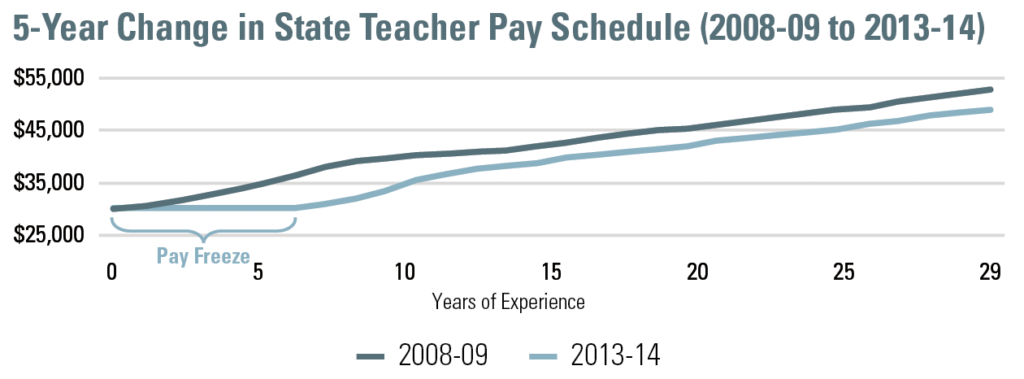
Spotlight On: Teacher Pay Trends The statewide teacher salary schedule is established in the state budget. The following charts show two major phases in the teacher pay schedules over the last ten years: pay freezes from 2009 to 2014, followed by investments of almost $1 billion from 2014 to 2019.
Spotlight On: Advanced Teaching Roles Initiative
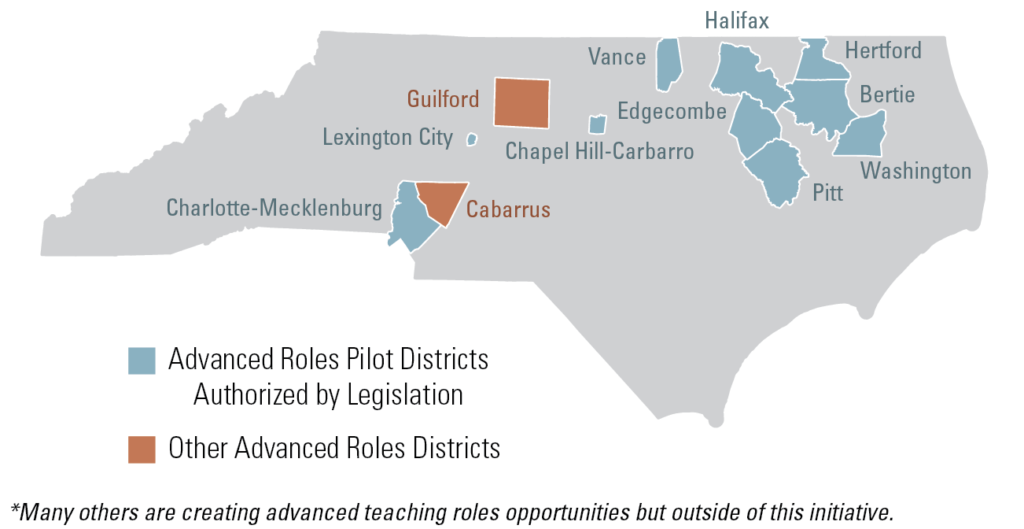
Spotlight On: Advanced Teaching Roles Initiative In 2016, North Carolina created the Advanced Teaching Roles Initiative. This legislation establishes a school leadership re-design model that empowers districts and educators to design new teaching roles that provide advancement opportunities, improved professional development, and greater support for student achievement. Advanced Teaching Roles enables highly-effective teachers to advance their careers, extend their positive impact on student achievement, and increase their compensation. The best part: they get to stay in the classroom! In effective models, developing teachers also benefit by having access to real-time professional development, relieving some of the pressures of principals who are traditionally the primary source of instructional leadership in the school. Today, ten districts are taking part in the Advanced Roles Initiative. Success by Design Program Created in 2013 and inspired by lessons learned from the Opportunity Culture model in Project LIFT schools, Success by Design is an official Advanced Roles program in Charlotte-Mecklenburg Schools (CMS). This approach is being phased in strategically over time. During the 2018-19 school year, Success by Design was implemented in 50 schools. Success by Design advanced roles teachers can earn up to $20,000 on top of their base salary, while increasing their impact on student achievement. Early results from the CMS program suggest that this model helps the district recruit and retain top talent, resulting in significant student achievement gains. During the 2017-18 school year, 58% of Success by Design schools exceeded growth, compared with 27% of all schools statewide. Also, a recent study published by the CALDER Center finds that students’ academic gains increased when taught by advanced roles teachers, with significant achievement gains in math. For more information visit www.BEST-NC.org/advancedroles.
Spotlight On: North Carolina’s Allotment Approach and How Teacher Sorting Affects Funding Fairness
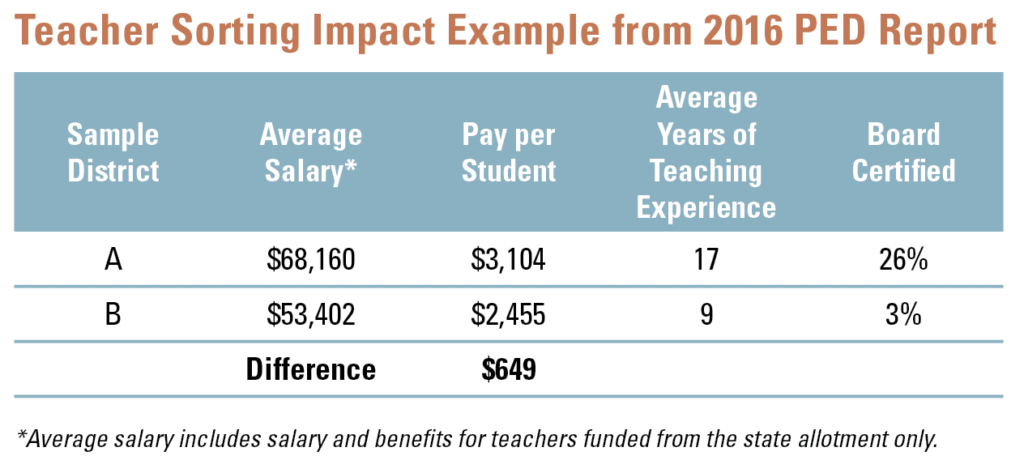
Spotlight On: North Carolina’s Allotment Approach and How Teacher Sorting Affects Funding Fairness In North Carolina, the state allots teaching positions to each school district based on the number of students in each grade, according to specific ratios set by the General Assembly. The classroom teacher allotment is by far the largest single state allotment: salary and benefits for teaching positions represent approximately 55% of total state support for education. What is unique about this approach is that the largest state education resource allocation is made in the form of positions, not dollars. This position-based allotment model was intended to give districts and principals more hiring flexibility, allowing them to have a ‘budget blind’ hiring process. In other words, a school or district can hire any qualified candidate, regardless of where he or she falls on the state salary schedule. While well-intended, a recent NC Program Evaluation Division (PED) study found that “the structure of the [position] allotment exacerbates” a phenomenon called “Teacher Sorting.” Teacher sorting occurs when experienced, highly qualified teachers become concentrated in affluent schools. Several studies have found that teacher sorting has negative effects on students because it limits access to highly effective educators. The PED analysis shows that North Carolina’s position allotment structure exacerbates this phenomenon and deprives high-poverty schools and systems from important funding resources. The financial impact of teacher sorting can be significant and has its greatest negative impact on low-wealth schools and districts. The figure below shows the disparity between the districts with the highest and lowest average teacher compensation. In this scenario, District B receives $649 less funding per student because their average teacher has less experience and is not Board Certified. If districts A and B each have 10,000 students, the funding differences between the districts is $6,490,000.
Spotlight On: School Support Staff and the Whole Child
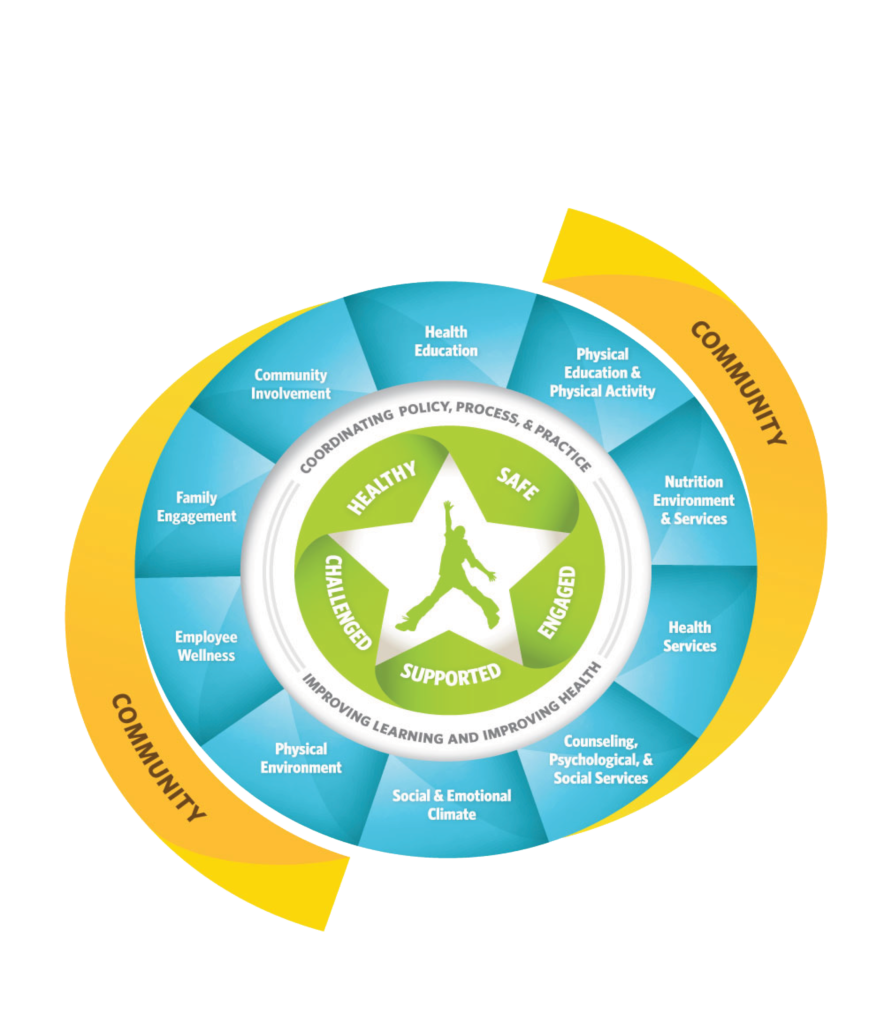
Spotlight On: School Support Staff and the Whole Child In 2016, the State Board of Education (SBE) adopted the Whole School, Whole Community, Whole Child model as a framework for supporting healthy behaviors and academic performance for students. In 2017-2018, there was one school counselor for every 370 students in North Carolina public schools. The American Counseling Association recommends a maximum ratio of one counselor for every 250 students. In 2016-2017, there was one school nurse for every 1,073 students in North Carolina public schools. The National Association of School Nurses recommends a maximum ratio of one school nurse for every 750 students without special health needs.
NC First in Teaching Roadmap
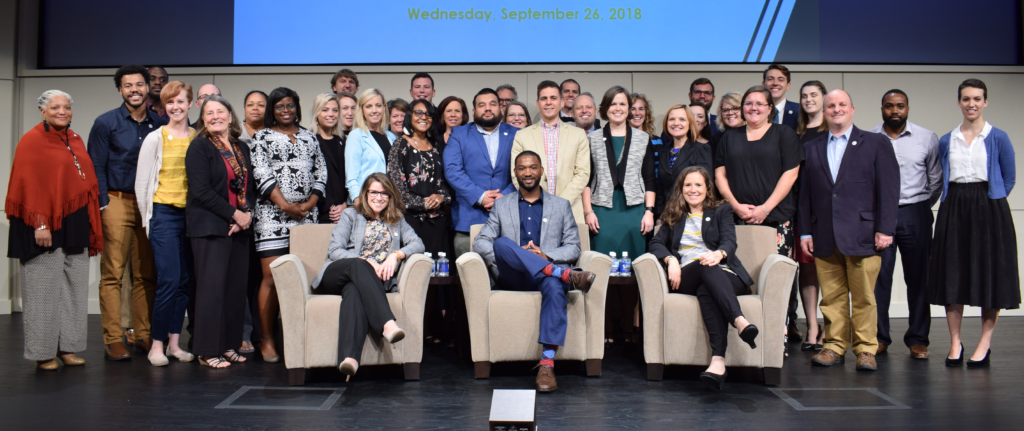
First in Freedom. First in Flight. Why shouldn’t North Carolina be First in Teaching, too? In 2018, more than 70 current and former educators from across North Carolina came together, sharing their stories, experiences, and ideas with the goal of elevating their profession. This group is known as the FIT Leaders. You can learn more about them here. Drawing from their diverse backgrounds and perspectives, they identified the qualities that embody what it means to be treated as a highly-skilled professional. The group also identified critical barriers that are preventing North Carolina from being First in Teaching (FIT). The culmination of their work, thus far, is the NC First in Teaching Roadmap, which highlights practical, actionable innovations to improve the teaching experience and allow educators to better serve their students. To learn more, download a copy of the FIT Roadmap and check out EdNC’s coverage of FIT Leader and Burroughs Wellcome Fund 2018 NC Teacher of the Year, Freebird McKinney!
BEST NC’s Response to Principal Preparation Consolidation (SB469)
We are grateful to the State of North Carolina for investing in two distinct, innovative principal preparation programs over the last four years. The timing is right to take the best practices from each of these outstanding programs and magnify their collective impact for the benefit of school leaders and the students they serve. Read our brief on the Transforming Principal Preparation Program here. Learn more about the NC Principal Fellows Program here. View Senate Bill 469 here.
Growth and Achievement in North Carolina

Growth and Achievement: you have probably heard these terms in conversations about education. But what are they? How do they differ, and what do they tell us about North Carolina’s students and teachers? Our new video “Growth and Achievement in North Carolina” explores some of these questions. Find out more at www.best-nc.org/growthandachievement.
Don Curtis Interview with Brenda Berg – Carolina Newsmakers
Classroom Teacher Allotments North Carolina Public Schools

Note: This blog post features a brief from page 22 of our 2018 Facts & Figures publication, contextualizing North Carolina education data with a short description of an historical feature or a critical issue in North Carolina. Read more at www.NCEdFacts.org. In North Carolina, the state allots teaching positions to each school district based on the number of students in each grade, according to specific ratios set by the General Assembly. The classroom teacher allotment is by far the largest single state allotment; salary and benefits for teaching positions represent approximately 55% of total state support for education. Over the past seven years, the state changed allotment ratios four times, generally decreasing student to teacher ratios in the lower grades, and increasing them in grades 4 through 12. Source: NC DPI Highlights of the Public School Budget In 2016, the General Assembly enacted legislation requiring actual average student to teacher ratios in grades K-3 not to exceed the allotment ratios starting in the 2018-19 academic year. This has sparked considerable debate, in part because for the first time since the development of the state’s Basic Educational Program, districts will be required to use the state’s full position allotment to fund classroom teachers. Currently, there is no separate allotment for elementary school art, music, physical education, and world language teachers.
North Carolina Teachers and State Employee Retirement System and Health Benefits

Note: This blog post features a brief from page 26 of our 2018 Facts & Figures publication, contextualizing North Carolina education data with a short description of an historical feature or a critical issue in North Carolina. Read more and find further information at www.NCEdFacts.org. All full-time employees in North Carolina public schools participate in the state’s Teachers and State Employees Retirement System (TSERS). TSERS provides qualifying employees a guaranteed salary and individual health benefits upon retirement from state government. In North Carolina, employees vest in TSERS after five years of service. Employees may retire with unreduced benefits after 30 years at any age, after 25 years of service at age 60 or older, or after five years at age 65 or older. Teachers contribute 6% of their pre-tax salary to TSERS, a rate that has been consistent since 1975. Nearly all states maintain a defined benefit (pension) plan for teachers and other state employees; in North Carolina and 29 other states, all teachers also participate in social security. TSERS is roughly comparable to the national median state plan and significantly more generous than the private sector average. Retiree health benefits in North Carolina are significantly more generous than the national median state plan and the private sector. Active state employee premiums for individual health care coverage are more generous than most other state plans and the private sector, but less generous than average for family plans. Source: North Carolina TSERS Handbook, NCGA Fiscal Research Division – Comparison of the Value of Employee Benefits