
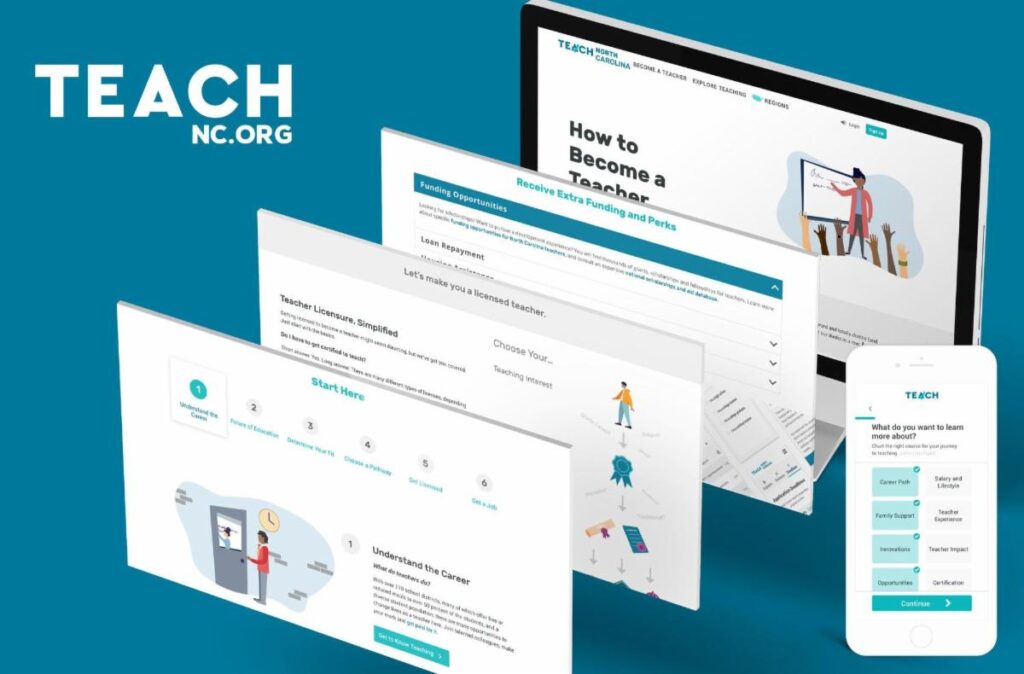
Announcing TeachNC: The One-Stop Resource for Becoming a Teacher in North Carolina We are thrilled to share that, for the first time ever, North Carolina has a unified, statewide teacher recruitment initiative that elevates the teaching profession and seeks to fill critical vacancies! At the August 14th meeting of the North Carolina Education Cabinet, education leaders and stakeholders gathered to celebrate the launch of TeachNC. Aligning with BEST NC’s longstanding commitment to improving the educator pipeline, we have collaborated with the North Carolina Department of Public Instruction and TEACH.org to create this statewide teacher recruitment initiative. TeachNC employs both a broad media campaign and a robust web platform to support teacher candidates in their quest to become a teacher in North Carolina. Members of the NC Education Cabinet stand in support of TeachNC. Why TeachNC? Every student deserves a quality education — that’s a given. What you might not know is that teacher quality is the #1 in-school factor for guaranteeing students’ long-term success. Since educators play a crucial role in the lives of our students, TeachNC is designed to inspire teaching candidates to pursue the career and remove barriers that stand in their way. The Audience The TeachNC initiative seeks to provide accurate and compelling information about the teaching profession that will be useful to both potential candidates and the general public. TeachNC targets students who are just beginning to think about their career options all the way to mid-career professionals who may be considering a career change. The Campaign TeachNC’s media campaign, “Teachers Have Better Work Stories,” highlights the ways in which teaching profession is challenging, fulfilling, and constantly evolving. These career qualities are particularly appealing to Millennials and Generation Z as they seek fulfilling professions. TeachNC’s first public service announcement can be viewed below. TeachNC will also be curating Better Work Stories from real North Carolina teachers. To view the stories collected so far, click here. If you are a teacher or know of one who should share their Better Work Story, please share it here. The Website TeachNC.org is an interactive digital recruitment platform that centralizes all of the information and resources needed to become a teacher: Licensure Understanding licensure is the first step to becoming a teacher. TeachNC outlines licensure requirements and pathways for all candidates, from beginning college students to mid-career professionals. Programs To help candidates choose an educator preparation program (EPP) that will qualify them for licensure, TeachNC provides a database of North Carolina’s EPPs, criteria to help candidates compare options, and advisors to provide 1-on-1 support. Affordability To help candidates understand affordability, TeachNC provides a finance guide with best practices, local and national scholarship listings, and cost-saving strategies. TeachNC also offsets candidates application costs through a $100 reimbursement scholarship. Applications Understanding licensure is the first step to becoming a teacher. TeachNC outlines licensure requirements and pathways for all candidates, from beginning college students to mid-career professionals. More to Come, and What YOU Can Do: Over the next months and years, TeachNC will continue to expand its resources with district landing pages and updated information as licensure requirements change. In the meantime, here is what you can do to help: If you know someone who is thinking about becoming a teacher, please share www.TeachNC.org and encourage them to register to get (free) resources. If you are a teacher and want to share your Better Work Story, take just a minute to film with your phone and upload it here. If you have any ideas or questions, reach out to the TeachNC Director, Princess Brown at Princess@TeachNC.org. TeachNC Partners TeachNC Funders
The State of Teaching

To Help New Teachers
[vc_row][vc_column width=”1/1″][vc_hidrop] Imagine this scene at a college career fair: As potential job seekers mill about, they notice one recruiting poster that stands out: “Come work in a hierarchical organization where your voice will be underappreciated, where you will have few opportunities for professional collaboration, and your career choices are essentially the same as they were 50 years ago!” The representative at this display begs the soon-to-be graduates to come to her table, saying, “Wait! You will be relentlessly evaluated by systems that don’t accurately measure your true worth, you will have long hours, and the pay is low!” Of course, I exaggerate. But not my much. The U.S. Department of Education’s Teacher Shortage Area reportfor 2015-16 highlights the fact that school districts across the country are having significant difficulty finding and keeping new teachers. And while much has been written about why we are not able to find enough qualified people to teach our next generation of citizens and leaders, we seem destined to continue down a path towards what is truly a national crisis. In addition to the examples I alluded to in my imaginary example above, the reality of inconsistent administrative support, excessive paperwork, pressures of state testing, and inadequate funding are obviously having a major impact on our ability to attract and retain new teachers. Over the past year, I have had the privilege of participating in a number of initiatives that are taking a much needed look at this chronic problem, both for my state of North Carolina, as well as on a national level. This includes working with a team from the Center for Teaching Qualityon recommendations about alternatives to my state’s compensation model, using my role as a TeachStrong Ambassador to highlight ways to modernize and elevate the teaching profession, and most recently, participating in an Innovation Lab hosted by BEST NC, where education stakeholders from across the country were asked to reimagine the PK-12 teacher pipeline. While each of these initiatives was different in overall scope and detail, one overarching outcome was striking: We will never attract and retain enough high quality teachers by simply relying on outdated models that are misaligned with the expectations of the Millennial generation, especially as we move to a gigeconomy. Individuals with the capacity and skill to be highly effective teachers will readily choose to enter and then stay in this profession when they are not only paid a competitive wage, but when they are valued for what they bring to the table from day one; when they have ready access to formal and informal leadership opportunities through which they can take advantage of incentives to foster peer-collaboration and shared expertise; and when there exists a culture of empowerment to drive innovation and creativity throughout every classroom in every school. These are the characteristics of any highly successful organization and it’s well past the time that we should expect them to be embedded in the DNA of every school in this country. Call me naive, but I firmly believe that if we can boldly move away from the top-down models that were designed for a different era and embrace what has been proven to work dynamic organizations both in and out of education, then we will indeed begin bringing more new teachers into a profession that so desperately needs them. It would put a whole new twist on my hypothetical career fair. Sign me up! Ben Owens spent 20 years as an engineer in industry before becoming a math and physics teacher at Tri- County Early College High School in the Murphy, N.C. He is the 2016 North Carolina Science Technology & Mathematics Center’s 9-16 Outstanding Educator, a 2014 Hope Street Group National Teacher Fellow, TeachStrong Ambassador, a Virtual Community Organizer for the Center for Teaching Quality, and a member of the Bill & Melinda Gates Foundation Teacher Advisory Council. Click here to view To Help New Teachers PDF [/vc_hidrop][/vc_column][/vc_row]
Teacher Raises and more under negotiation
[vc_row][vc_column][/vc_column][/vc_row][vc_row][vc_column width=”1/1″][vc_hidrop] BY LYNN BONNER lbonner@newsobserver.com As state House and Senate negotiators prepare to work out a final budget, a lot of attention will be focused on the size of pay raises for teachers. Teacher raises turned into a major sticking point two years ago when the Senate voted for bigger raises than the House. This year, the House proposes average teacher raises of 4.1 percent. The Senate plan would raise teacher salaries an average of 6.5 percent. There’s more going on under the hood beyond the raw numbers. The Senate plan also departs from a change made two years ago when the legislature compressed the teacher salary schedule – creating broad tiers. Under the current system, teachers with 14 years experience make as much as teachers with nine, and teachers with 19 years experience make as much as those with Senate plan goes back to giving teachers more for each year they work, from the third year to the 15th year. At 15 years experience, the Senate pay schedule returns to salary tiers. Gov. Pat McCrory’s proposed salary schedule also would revert to yearly raises for most teachers. His education adviser told the State Board of Education that teachers didn’t like the new tier structure. Although House and Senate plans are different, they both give bigger percentage raises to mid- career teachers. The pay plans shortchange teachers with the most experience, said Mark Jewell, vice president of the N.C. Association of Educators. “Clearly, we are pleased the General Assembly has heard us beat the drum of the teacher shortage crisis and teacher compensation,” Jewell said. “When you look at this, it still falls short for those with the most experience,” he said. Teacher pay reliably appears as a campaign issue every two years. Even with an increase, teachers have plenty of issues to worry about, Jewell said. Schools don’t have enough textbooks, making it hard for parents to help with homework, he said. Teachers who don’t already have advanced degrees won’t get pay bumps for earning them, as they used to, and legislators want to expand the school voucher program. “They see what’s going on, and they don’t like it,” Jewell said. “I don’t think they’re going to be fooled with an election-year ploy like this.” General Roy Cooper in the governor’s race and Democrats in four Council of State races. But Dallas Woodhouse, executive director of the state Republican Party, said pay raises will help GOP candidates going into election season. He described the increases as a result of Republican policies. “The policy of properly compensating teachers is now possible because of the strong economic policies that have turned North Carolina’s economic fortunes around by getting people off unemployment and getting people back to work,” Woodhouse said in a statement. “Teachers and state employees will not only benefit from higher pay but from the broad based middle class tax relief that has made North Carolina’s economic recovery an envy of thesouth.” Plenty of education issues are in the mix for budget negotiations. The House and Senate take different approaches to promoting early childhood literacy, increasing the supply of teachers, and principal training. On literacy The House halts a plan to hire more teachers to reduce first-grade class sizes, which would have cost about $27 million. Instead, the House spends $25 million on literacy coaches for elementary schools in the bottom fifth in performance. The House budget also cuts $10 million from summer reading camps for first- and second-graders who aren’t reading at grade level. The Senate keeps the $27 million for the additional first-grade teachers and adds another $27 million to hire more second-grade teachers to reduce class sizes by one student. The budget has $10 million to pay for a pilot program giving bonuses to top third-grade reading teachers. The legislature has focused on elementary school reading for the past four years. A law called Read to Achieve requires most students read proficiently by the end of third grade or risk retention. These different approaches offer an opportunity for legislators to talk about “which elements are going to affect third-grade literacy the most,” said Brenda Berg, president and CEO of BEST NC, a business group focused on education. Teacher pipeline Enrollment at UNC schools of education has dropped 30 percent in the last five years. Local districts say their problems with teacher recruitment extend from high school math and science down to elementary schools. The House budget includes a $2 million merit scholarship program for college students studying to become teachers in subjects such as math or science, or who plan to work in hard- to-staff schools. The Senate budget has $112,500 to reimburse 25 teacher assistants in five counties studying to become teachers. They would receive up to $4,500 a year. The budget also includes a plan for five lateral entry teacher preparation programs local school boards would administer. Principal preparation The House budget provides an additional $7.5 million to the program for school-leadership development, bringing the total to $8.5 million. The Senate eliminates that program, but would establish lab schools at UNC-system schools that have teacher training programs. The intent is to improve student achievement in districts with low-performing schools, and to provide teacher and principal training in those districts. The budget has $1 million in startup funds. STAFF WRITER COLIN CAMPBELL CONTRIBUTED Lynn Bonner: 919-829-4821, @Lynn_Bonner Click here to view Teacher raises and more under negotiation PDF [/vc_hidrop][/vc_column][/vc_row]
‘- Facts vs-facts in education debate
[vc_row][vc_column width=”1/1″][vc_hidrop] Facts vs. facts in education debate by Ferrel Guillory | February 26, 2016 Keith Poston and James Ford of the Public Schools Forum of NC. Photo Credit: Alex Granados/EdNC To provide more in-depth coverage on schools in North Carolina, EdNC will shortly launch the EdData Dashboard. Our editor, Mebane Rash, and her staff have produced a handsome, easy-to-use, and substantive “dashboard’’ that they will up-date quarterly. We trust you will find the data charts, graphs, and packages informative, enriching your perspectives on education in our state. We welcome your comments and suggestions. I often repeat the time-honored wisdom that “data without analysis is junk.” Yes, we have to put the facts down. But we also have to array facts, connect dots, and examine time lines to make the facts mean something by which to drive action. This week’s column examines the challenge of dealing with data. Elections call upon voters to compare and contrast candidates in terms of personality, policy, and partisanship, as well as ability, priorities, and values. As the education issues play out in campaign 2016 in North Carolina, voters will encounter another dimension of debate: facts fighting facts. What’s an engaged citizen to do as candidates, parties, think tanks, and advocacy groups offer an array of facts, all objectively accurate but telling conflicting stories and leading to clashing conclusions about North Carolina and its schools? There’s no easy answer, except to weigh the competing facts and assess which set of statistics offer a story that adds up to reality. Already, Gov. Pat McCrory and Lt. Gov. Dan Forest, the Republican incumbents seeking re-election, have spelled out a long list of facts in explanation and defense of the GOP record since gaining control of the governorship and the General Assembly by a veto-proof majority in 2012. The governor’s list appears under the “record of success’’ section of his campaign’s website. Forest, who as lieutenant governor serves on the State Board of Education, has emerged as a more aggressive, and charismatic, champion of the Republican message on schools. A few days ago, he stepped before the combined Wake County Republican precinct caucuses and sought to arm party activists with data-points to counter “misinformation (that) Republicans are decimating education.” Forest also has posted three education-oriented videos, one entitled “education fast facts,’’ on his campaign website and YouTube. Both the governor and lieutenant governor draw a contrast between the education budgets under former Democratic Gov. Bev Perdue and under Republicans since 2012. McCrory points to spending reductions of “almost $1 billion between 2008 and 2011.” Forest says Republicans have put “$1.5 billion back into education,” thus spending “more than ever in the history of North Carolina.” As you consider those facts do so in the context of the Great Recession of 2008-09 that produced a drastic upward spike in unemployment and a downward spike in state revenues. Whoever, Democrats or Republicans, ruled in Raleigh between 2009 and 2012 would have had to slash state spending or raise taxes or both, to produce a balanced budget as the iron-clad law provides. As the economy recovered over the past three years, Republicans have appropriated more in total dollars to K-12 education. Independent analysts and advocacy groups, some of which are critics of the current administration, offer other facts. Some draw on data from before the Great Recession. Others focus on growth in enrollment. For example, a recent report by the nonpartisan Public School Forum of North Carolina presents a state-by-state chart showing that North Carolina’s per pupil spending, adjusted for inflation, declined by $855 from fiscal 2008 to 2015, the sixth largest decline among states. The 2016 Facts and Figures publication by BEST NC, a nonprofit formed by business leaders, reports that “North Carolina ranked 46th in the country in total K-12 per-pupil spending in 2014-15 in constant dollars, but 39th in cost of living adjusted dollars.” The McCrory campaign website says that “in 2014 the average salary for teachers in North Carolina increased more than any other state in the nation.” A Forest video says the state’s previous leadership had “frozen’’ teacher pay for years, then Republicans raised teacher pay an average of 11 percent. The legislature’s website has a chart of pay raises for teachers and state employees going back to 1973-74: It shows substantial teacher pay raises before the Great Recession. Teacher pay raises averaged 8.2 percent, 5 percent, and 3 percent in the last three years of Democratic Gov. Mike Easley’s administration. Then came no pay raise for three consecutive fiscal years – “frozen’’ from 2009 to 2012 – budgets hard hit by the recession. Teachers received a 1.2 percent raise in 2012-13 and then, as the legislative staff calculated, raises ranging from .5 percent to 18.5 percent (a 7 percent average) in 2014-15. Republican legislators have targeted raises on early-career teachers, while also revising the career “step-increase’’ pay system. The most recent pay legislation gave some experienced teachers a step increase, again increased new teachers’ pay and provided a one-time $750 raise across the board. The BEST NC report has a chart comparing North Carolina teacher compensation to the national average. In 2001, the North Carolina average was $41,496, just below the national average of $43,378. The gap widened to more than $10,000 by 2014. The latest pay raise brings North Carolina up to about $50,000, still below the national average. The Public School Forum reports that North Carolina ranks 42nd among the states in teacher pay, up from 47th a year earlier. In his talk to Wake Republicans, Forest declared, “Teachers are not leaving North Carolina in droves; how many of you know that?” In one of his videos, the lieutenant governor deconstructs a state report on teacher turnover to make the point that 6.8 percent of teachers fully left the profession last year, well below the 14.9 percent turnover rate widely reported. Only one percent has gone to other states, he said. […]