
BEST NC Releases Comprehensive Teacher Pay Report
BEST NC Releases Comprehensive Teacher Pay Report In 2023, BEST NC released a new report on teacher pay entitled Teacher Pay in North Carolina: A Smart Investment in Student Achievement. The BEST NC team, along with leading economists and experts from across the country examined the complex issue of teacher pay. In our analysis, we uncovered important new evidence that the existing teacher pay structures in North Carolina, and across the country, fail to address dramatic decades-long shifts in our national workforce and are inadequate for meeting the personal and professional needs of today’s teachers. This teacher pay report offers specific, actionable recommendations for both an increased and transformed teacher salary structure that can help retain exceptional educators and attract the next generation of top-tier talent into North Carolina public schools. You can access the full report and the executive summary here. Below is an overview of the report. This is the first in a series of blogs that will highlight key concepts and recommendations from the report. Background: Why Professional Compensation Matters Research has consistently found that teacher quality is the most important in-school factor for student success, with high-performing teachers producing significantly higher achievement gains than low-performing teachers. Given this reality, it is essential for teacher compensation to attract highly qualified candidates into the profession and to support continued professional growth throughout their career in the classroom. In his NYT best-selling book Drive: The Surprising Truth About What Motivates Us, Daniel Pink contends that professional compensation is fundamentally important to fulfill an individual’s biological need to support oneself and one’s family (compensation must be adequate), and individuals must feel that they are fairly paid for the skills they hold and the work they do (compensation must be equitable). The Teacher Pay in North Carolina report considers Pink’s framing of professional compensation, compared to the current, 100-year-old teacher step-and-lane pay structure that is used in North Carolina and across the country. Through this lens, the report finds that our teacher pay and retention practices are outdated and fail to recruit and retain the top-tier candidates our students deserve. Beyond baseline requirements of adequacy and equitability, Pink finds that high-skilled professionals are motivated to perform at their best when their jobs present the opportunity for mastery, autonomy, and purpose. Current teacher pay practices and organizational structures, in stark contrast, encourage a “one-teacher, one classroom” approach that stifles growth and leaves high-performing teachers with few opportunities for professional advancement. Five Key Challenges of Current Teacher Compensation Models An exploration of research on best practices in teacher compensation revealed five major challenges, each of which is examined closely in the Teacher Pay in North Carolina report. Challenge 1: Teaching is a Mostly Female Workforce, Yet Teacher Pay Has Not Kept Up with Increasing Opportunities and Pay for Female, College-Educated Professionals. Nationally, between 1985 and 2021, median income for women with a bachelor’s degree grew by 22% when adjusted for inflation, compared to just 10% for teachers. Earnings for college-educated women have now eclipsed earnings for teachers. Women still comprise the majority of the teaching workforce, but, as women have more professional opportunities than ever before, teaching is arguably less attractive now than ever before for top-tier female candidates. v Challenge 2: Under the Existing Salary Schedule, North Carolina Teachers Must Wait Far Too Long Before Their Salaries Provide a Living Wage that Can Support a Family. Outside of retirement, teacher attrition is highest in the first five years of a teacher’s career. These years coincide with the time that teachers are starting to build their families. At this crucial juncture, the traditional step-and-lane schedule does not provide a living wage that allows teachers to support a family. The Teacher Pay in North Carolina report uses the Living Wage Calculator from the Massachusetts Institute of Technology, which leverages geographically specific data on living expenses (e.g. housing, health insurance, food, childcare), to estimate that nearly one-third of North Carolina teachers earned less than a living wage for a family of four in 2021-22. Even when compared to other public sector employees in our state, teachers earn less and take much longer to reach the top of the base salary schedule. Challenge 3: The Traditional Teacher Compensation Model Does Not Provide Meaningful Professional Promotions that Attract Top Talent and Keep Effective Educators in the Classroom. Research has demonstrated that the traditional step-and-lane salary schedule limits overall earning potential and discourages high-aptitude individuals from pursuing a teaching career. Reinforcing this notion, a report issued by McKinsey in 2010 revealed that 87% of top-tier candidates indicate that their preferred occupation provides opportunities to advance, compared to just 45% who believe teaching will provide similar advancement opportunities. The same report noted that nations that perform at the top on international assessments recruit 100% of teachers from students in the top-third of their class. In the United States it is 23%, and only 14% for teachers in higher poverty schools. Advanced Teaching Roles provide one pathway for highly effective educators to advance professionally as they take on greater responsibility and leadership. Currently, approximately 1,000 North Carolina teachers are working in advanced roles, earning up to $20,000 in additional pay. However, with just 21% of districts currently participating, there is significant room for growth. Challenge 4: Existing Pay Structures are not Designed to Fill Hard-to-Staff Subject Area Positions and Schools, Leading to Persistent, Critical Vacancies and Disparities in Student Access to Effective Educators. Like most states, teacher staffing inequities in North Carolina are driven, in part, by the structure of the state teacher salary schedule, which requires that teacher base pay is the same for equivalently experienced teachers, regardless of what, where, or how well a teacher teaches. In high-demand fields like STEM subjects, average teacher pay significantly trails average wages for recent UNC System graduates for those majors. These subject areas also see markedly higher teacher vacancy rates. Additionally, there are tremendous disparities in student access to highly qualified teachers […]
Spotlight On: Advanced Teaching Roles Initiative
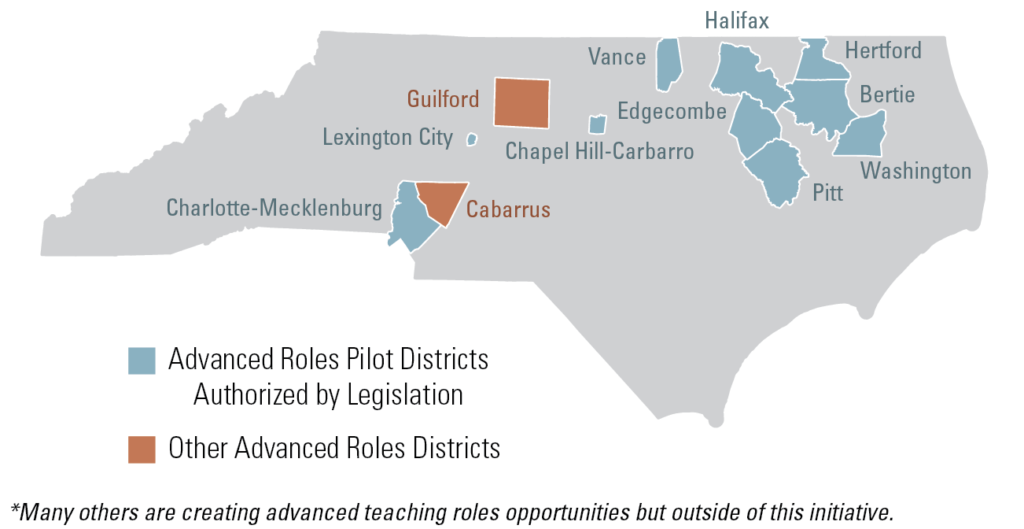
Spotlight On: Advanced Teaching Roles Initiative In 2016, North Carolina created the Advanced Teaching Roles Initiative. This legislation establishes a school leadership re-design model that empowers districts and educators to design new teaching roles that provide advancement opportunities, improved professional development, and greater support for student achievement. Advanced Teaching Roles enables highly-effective teachers to advance their careers, extend their positive impact on student achievement, and increase their compensation. The best part: they get to stay in the classroom! In effective models, developing teachers also benefit by having access to real-time professional development, relieving some of the pressures of principals who are traditionally the primary source of instructional leadership in the school. Today, ten districts are taking part in the Advanced Roles Initiative. Success by Design Program Created in 2013 and inspired by lessons learned from the Opportunity Culture model in Project LIFT schools, Success by Design is an official Advanced Roles program in Charlotte-Mecklenburg Schools (CMS). This approach is being phased in strategically over time. During the 2018-19 school year, Success by Design was implemented in 50 schools. Success by Design advanced roles teachers can earn up to $20,000 on top of their base salary, while increasing their impact on student achievement. Early results from the CMS program suggest that this model helps the district recruit and retain top talent, resulting in significant student achievement gains. During the 2017-18 school year, 58% of Success by Design schools exceeded growth, compared with 27% of all schools statewide. Also, a recent study published by the CALDER Center finds that students’ academic gains increased when taught by advanced roles teachers, with significant achievement gains in math. For more information visit www.BEST-NC.org/advancedroles.
Don Curtis Interview with Brenda Berg – Carolina Newsmakers
Shamrock Gardens Elementary School: A Blueprint for Educator Innovation
May 2017, By Brenda Berg, CEO, BEST NC. For several years, a primary focus of BEST NC’s student-focused advocacy work has been around the importance of having strong, well-supported educators in every classroom from; pre-K to higher education. Without great educators, anything else we advocate for is unlikely to work. That’s why we developed our primary advocacy priority, which we call Educator Innovation.
Don Flow: North Carolina should invest in principals- The Winston-Salem Journal

Over the past few years, North Carolina teachers have seen significant pay increases. Signals from Gov. Roy Cooper and last week’s Senate budget proposal indicate that the next few years will see even more increases. This commitment by our legislative leaders is extremely important for the future of our state. The growth of our state is directly tied to the educational outcomes of our students.
Don Flow: Time to Pay School Principals as Executives – Triangle Business Journal

Over the past few years, North Carolina teachers have seen significant pay increases. Signals from Gov. Roy Coo per and last wee k ‘s Senate budget proposal indicate that the next few years will see even more increases. This commitment by our legislative leaders is extremely important for the future of our state.
Don Flow: Paying School Principals as Executives- The Herald-Sun

Over the past few years, North Carolina teachers have seen significant pay increases. Signals from Gov. Roy Cooper and this month’s Senate budget proposal indicate that the next few years will see even more increases. This commitment by our legislative leaders is extremely important for the future of our state. The growth of our state is directly tied to the educational outcomes of our students.
The State of Teaching

Fact Check: Does average NC teacher really make $50,000
[vc_row][vc_column width=”1/1″][vc_hidrop] By Mark Binker RALEIGH, N.C. — No single claim has been used more often by more candidates this election season, or been more often questioned by critics and our readers, than the assertion that the average public school teacher in North Carolina will make $50,000 during the current school year. $50,000,” Republican Gov. Pat McCrory says in one of his most recent televisionads. The Carolina Partnership for Reform, a 501(c)(4) nonprofit group that backs Republicans such as Wake County Sens. Tamara Barringer, Chad Barefoot and JohnAlexander, says, “Now, for the first time, our teachers make over $50,000 a year.” Meanwhile, Democrats such as Attorney General Roy Cooper, who is running against McCrory, air spots and send direct mail decrying the state’s lack of teacher funding. THE QUESTION: Will the average North Carolina teacher make $50,000 in the upcoming year? SUMMARY JUDGMENT: That claim doesn’t appear to be a lie or purposeful exaggeration, but it doesn’t get a green light on our fact-checking scalefor two broad reasons. The first is purely a math question. For reasons outlined below, it’s impossible to say definitively whether average teacher pay will actually top $50,000 for the coming school year, according to both state government sources and outside analysts. But even if one assumes lawmakers hit their mark, teacher pay is complex, and the situation varies among the state’s 115 school districts. Just because the average teacher in North Carolina might make $50,000 doesn’t mean your child’s teacher will or that the average teacher in your local school system does. Boiling teacher pay down to one number papers over those important differences. ABOUT THE AVERAGE: The first thing to note about the average McCrory and other Republicans are putting forward is that it is based in part on rankings and methodology by the National EducationAssociation, which bills itself as “the nation’s largest professional employee organization” and is viewed as more sympathetic to Democrats than the GOP. Using the NEA’s methodology, North Carolina’s Department of Public Instruction says average teacher salary was $47,931 in the 2015-16school year. Officials with the department say they won’t be able to calculate an estimated average for the current school year until at least December, when school districts will report a host of data to the state. Certainly, lawmakers have reason to think the average teacher salary will cross the $50,000 mark this year, as they outlined in their budget andrelated announcementsthat touted big raises. But not all teachers, especially those who have been in the profession the longest, will benefit from this year’s round of salary increases. On its website, Carolina Partnership for Reform pegs average teachersalary at a very specific $50,150per year. That number appears to come from the state budget, which says the “expected average salary for educators from all fund sources” will reach over $50,150 in 2016-17. That number is a projection and not a guarantee. Also, there is slight variation between the budget passed by lawmakers and how the administration talks about it. The Office of State Budget and Management says average teacher salaries will be “in excess of $50,000,” rather than $50,150, in its fact sheet on the budget. “We are very confident that teacher pay will get to $50k, taking into account both the teacher universe and teacher turnover,” Andrew Heath, McCrory’s budget director, said in an email. Outside experts suggest the claim is at least close to accurate. “We got pretty darned close to $50,000 when we did the math,” said Brenda Berg, executive director of BEST NC, an education advocacy group backed by large businesses in the state. Although her group’s estimates fell just shy of $50,000, BEST NC’s analyst also cautioned that it wasn’t prudent to make a firm projection until school districts report more information about their workforce, including teacher turnover. TURNOVER: Teacher turnover is an important factor because more experienced teachers make more money. If more senior teachers leave the profession, it will drag down the average salary. As WRAL News reported earlier this year, teacher turnover was close to 15 percent statewide last year. Kris Nordstrom of the liberal North Carolina Justice Center’s Educationand Law Projectand a fact check for WFDD-FM have posited that hitting the pay benchmarks outlined by lawmakers would require zero, or at least very little, teacher turnover. Heath, in an email, said that his office took turnover into account. However, fiscal analysts with the state legislature use a methodology that assumes no turnover, something they’ve done for the past decade or more. The uncertainty brought about by turnover is one big reason the Department of Public Instruction is unable to verify the $50,000 average. SUPPLEMENTS: Whether the average teacher salary turns out to be just over or under $50,000, it wouldn’t be close to that number without help from local taxpayers. In order to compile national figures that can be compared state-to-state, the NEA methodology figure lumps salary paid by the state together with local salary contributions. “You have to do that,” Berg said. “Most other states mainly fund salaries at the local level.” The reason this is an important is obvious to anyone looking at the statewide salary schedule for teachers. For the coming school year, teachers with a bachelor’s degree and no other certification will earn $35,000 per year. Without additional national board certifications or other salary boosters, teachers on the state salary schedule won’t earn more than $50,000 until their 25th year in the profession. That’s where local supplements come in. Chapel Hill-Carrboro City Schools, for example, supplements base payby 16 percent in a teacher’s first 19 yearsand pays a 25 percent supplement to those who have been in the profession 25 years or more. In Wake County, a first-year teacher with a bachelor’s degree earned $41,037.50 last year and, even before the last round of pay raises kickedin, would crest the $50,000 mark in his or her 15th year of teaching. That means there’s a big difference in what teachers in relatively large and wealthy school districts earn and what those in […]
NC teachers see broad raises, more bonus chances
[vc_row opacity=”1.00″ padding_top=”0px” padding_bottom=”0px” padding_left=”0px” padding_right=”0px” margin_bottom=”0px” bg_type=”theme_default” bg_grad=”background: -webkit-gradient(linear, left top, left bottom, color-stop(0%, #FBFBFB), color-stop(50%, #E3E3E3), color-stop(100%, #C2C2C2));background: -moz-linear-gradient(top,#FBFBFB 0%,#E3E3E3 50%,#C2C2C2 100%);background: -webkit-linear-gradient(top,#FBFBFB 0%,#E3E3E3 50%,#C2C2C2 100%);background: -o-linear-gradient(top,#FBFBFB 0%,#E3E3E3 50%,#C2C2C2 100%);background: -ms-linear-gradient(top,#FBFBFB 0%,#E3E3E3 50%,#C2C2C2 100%);background: linear-gradient(top,#FBFBFB 0%,#E3E3E3 50%,#C2C2C2 100%);” parallax_style=”vcpb-default” bg_image_repeat=”no-repeat” bg_image_size=”cover” bg_img_attach=”fixed” parallax_sense=”30″ bg_override=”0″][vc_column width=”1/1″][vc_hidrop] RALEIGH, N.C. (AP) – The North Carolina legislature agreed on broad pay raises for public school teachers for the second time since 2014 and is aiming to jump-start again giving instructors even more when they take on additional responsibilities or their students make academic progress. The $22.3 billion budget on Gov. Pat McCrory’s desk for his expected signature purports to increase state-funded teacher and instructional staff salaries on average by 4.7 percent this fall. Budget-writers predict the adjustments will bring average salaries – when local supplements are added – above $50,000 statewide. The budget approved July 1 also directs bonuses to follow in January for many. Teachers would receive $25 or $50 for each student they taught who scored high this past year on Advanced Placement, International Baccalaureate and technical certification tests, capped at $2,000.Andthird-gradeteachers whose students showed the best growth in reading skills could receive as much as$6,800. Both programs last two years. There also will be a three-year performance-pay program starting in fall 2017 in which 10 districts will be picked to offer teachers salary supplements of up to 30 percent. Similar ideas have been floated or experimented with over the past 30 years. A former statewide bonus program ended due to lack of funds and questions about effectiveness. “We put a heavy emphasis in this budget on training the teachers, offering teachers opportunities to grow, not just because they can earn more money but so they can take on more responsibility,” said Rep. Craig Horn, R-Union, an education budget-writer. Teachers getting raises would see increases from about 2 percent to 13 percent, depending on where they sat on the salary schedule last year. For example, a 10-year teacher making a base salary of $40,000 will make $41,000 this fall. A 19-year teacher making $43,500 will earn $48,000. Up to 2,700 of the 92,000 instructors funded by the state wouldn’t see any raise, according to the Department of Public Instruction. These teachers have worked at least 32 years in the schools and have been paid at rates separate from the salary schedule since 2014, when the schedule got consolidated. These teachers already make more than the schedule’s top rung of 25 years, increasing this fall from $50,000 to $51,000. Still, critics of Republican education policy are emphasizing how some teachers are being left out. “Again, experienced teachers in North Carolina get shortchanged,” North Carolina Association of Educators President Mark Jewell said. Attorney General Roy Cooper, who is running against McCrory this November, and other Democrats argue additional money for public school salaries and supplies instead are being rerouted to corporate tax cuts and for scholarships for more K-12 students to attend private schools. But Republicans say public education spending is at an all- time high and teacher pay is rebounding after the Great “This budget keeps our promises to support our public schools and raise teacher pay above $50,000,” Senate leader Phil Berger said in a release. The pay proposal likely will increase North Carolina’s average pay ranking in the South from ninth out of 12 states to seventh, according to the Public School Forum of North Carolina. This past year North Carolina was ranked 41st nationally at $47,985, according to the National Education Association. “Until we adopt a plan that brings our teachers to the national average in salaries, we’re going to continue hemorrhaging teachers to whoever the competition might be,” Senate Minority Leader Dan Blue, D-Wake. “It takes more than just keeping a campaign promise.” A budget provision says the Legislature wants a salary schedule in fall 2018 that will reduce the number of years teachers work to meet or exceed a $50,000 base salary from 25 years to 15 years. The schedule would still be capped at $51,000. Brenda Berg, president of BEST NC, a business-oriented education advocacy group, said the move toward paying higher salaries sooner reinforces the need for putting performance-based programs in place now to boost their earnings potential. “We need to give them a lot of real big opportunities to make more money,” said Berg. Click here to view N Carolina teachers see broad raises, more bonus chances PDF [/vc_hidrop][/vc_column][/vc_row]