
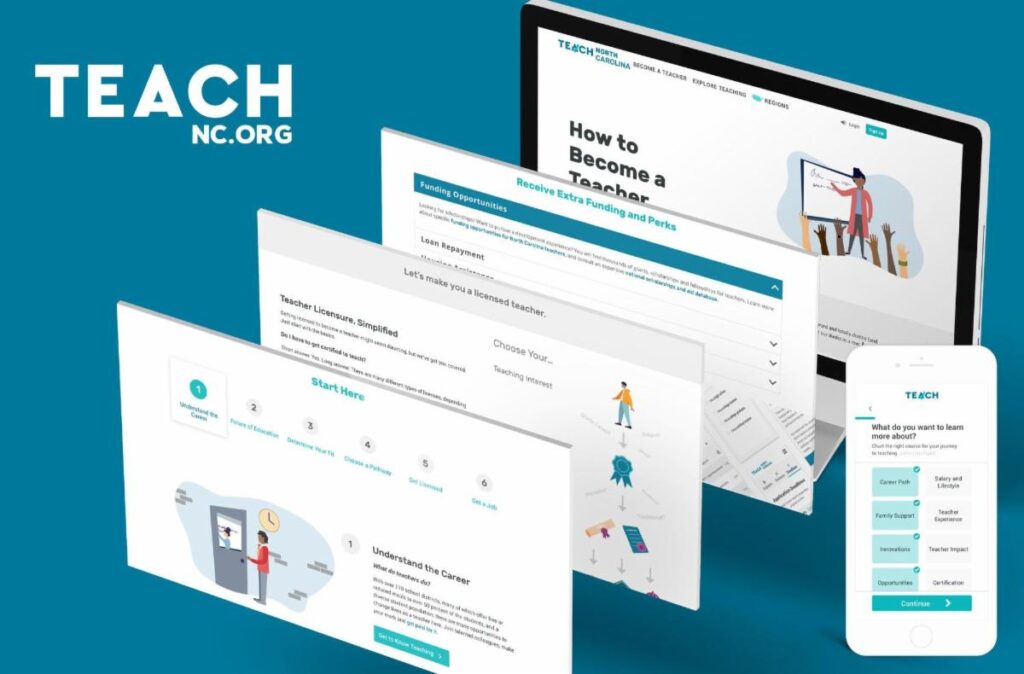
Announcing TeachNC: The One-Stop Resource for Becoming a Teacher in North Carolina We are thrilled to share that, for the first time ever, North Carolina has a unified, statewide teacher recruitment initiative that elevates the teaching profession and seeks to fill critical vacancies! At the August 14th meeting of the North Carolina Education Cabinet, education leaders and stakeholders gathered to celebrate the launch of TeachNC. Aligning with BEST NC’s longstanding commitment to improving the educator pipeline, we have collaborated with the North Carolina Department of Public Instruction and TEACH.org to create this statewide teacher recruitment initiative. TeachNC employs both a broad media campaign and a robust web platform to support teacher candidates in their quest to become a teacher in North Carolina. Members of the NC Education Cabinet stand in support of TeachNC. Why TeachNC? Every student deserves a quality education — that’s a given. What you might not know is that teacher quality is the #1 in-school factor for guaranteeing students’ long-term success. Since educators play a crucial role in the lives of our students, TeachNC is designed to inspire teaching candidates to pursue the career and remove barriers that stand in their way. The Audience The TeachNC initiative seeks to provide accurate and compelling information about the teaching profession that will be useful to both potential candidates and the general public. TeachNC targets students who are just beginning to think about their career options all the way to mid-career professionals who may be considering a career change. The Campaign TeachNC’s media campaign, “Teachers Have Better Work Stories,” highlights the ways in which teaching profession is challenging, fulfilling, and constantly evolving. These career qualities are particularly appealing to Millennials and Generation Z as they seek fulfilling professions. TeachNC’s first public service announcement can be viewed below. TeachNC will also be curating Better Work Stories from real North Carolina teachers. To view the stories collected so far, click here. If you are a teacher or know of one who should share their Better Work Story, please share it here. The Website TeachNC.org is an interactive digital recruitment platform that centralizes all of the information and resources needed to become a teacher: Licensure Understanding licensure is the first step to becoming a teacher. TeachNC outlines licensure requirements and pathways for all candidates, from beginning college students to mid-career professionals. Programs To help candidates choose an educator preparation program (EPP) that will qualify them for licensure, TeachNC provides a database of North Carolina’s EPPs, criteria to help candidates compare options, and advisors to provide 1-on-1 support. Affordability To help candidates understand affordability, TeachNC provides a finance guide with best practices, local and national scholarship listings, and cost-saving strategies. TeachNC also offsets candidates application costs through a $100 reimbursement scholarship. Applications Understanding licensure is the first step to becoming a teacher. TeachNC outlines licensure requirements and pathways for all candidates, from beginning college students to mid-career professionals. More to Come, and What YOU Can Do: Over the next months and years, TeachNC will continue to expand its resources with district landing pages and updated information as licensure requirements change. In the meantime, here is what you can do to help: If you know someone who is thinking about becoming a teacher, please share www.TeachNC.org and encourage them to register to get (free) resources. If you are a teacher and want to share your Better Work Story, take just a minute to film with your phone and upload it here. If you have any ideas or questions, reach out to the TeachNC Director, Princess Brown at Princess@TeachNC.org. TeachNC Partners TeachNC Funders
Spotlight On: Advanced Teaching Roles Initiative
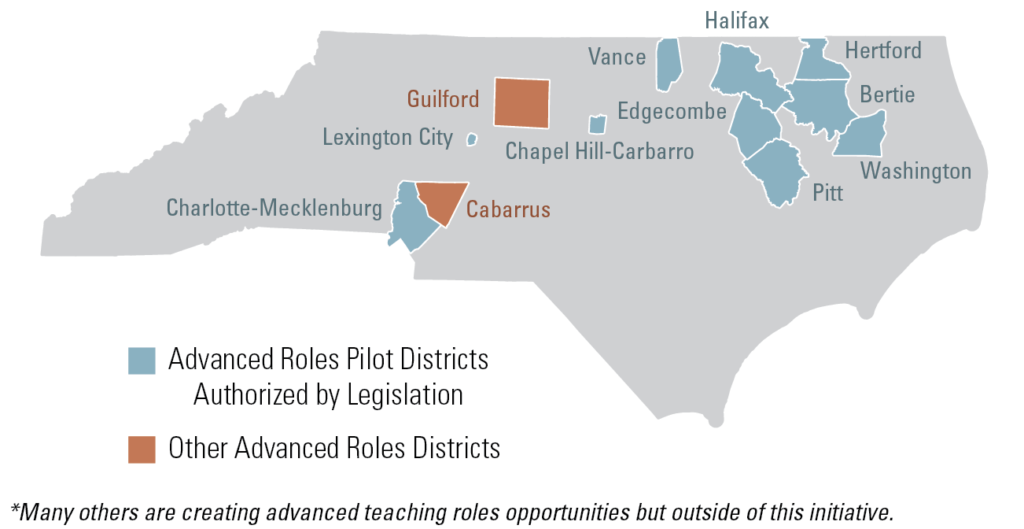
Spotlight On: Advanced Teaching Roles Initiative In 2016, North Carolina created the Advanced Teaching Roles Initiative. This legislation establishes a school leadership re-design model that empowers districts and educators to design new teaching roles that provide advancement opportunities, improved professional development, and greater support for student achievement. Advanced Teaching Roles enables highly-effective teachers to advance their careers, extend their positive impact on student achievement, and increase their compensation. The best part: they get to stay in the classroom! In effective models, developing teachers also benefit by having access to real-time professional development, relieving some of the pressures of principals who are traditionally the primary source of instructional leadership in the school. Today, ten districts are taking part in the Advanced Roles Initiative. Success by Design Program Created in 2013 and inspired by lessons learned from the Opportunity Culture model in Project LIFT schools, Success by Design is an official Advanced Roles program in Charlotte-Mecklenburg Schools (CMS). This approach is being phased in strategically over time. During the 2018-19 school year, Success by Design was implemented in 50 schools. Success by Design advanced roles teachers can earn up to $20,000 on top of their base salary, while increasing their impact on student achievement. Early results from the CMS program suggest that this model helps the district recruit and retain top talent, resulting in significant student achievement gains. During the 2017-18 school year, 58% of Success by Design schools exceeded growth, compared with 27% of all schools statewide. Also, a recent study published by the CALDER Center finds that students’ academic gains increased when taught by advanced roles teachers, with significant achievement gains in math. For more information visit www.BEST-NC.org/advancedroles.
Classroom Teacher Allotments North Carolina Public Schools

Note: This blog post features a brief from page 22 of our 2018 Facts & Figures publication, contextualizing North Carolina education data with a short description of an historical feature or a critical issue in North Carolina. Read more at www.NCEdFacts.org. In North Carolina, the state allots teaching positions to each school district based on the number of students in each grade, according to specific ratios set by the General Assembly. The classroom teacher allotment is by far the largest single state allotment; salary and benefits for teaching positions represent approximately 55% of total state support for education. Over the past seven years, the state changed allotment ratios four times, generally decreasing student to teacher ratios in the lower grades, and increasing them in grades 4 through 12. Source: NC DPI Highlights of the Public School Budget In 2016, the General Assembly enacted legislation requiring actual average student to teacher ratios in grades K-3 not to exceed the allotment ratios starting in the 2018-19 academic year. This has sparked considerable debate, in part because for the first time since the development of the state’s Basic Educational Program, districts will be required to use the state’s full position allotment to fund classroom teachers. Currently, there is no separate allotment for elementary school art, music, physical education, and world language teachers.
North Carolina Teachers and State Employee Retirement System and Health Benefits

Note: This blog post features a brief from page 26 of our 2018 Facts & Figures publication, contextualizing North Carolina education data with a short description of an historical feature or a critical issue in North Carolina. Read more and find further information at www.NCEdFacts.org. All full-time employees in North Carolina public schools participate in the state’s Teachers and State Employees Retirement System (TSERS). TSERS provides qualifying employees a guaranteed salary and individual health benefits upon retirement from state government. In North Carolina, employees vest in TSERS after five years of service. Employees may retire with unreduced benefits after 30 years at any age, after 25 years of service at age 60 or older, or after five years at age 65 or older. Teachers contribute 6% of their pre-tax salary to TSERS, a rate that has been consistent since 1975. Nearly all states maintain a defined benefit (pension) plan for teachers and other state employees; in North Carolina and 29 other states, all teachers also participate in social security. TSERS is roughly comparable to the national median state plan and significantly more generous than the private sector average. Retiree health benefits in North Carolina are significantly more generous than the national median state plan and the private sector. Active state employee premiums for individual health care coverage are more generous than most other state plans and the private sector, but less generous than average for family plans. Source: North Carolina TSERS Handbook, NCGA Fiscal Research Division – Comparison of the Value of Employee Benefits
K-12 Education Finance in North Carolina

Note: This blog post features a brief from page 42 of our 2018 Facts & Figures publication, contextualizing North Carolina education data with a short description of an historical feature or a critical issue in North Carolina. Read more at www.NCEdFacts.org. In North Carolina and nationwide, public education is financed through federal, state, and local expenditures. Nearly two-thirds of total K-12 public education funding in North Carolina comes from the state through position, dollar and category allotments (such as allotments for teachers, principals, teacher assistants, textbooks, classroom materials, and transportation). Districts received additional funding from the state based on student learning needs (such as for children with disabilities, English language learners, and economically disadvantaged students). The state also provides supplemental funding to low-wealth counties (68 across the state) and small counties (27). Combining state funding allotments, a first grade student with no special learning needs would receive $5,861 in state funding; an economically disadvantaged first grade student with limited English proficiency and special learning needs in a small, low-wealth county would receive $17,279 in state education funding. Roughly 11% of K-12 public education funding in North Carolina comes from the Federal government. Federal funds mainly support child nutrition, students with disabilities, and students from low-income households. Source: NC DPI 2017 Highlights of the Public School Budget K-12 Education Finance In addition to state and federal funds, local North Carolina counties provide additional funding to supplement state support for K-12 school operations; and provide funds to build, furnish, and maintain K-12 school buildings. Local dollars fund nearly 28,000 positions in K-12 public schools, including 7,315 service workers, 6,313 teachers, 1,937 teacher assistants, and 756 assistant principals across the state. Local funds for school operations range from $849 per pupil in Robeson County to $6,151 in Chapel-Hill/Carrboro City Schools. Source: NC DPI Annual Expenditure Report by LEA
Statement from BEST NC on Principal Pay
Cary, NC – This year, North Carolina made the largest investment in state history in principal salaries through an updated salary schedule and bonus opportunities. The impetus was an average principal salary ranking at the bottom of the Southeast and among the lowest in the nation and increasing recognition that that North Carolina’s way of paying principals was outdated and convoluted.
Shamrock Gardens Elementary School: A Blueprint for Educator Innovation
May 2017, By Brenda Berg, CEO, BEST NC. For several years, a primary focus of BEST NC’s student-focused advocacy work has been around the importance of having strong, well-supported educators in every classroom from; pre-K to higher education. Without great educators, anything else we advocate for is unlikely to work. That’s why we developed our primary advocacy priority, which we call Educator Innovation.
We Pay Principals the Wrong Way in NC

As a business leader, I know the value of great leadership on my executive teams, and in our public schools. That’s why a top priority for me as a member of BEST NC has been to encourage substantial and sustained investments in principal compensation. Investing in our principals is a fundamental principle of investing in our schools and our children.
In Depth: Time Warner Cable Interview
Principal Pay and School Performance