
Spotlight On: Advanced Teaching Roles Initiative
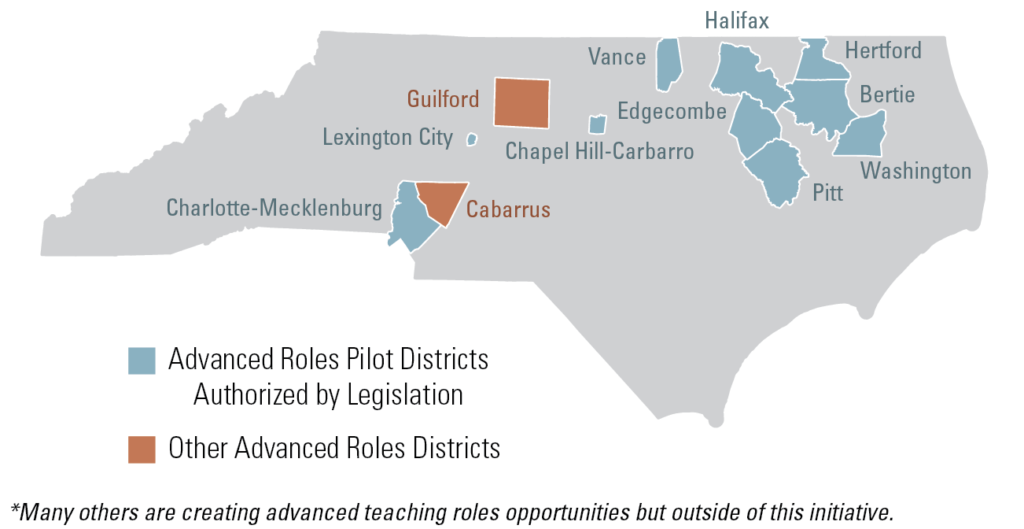
Spotlight On: Advanced Teaching Roles Initiative In 2016, North Carolina created the Advanced Teaching Roles Initiative. This legislation establishes a school leadership re-design model that empowers districts and educators to design new teaching roles that provide advancement opportunities, improved professional development, and greater support for student achievement. Advanced Teaching Roles enables highly-effective teachers to advance their careers, extend their positive impact on student achievement, and increase their compensation. The best part: they get to stay in the classroom! In effective models, developing teachers also benefit by having access to real-time professional development, relieving some of the pressures of principals who are traditionally the primary source of instructional leadership in the school. Today, ten districts are taking part in the Advanced Roles Initiative. Success by Design Program Created in 2013 and inspired by lessons learned from the Opportunity Culture model in Project LIFT schools, Success by Design is an official Advanced Roles program in Charlotte-Mecklenburg Schools (CMS). This approach is being phased in strategically over time. During the 2018-19 school year, Success by Design was implemented in 50 schools. Success by Design advanced roles teachers can earn up to $20,000 on top of their base salary, while increasing their impact on student achievement. Early results from the CMS program suggest that this model helps the district recruit and retain top talent, resulting in significant student achievement gains. During the 2017-18 school year, 58% of Success by Design schools exceeded growth, compared with 27% of all schools statewide. Also, a recent study published by the CALDER Center finds that students’ academic gains increased when taught by advanced roles teachers, with significant achievement gains in math. For more information visit www.BEST-NC.org/advancedroles.
BEST NC’s Response to Principal Preparation Consolidation (SB469)
We are grateful to the State of North Carolina for investing in two distinct, innovative principal preparation programs over the last four years. The timing is right to take the best practices from each of these outstanding programs and magnify their collective impact for the benefit of school leaders and the students they serve. Read our brief on the Transforming Principal Preparation Program here. Learn more about the NC Principal Fellows Program here. View Senate Bill 469 here.
Classroom Teacher Allotments North Carolina Public Schools

Note: This blog post features a brief from page 22 of our 2018 Facts & Figures publication, contextualizing North Carolina education data with a short description of an historical feature or a critical issue in North Carolina. Read more at www.NCEdFacts.org. In North Carolina, the state allots teaching positions to each school district based on the number of students in each grade, according to specific ratios set by the General Assembly. The classroom teacher allotment is by far the largest single state allotment; salary and benefits for teaching positions represent approximately 55% of total state support for education. Over the past seven years, the state changed allotment ratios four times, generally decreasing student to teacher ratios in the lower grades, and increasing them in grades 4 through 12. Source: NC DPI Highlights of the Public School Budget In 2016, the General Assembly enacted legislation requiring actual average student to teacher ratios in grades K-3 not to exceed the allotment ratios starting in the 2018-19 academic year. This has sparked considerable debate, in part because for the first time since the development of the state’s Basic Educational Program, districts will be required to use the state’s full position allotment to fund classroom teachers. Currently, there is no separate allotment for elementary school art, music, physical education, and world language teachers.
Principal Pay in North Carolina
Note: This blog post features a brief from page 30 of our 2018 Facts & Figures publication, contextualizing North Carolina education data with a short description of an historical feature or a critical issue in North Carolina. Read more at www.NCEdFacts.org. In recent years, principal pay in North Carolina ranked last in the Southeast and near the bottom nationally. In 2017, the North Carolina General Assembly transformed the state salary schedule for principals with an investment of $24M, or an average raise of approximately nine percent. The previous statewide schedule was based on each principals’ years of experience, level of education, and the number of teachers in the school they led. Annual state-funded pay ranged from $52,656 to $111,984, with an average of $64,416 in 2017. The updated schedule is based on the size of the school and the principal’s growth status (derived from students’ performance on standardized End-of-Course and End-of-Grade exams). Principals are also eligible for two stackable bonuses based on their school-level growth scores and school performance grades: Source: North Carolina General Assembly – 2017 Appropriations Act
Raising and Transforming Principal Pay: North Carolina Leading the Nation

Amid a flurry of budget negotiations, a gubernatorial veto and the subsequent legislative veto override this summer, it’s been easy to get caught up in the partisan analysis of North Carolina’s latest $22B state budget. Like any budget – or any 438-page document, for that matter – it is a complex list of competing priorities, with parts both to like and to criticize.
We Pay Principals the Wrong Way in NC

As a business leader, I know the value of great leadership on my executive teams, and in our public schools. That’s why a top priority for me as a member of BEST NC has been to encourage substantial and sustained investments in principal compensation. Investing in our principals is a fundamental principle of investing in our schools and our children.
Don Flow: North Carolina should invest in principals- The Winston-Salem Journal

Over the past few years, North Carolina teachers have seen significant pay increases. Signals from Gov. Roy Cooper and last week’s Senate budget proposal indicate that the next few years will see even more increases. This commitment by our legislative leaders is extremely important for the future of our state. The growth of our state is directly tied to the educational outcomes of our students.
Don Flow: Time to Pay School Principals as Executives – Triangle Business Journal

Over the past few years, North Carolina teachers have seen significant pay increases. Signals from Gov. Roy Coo per and last wee k ‘s Senate budget proposal indicate that the next few years will see even more increases. This commitment by our legislative leaders is extremely important for the future of our state.
Don Flow: Paying School Principals as Executives- The Herald-Sun
Over the past few years, North Carolina teachers have seen significant pay increases. Signals from Gov. Roy Cooper and this month’s Senate budget proposal indicate that the next few years will see even more increases. This commitment by our legislative leaders is extremely important for the future of our state. The growth of our state is directly tied to the educational outcomes of our students.
The State of Teaching