
Growth and Achievement in North Carolina

Growth and Achievement: you have probably heard these terms in conversations about education. But what are they? How do they differ, and what do they tell us about North Carolina’s students and teachers? Our new video “Growth and Achievement in North Carolina” explores some of these questions. Find out more at www.best-nc.org/growthandachievement.
School reform requires strong leaders

My father was Darth Vader. No, that doesn’t make me a Jedi Knight. My father was also Boss Hogg and a range of other bad guys. During his nearly two decades as principal of North Carolina’s largest elementary school, located in the Mecklenburg County community of Matthews.
Addressing the Early Conundrum
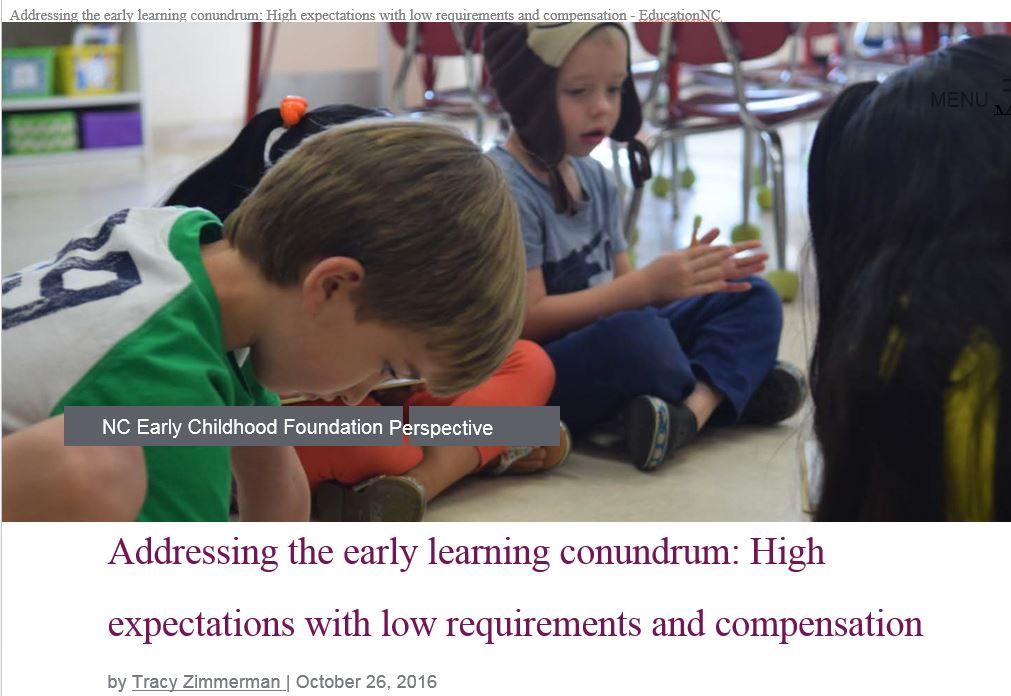
[vc_row][vc_column width=”1/1″][vc_hidrop] The expectations on the early learning workforce are high. By the time children transition to kindergarten, they ideally will – according to North Carolina’s definition of school readiness—have skills that range from being able to resolve conflict positively and problem-solve, to recognizing the relationship between letters and sounds and identifying basic shapes.[1][2] Early learning educators, in partnership with parents, play a decisive role in preparing children to succeed in school. The stakes are high – approximately 75 percent of children who begin kindergarten behind will never catch up to their classmates.[3] At the same time, North Carolina has low minimal requirements to become an early learning educator – a high school diploma and one basic course in early childhood education. At a median wage of approximately $10.50 per hour, the pay is low enough that 42 percent of North Carolina child care worker families must participate in one or more public support programs like Medicaid and SNAP (Food Stamps) to make ends meet – at a cost of millions of dollars.[4] This juxtaposition of high expectations and low requirements and pay is not limited to North Carolina. In 2016, recognizing that the early childhood workforce system needed to advance to reflect the latest scientific knowledge of how children develop, the Institute of Medicine (IOM) and the National Research Council released Transforming the Workforce for Children Birth Through Age 8: A Unifying Foundation.[5] The report reflects on how much we have learned about children’s development in recent years. Brain scientists have discovered that during children’s earliest years, their experiences are built into their bodies – shaping the brain’s architecture and impacting how biological systems develop. Positive early experiences build a strong foundation for learning and future health. The interactions between parents and caregivers and children shape the developing brain. As pediatrician Jack Shonkoff says, “Brains are built, not born.” While much is known about how children learn and develop, what professionals need to know and be able to do, and what professional learning supports they need, this knowledge is not reflected in “the current capacities and practices of the workforce, the settings in which they work, the policies and infrastructure that set qualifications and provide professional learning, and the government and other funders who support and oversee these systems.”[6] The report outlines 13 recommendations to ensure that all children’s development and early learning is supported by high-quality teachers and settings. Included among the recommendations is that states transition to a minimum bachelor’s degree qualification requirement, with specialized knowledge and competencies, for all lead educators working with children from birth through age eight. In North Carolina, despite our low requirement, the state has made progress on increasing education levels. North Carolina’s star-rated license includes incentives to increase teachers’ education. The T.E.A.C.H. Early Childhood® scholarship program supports early educators in the costs of obtaining higher education. And early education degree programs are available in every North Carolina Community College and in the majority of four-year higher education institutions. As a result, by 2015, 63 percent of all early childhood teachers had already obtained an Associate’s degree or higher, and 37 percent of those teachers had obtained a Bachelor’s degree. The issue of increased education requirements for early childhood teachers is gaining additional attention from stakeholders across North Carolina. BEST NC, a business-led advocacy group focused on North Carolina education from preschool through post-graduate, convened education leaders from across sectors this fall to focus on elevating the early childhood workforce. In addition, the NC Child Care Coalition, a coalition of more than 100 state, local and regional organizations across the state, is recommending increasing the requirements for lead teachers. They are proposing that the General Assembly require that by 2020: Increasing compensation for early educators goes hand-in-hand with increasing education requirements. The IOM report points out that transforming the early learning workforce to achieve the outcomes demanded from it also means “making substantial improvements in working conditions, well-being, compensation, and perceived status or prestige.” In North Carolina, more than half of early learning teachers have family incomes below $30,000 per year.[7] As a result, our teachers often face the same daily stresses around paying for food, transportation, and doctor visits as the families of the children in their care, which can impact their ability to support children’s optimal development. WAGE$® is a tool that that has been used effectively in North Carolina and other states. The program provides education-based salary supplements to early learning teachers, directors and family child care providers. It has successfully supported increased education levels, reduced turnover and increased teacher retention.[8] In fiscal year 2016-17, WAGE$® is only available in 53 counties in North Carolina through support from local Smart Start Partnerships for Children at their discretion. In fiscal year 2015, 3,800 early childhood teachers—only 14 percent of the total early education teaching workforce—received WAGE$® salary supplements.[9] The members of BEST NC’s Working Group on Early Childhood Educators explored the issue of early childhood compensation, as well. To begin to address compensation, the NC Child Care Coalition recommends that the General Assembly develop a state-level salary supplement program based on the current Child Care WAGE Program. To support children’s optimal development, early learning professionals need a core set of skills and competencies. As the IOM report concludes, “Persisting with the status quo for the professionals who do this important, complex work . . . will result in inadequate learning and development, especially among America’s most vulnerable families and communities.” About the Author: Tracy Zimmerman is the executive director of the NC EarlyChildhood Foundation. Click here to view Addressing the early learning conundrum PDF [/vc_hidrop][/vc_column][/vc_row]
‘- Facts vs-facts in education debate
[vc_row][vc_column width=”1/1″][vc_hidrop] Facts vs. facts in education debate by Ferrel Guillory | February 26, 2016 Keith Poston and James Ford of the Public Schools Forum of NC. Photo Credit: Alex Granados/EdNC To provide more in-depth coverage on schools in North Carolina, EdNC will shortly launch the EdData Dashboard. Our editor, Mebane Rash, and her staff have produced a handsome, easy-to-use, and substantive “dashboard’’ that they will up-date quarterly. We trust you will find the data charts, graphs, and packages informative, enriching your perspectives on education in our state. We welcome your comments and suggestions. I often repeat the time-honored wisdom that “data without analysis is junk.” Yes, we have to put the facts down. But we also have to array facts, connect dots, and examine time lines to make the facts mean something by which to drive action. This week’s column examines the challenge of dealing with data. Elections call upon voters to compare and contrast candidates in terms of personality, policy, and partisanship, as well as ability, priorities, and values. As the education issues play out in campaign 2016 in North Carolina, voters will encounter another dimension of debate: facts fighting facts. What’s an engaged citizen to do as candidates, parties, think tanks, and advocacy groups offer an array of facts, all objectively accurate but telling conflicting stories and leading to clashing conclusions about North Carolina and its schools? There’s no easy answer, except to weigh the competing facts and assess which set of statistics offer a story that adds up to reality. Already, Gov. Pat McCrory and Lt. Gov. Dan Forest, the Republican incumbents seeking re-election, have spelled out a long list of facts in explanation and defense of the GOP record since gaining control of the governorship and the General Assembly by a veto-proof majority in 2012. The governor’s list appears under the “record of success’’ section of his campaign’s website. Forest, who as lieutenant governor serves on the State Board of Education, has emerged as a more aggressive, and charismatic, champion of the Republican message on schools. A few days ago, he stepped before the combined Wake County Republican precinct caucuses and sought to arm party activists with data-points to counter “misinformation (that) Republicans are decimating education.” Forest also has posted three education-oriented videos, one entitled “education fast facts,’’ on his campaign website and YouTube. Both the governor and lieutenant governor draw a contrast between the education budgets under former Democratic Gov. Bev Perdue and under Republicans since 2012. McCrory points to spending reductions of “almost $1 billion between 2008 and 2011.” Forest says Republicans have put “$1.5 billion back into education,” thus spending “more than ever in the history of North Carolina.” As you consider those facts do so in the context of the Great Recession of 2008-09 that produced a drastic upward spike in unemployment and a downward spike in state revenues. Whoever, Democrats or Republicans, ruled in Raleigh between 2009 and 2012 would have had to slash state spending or raise taxes or both, to produce a balanced budget as the iron-clad law provides. As the economy recovered over the past three years, Republicans have appropriated more in total dollars to K-12 education. Independent analysts and advocacy groups, some of which are critics of the current administration, offer other facts. Some draw on data from before the Great Recession. Others focus on growth in enrollment. For example, a recent report by the nonpartisan Public School Forum of North Carolina presents a state-by-state chart showing that North Carolina’s per pupil spending, adjusted for inflation, declined by $855 from fiscal 2008 to 2015, the sixth largest decline among states. The 2016 Facts and Figures publication by BEST NC, a nonprofit formed by business leaders, reports that “North Carolina ranked 46th in the country in total K-12 per-pupil spending in 2014-15 in constant dollars, but 39th in cost of living adjusted dollars.” The McCrory campaign website says that “in 2014 the average salary for teachers in North Carolina increased more than any other state in the nation.” A Forest video says the state’s previous leadership had “frozen’’ teacher pay for years, then Republicans raised teacher pay an average of 11 percent. The legislature’s website has a chart of pay raises for teachers and state employees going back to 1973-74: It shows substantial teacher pay raises before the Great Recession. Teacher pay raises averaged 8.2 percent, 5 percent, and 3 percent in the last three years of Democratic Gov. Mike Easley’s administration. Then came no pay raise for three consecutive fiscal years – “frozen’’ from 2009 to 2012 – budgets hard hit by the recession. Teachers received a 1.2 percent raise in 2012-13 and then, as the legislative staff calculated, raises ranging from .5 percent to 18.5 percent (a 7 percent average) in 2014-15. Republican legislators have targeted raises on early-career teachers, while also revising the career “step-increase’’ pay system. The most recent pay legislation gave some experienced teachers a step increase, again increased new teachers’ pay and provided a one-time $750 raise across the board. The BEST NC report has a chart comparing North Carolina teacher compensation to the national average. In 2001, the North Carolina average was $41,496, just below the national average of $43,378. The gap widened to more than $10,000 by 2014. The latest pay raise brings North Carolina up to about $50,000, still below the national average. The Public School Forum reports that North Carolina ranks 42nd among the states in teacher pay, up from 47th a year earlier. In his talk to Wake Republicans, Forest declared, “Teachers are not leaving North Carolina in droves; how many of you know that?” In one of his videos, the lieutenant governor deconstructs a state report on teacher turnover to make the point that 6.8 percent of teachers fully left the profession last year, well below the 14.9 percent turnover rate widely reported. Only one percent has gone to other states, he said. […]