
BEST NC Releases Comprehensive Teacher Pay Report
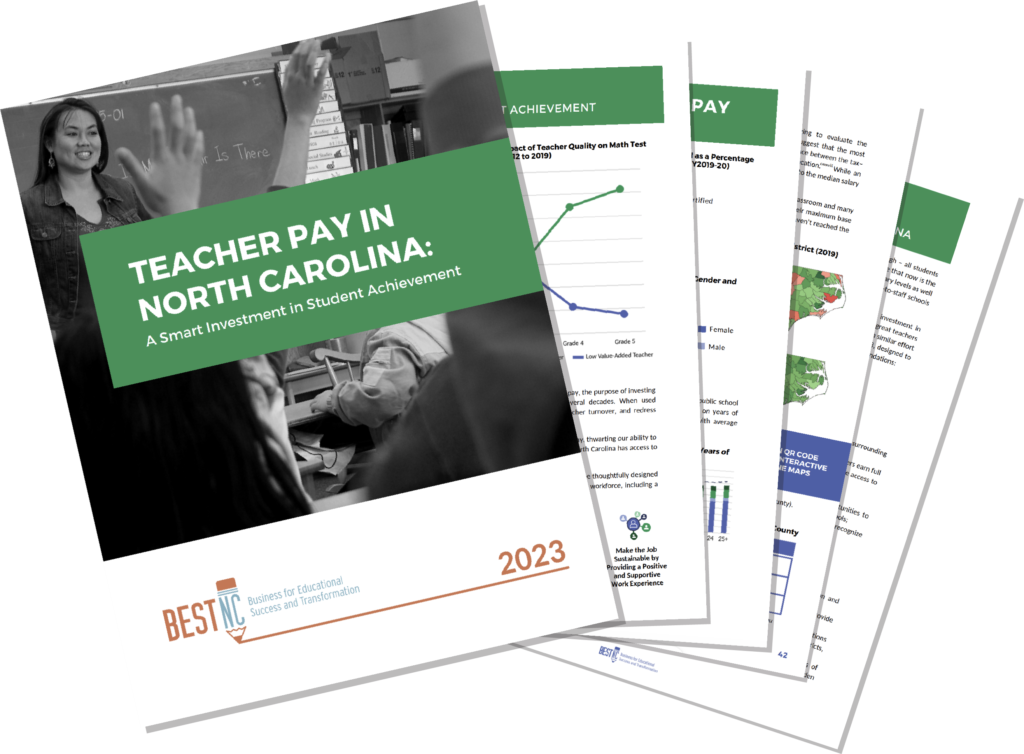
BEST NC Releases Comprehensive Teacher Pay Report In 2023, BEST NC released a new report on teacher pay entitled Teacher Pay in North Carolina: A Smart Investment in Student Achievement. The BEST NC team, along with leading economists and experts from across the country examined the complex issue of teacher pay. In our analysis, we uncovered important new evidence that the existing teacher pay structures in North Carolina, and across the country, fail to address dramatic decades-long shifts in our national workforce and are inadequate for meeting the personal and professional needs of today’s teachers. This teacher pay report offers specific, actionable recommendations for both an increased and transformed teacher salary structure that can help retain exceptional educators and attract the next generation of top-tier talent into North Carolina public schools. You can access the full report and the executive summary here. Below is an overview of the report. This is the first in a series of blogs that will highlight key concepts and recommendations from the report. Background: Why Professional Compensation Matters Research has consistently found that teacher quality is the most important in-school factor for student success, with high-performing teachers producing significantly higher achievement gains than low-performing teachers. Given this reality, it is essential for teacher compensation to attract highly qualified candidates into the profession and to support continued professional growth throughout their career in the classroom. In his NYT best-selling book Drive: The Surprising Truth About What Motivates Us, Daniel Pink contends that professional compensation is fundamentally important to fulfill an individual’s biological need to support oneself and one’s family (compensation must be adequate), and individuals must feel that they are fairly paid for the skills they hold and the work they do (compensation must be equitable). The Teacher Pay in North Carolina report considers Pink’s framing of professional compensation, compared to the current, 100-year-old teacher step-and-lane pay structure that is used in North Carolina and across the country. Through this lens, the report finds that our teacher pay and retention practices are outdated and fail to recruit and retain the top-tier candidates our students deserve. Beyond baseline requirements of adequacy and equitability, Pink finds that high-skilled professionals are motivated to perform at their best when their jobs present the opportunity for mastery, autonomy, and purpose. Current teacher pay practices and organizational structures, in stark contrast, encourage a “one-teacher, one classroom” approach that stifles growth and leaves high-performing teachers with few opportunities for professional advancement. Five Key Challenges of Current Teacher Compensation Models An exploration of research on best practices in teacher compensation revealed five major challenges, each of which is examined closely in the Teacher Pay in North Carolina report. Challenge 1: Teaching is a Mostly Female Workforce, Yet Teacher Pay Has Not Kept Up with Increasing Opportunities and Pay for Female, College-Educated Professionals. Nationally, between 1985 and 2021, median income for women with a bachelor’s degree grew by 22% when adjusted for inflation, compared to just 10% for teachers. Earnings for college-educated women have now eclipsed earnings for teachers. Women still comprise the majority of the teaching workforce, but, as women have more professional opportunities than ever before, teaching is arguably less attractive now than ever before for top-tier female candidates. v Challenge 2: Under the Existing Salary Schedule, North Carolina Teachers Must Wait Far Too Long Before Their Salaries Provide a Living Wage that Can Support a Family. Outside of retirement, teacher attrition is highest in the first five years of a teacher’s career. These years coincide with the time that teachers are starting to build their families. At this crucial juncture, the traditional step-and-lane schedule does not provide a living wage that allows teachers to support a family. The Teacher Pay in North Carolina report uses the Living Wage Calculator from the Massachusetts Institute of Technology, which leverages geographically specific data on living expenses (e.g. housing, health insurance, food, childcare), to estimate that nearly one-third of North Carolina teachers earned less than a living wage for a family of four in 2021-22. Even when compared to other public sector employees in our state, teachers earn less and take much longer to reach the top of the base salary schedule. Challenge 3: The Traditional Teacher Compensation Model Does Not Provide Meaningful Professional Promotions that Attract Top Talent and Keep Effective Educators in the Classroom. Research has demonstrated that the traditional step-and-lane salary schedule limits overall earning potential and discourages high-aptitude individuals from pursuing a teaching career. Reinforcing this notion, a report issued by McKinsey in 2010 revealed that 87% of top-tier candidates indicate that their preferred occupation provides opportunities to advance, compared to just 45% who believe teaching will provide similar advancement opportunities. The same report noted that nations that perform at the top on international assessments recruit 100% of teachers from students in the top-third of their class. In the United States it is 23%, and only 14% for teachers in higher poverty schools. Advanced Teaching Roles provide one pathway for highly effective educators to advance professionally as they take on greater responsibility and leadership. Currently, approximately 1,000 North Carolina teachers are working in advanced roles, earning up to $20,000 in additional pay. However, with just 21% of districts currently participating, there is significant room for growth. Challenge 4: Existing Pay Structures are not Designed to Fill Hard-to-Staff Subject Area Positions and Schools, Leading to Persistent, Critical Vacancies and Disparities in Student Access to Effective Educators. Like most states, teacher staffing inequities in North Carolina are driven, in part, by the structure of the state teacher salary schedule, which requires that teacher base pay is the same for equivalently experienced teachers, regardless of what, where, or how well a teacher teaches. In high-demand fields like STEM subjects, average teacher pay significantly trails average wages for recent UNC System graduates for those majors. These subject areas also see markedly higher teacher vacancy rates. Additionally, there are tremendous disparities in student access to highly qualified teachers […]
WCPSS Seeking to Add More ‘Charter-Like’ Schools

[vc_row][vc_column width=”1/1″][vc_hidrop] WCPSS Seeking to Add More ‘Charter-Like’ Schools The “restart” model for high-needs schools will expand to 10 more WCPSS schools next year. Last week, the state Board of Education approved the application submitted by WCPSS to restart five more elementary schools and five middle schools. All of which are schools that need to improve their test scores. The school system “relaunched” Walnut Creek and Barwell Road elementary schools last year under the state’s restart program, bringing “charter-like” flexibility in school start and end times, calendar, budgeting and hiring. WCPSS retains full control of the schools, however, and all teachers must still be actively certified to teach. The restart model was so well received at those two schools, the WCPSS staff decided to add 10 more schools for next school year. This is different than the Renaissance School Program implemented under former Superintendent Tony Tata. That model focused on human resource incentives such as offering signing and performance bonuses, hiring additional teachers, and adding more professional development all funded partly by federal Race Top The Top grant money. WCPSS ended that program two years ago when the grant money ran out. The restart model gives principals, teachers, and parents the room todevelop creative, data-driven solutions to the issues raised by the data at each school. The school system also gains flexibility for converting funds to pay for additional staff, and the schools offer and extended school day one day a week, parent academies, and additional family services that aren’t typically offered inschools. To qualify, a school must be designated as “recurring, low performing” by the state based on its test scores in two of the last three years on a rolling basis. Walnut Creek and Barwell are part of the 12-school Elementary Support Model group overseen by Area Superintendent James Overman. All 12 schools would qualify for restart status, but not all ESM schools are part of Wake’s application this time. The school system submitted requests for a combination of elementary and middle schools, many of them magnet schools. Bugg Elementary School Carroll Magnet Middle School East Garner Elementary School East Garner Magnet Middle School East Millbrook Middle School East Wake Middle School Fox Road Magnet Elementary School Millbrook Elementary School Poe GT/AIG Basics Magnet Elementary School Wendell Middle School Now that the State Board of Education approved the application for all 10 schools, each school will develop plans which may include extending the school day, extending the school year, changing the school calendar, adding family support services. Many changes will need to be approved by the WCPSS School Board. Click here to view State School Funding Overhaul, Principal_AP Pay Plan PDF [/vc_hidrop][/vc_column][/vc_row]