
Teacher Raises and more under negotiation
[vc_row][vc_column][/vc_column][/vc_row][vc_row][vc_column width=”1/1″][vc_hidrop] BY LYNN BONNER lbonner@newsobserver.com As state House and Senate negotiators prepare to work out a final budget, a lot of attention will be focused on the size of pay raises for teachers. Teacher raises turned into a major sticking point two years ago when the Senate voted for bigger raises than the House. This year, the House proposes average teacher raises of 4.1 percent. The Senate plan would raise teacher salaries an average of 6.5 percent. There’s more going on under the hood beyond the raw numbers. The Senate plan also departs from a change made two years ago when the legislature compressed the teacher salary schedule – creating broad tiers. Under the current system, teachers with 14 years experience make as much as teachers with nine, and teachers with 19 years experience make as much as those with Senate plan goes back to giving teachers more for each year they work, from the third year to the 15th year. At 15 years experience, the Senate pay schedule returns to salary tiers. Gov. Pat McCrory’s proposed salary schedule also would revert to yearly raises for most teachers. His education adviser told the State Board of Education that teachers didn’t like the new tier structure. Although House and Senate plans are different, they both give bigger percentage raises to mid- career teachers. The pay plans shortchange teachers with the most experience, said Mark Jewell, vice president of the N.C. Association of Educators. “Clearly, we are pleased the General Assembly has heard us beat the drum of the teacher shortage crisis and teacher compensation,” Jewell said. “When you look at this, it still falls short for those with the most experience,” he said. Teacher pay reliably appears as a campaign issue every two years. Even with an increase, teachers have plenty of issues to worry about, Jewell said. Schools don’t have enough textbooks, making it hard for parents to help with homework, he said. Teachers who don’t already have advanced degrees won’t get pay bumps for earning them, as they used to, and legislators want to expand the school voucher program. “They see what’s going on, and they don’t like it,” Jewell said. “I don’t think they’re going to be fooled with an election-year ploy like this.” General Roy Cooper in the governor’s race and Democrats in four Council of State races. But Dallas Woodhouse, executive director of the state Republican Party, said pay raises will help GOP candidates going into election season. He described the increases as a result of Republican policies. “The policy of properly compensating teachers is now possible because of the strong economic policies that have turned North Carolina’s economic fortunes around by getting people off unemployment and getting people back to work,” Woodhouse said in a statement. “Teachers and state employees will not only benefit from higher pay but from the broad based middle class tax relief that has made North Carolina’s economic recovery an envy of thesouth.” Plenty of education issues are in the mix for budget negotiations. The House and Senate take different approaches to promoting early childhood literacy, increasing the supply of teachers, and principal training. On literacy The House halts a plan to hire more teachers to reduce first-grade class sizes, which would have cost about $27 million. Instead, the House spends $25 million on literacy coaches for elementary schools in the bottom fifth in performance. The House budget also cuts $10 million from summer reading camps for first- and second-graders who aren’t reading at grade level. The Senate keeps the $27 million for the additional first-grade teachers and adds another $27 million to hire more second-grade teachers to reduce class sizes by one student. The budget has $10 million to pay for a pilot program giving bonuses to top third-grade reading teachers. The legislature has focused on elementary school reading for the past four years. A law called Read to Achieve requires most students read proficiently by the end of third grade or risk retention. These different approaches offer an opportunity for legislators to talk about “which elements are going to affect third-grade literacy the most,” said Brenda Berg, president and CEO of BEST NC, a business group focused on education. Teacher pipeline Enrollment at UNC schools of education has dropped 30 percent in the last five years. Local districts say their problems with teacher recruitment extend from high school math and science down to elementary schools. The House budget includes a $2 million merit scholarship program for college students studying to become teachers in subjects such as math or science, or who plan to work in hard- to-staff schools. The Senate budget has $112,500 to reimburse 25 teacher assistants in five counties studying to become teachers. They would receive up to $4,500 a year. The budget also includes a plan for five lateral entry teacher preparation programs local school boards would administer. Principal preparation The House budget provides an additional $7.5 million to the program for school-leadership development, bringing the total to $8.5 million. The Senate eliminates that program, but would establish lab schools at UNC-system schools that have teacher training programs. The intent is to improve student achievement in districts with low-performing schools, and to provide teacher and principal training in those districts. The budget has $1 million in startup funds. STAFF WRITER COLIN CAMPBELL CONTRIBUTED Lynn Bonner: 919-829-4821, @Lynn_Bonner Click here to view Teacher raises and more under negotiation PDF [/vc_hidrop][/vc_column][/vc_row]
Proposed state Senate budget ups the ante on teacher pay
[vc_row][vc_column width=”1/1″][vc_hidrop] Posted May 25, 2016 at4:59PMUpdated May 25, 2016 at 5:03 PM By the Associated Press RALEIGH — North Carolina Senate Republicans on Wednesday previewed their plan to pay teachers more than what Gov. Pat McCrory and House members have offered, but didn’t provide many details about how they would pay for it. Senate leader Phil Berger said the chamber is committed to raising average teacher pay— including local supplements — by several thousand dollars to more than $54,200 by the 2017-18 school year. In a frst step, the Senate’s recommended budget adjustments, to be unveiled next week, would raise the state average to slightly more than $51,000 this fall, he said. North Carolina is currently ranked 41st in the nation for teacher pay, with an estimated average salary for the current school year of $47,985, according to the National Education Association. The Senate plan, if implemented, would move North Carolina up to the middle among the states and District of Columbia, Berger said. The effort “will make North Carolina the Southeast’s leader in teacher pay and encourage the best and the brightest in the teaching profession to make a long-term commitment to our students and to our state,” Berger, R-Rockingham, said at a Legislative Building news conference. McCrory’s budget proposes raising the state’s share of teacher pay on average by 5 percent this fall, to slightly more than $50,000. The House budget, approved last week, would raise teacher salaries by 4.1 percent, not quite reaching a $50,000 average, although House Republicans said they would provide more raises next year. One-time bonuses also are included in proposals by McCrory and the House. The two chambers ultimately will work out a fnal agreement for the coming year to present to McCrory. Action on 2017-18 salaries wouldn’t occur until the next session and the next two-year budget. Berger said the Senate’s entire plan would cost $538 million over two years and not require tax increases, relying instead on a stronger economy and healthy state revenues to pay for it. Pressed for what other spending changes, if any, would be needed to carry it out, he responded: “Once you see the full budget, you’ll be able to see the details about it.” Paying for raises this year would appear trickier given that House and Senate leaders have agreed to spend no more than $22.2 billion in the new fscal year starting July 1. Meanwhile, a Senate plan to increase standard income tax deductions, also expected in the budget bill, would reduce revenues by $145 million next fscal year, compared to a reduction of $25 million in the House budget, which phases in the tax break. Under the Senate’s plan, for example, base pay for teachers with 10 years of experience would increase 6.3 percent to $42,500 this fall and to $45,000 the following year, according to a Senate Republican website referred to by Berger. The plan also envisions teachers reaching the current $50,000 maximum on the state-only teacher salary scale at 15 years of experience, compared to the current 25. “The Senate’s proposal for teachers to earn more money, faster will help recruit top talent to the profession, reduce turnover and dramatically increase career earnings,” said Brenda Berg, who runs BEST NC, a business-oriented public education advocacy group. The North Carolina Association of Educators, the state’s largest teacher lobbying group and a critic of Republican legislators, was more suspicious about a plan lacking many details. “Now, because it’s an election year, Senate leaders are trying to play catch up from the destructive swath they created for our public schools,” NCAE President Rodney Ellis said in a release. Teachers have received raises two years in a row, including a signifcant 7 percent average increase for the 2014-15 school year. But the most experienced teachers did not get permanent raises this year. Click to view Proposed state Senate budget ups the ante on teacher pay PDF [/vc_hidrop][/vc_column][/vc_row]
Senate GOP pitches teacher raise
[vc_row][vc_column][/vc_column][/vc_row][vc_row][vc_column width=”1/1″][vc_hidrop] By Mark Binker RALEIGH, N.C. — Senate leaders say their budget includes a teacher pay plan that ensures educators hit the top of the state’s salary scale in 15 years and raises average teacher salaries to more than $54,000 over two years. “We think this is the right plan for teachers in North Carolina at this time,” Senate President Pro Tem Phil Berger said. Berger, R-Rockingham, did not say how his chamber would pay for the raises and did not provide a detailed salary schedule. However, he said that tax collections have been on the upswing in recent years and that a generally improving economy allowed the Senate to take up long-delayed priorities. “We put forward where our priorities are,” he said. Along with plans from Gov. Pat McCrory and the state House, this is the third major teacher raise proposal put forward by state government this year, although all three work somewhat differently. The Senate will roll out its entire budget next week, Berger said. When asked how the Senate budget would deal with pay raises for state employees or other areas of spending, he said he was “not prepared” to discuss those items. Referring reporters to a website put together by the Senate Republicans’ political operation, he pointed out that the raises would make North Carolina’s teacher pay the highest in the Southeast and 24th in the country. “This is on top of the teacher pay raises we passed in the 2014 and 2015 budgets,” Berger said. He said the Senate plan would move teachers to the top of the pay scale within 15 years rather than the current 25 years of service needed to max out. Brenda Berg, president of BEST NC, a group of business leaders that have advocated for more education funding, said that faster rise to the top of the salary scale is key to stemming the tide of young teachers leaving the profession due to poor pay. “We know they’re leaving early in their career, and this is why they’re leaving,” Berg said. She said it makes sense to raise salaries quickly over the first decade of a teacher’s career. “These 10 to 15 years are when you’re making the most professional progress,” Berg said. Teacher pay has been a major political issues for years in North Carolina, with school systems and advocacy organizations alike saying that the state is losing teachers to other professions and other states. State government provides a base salary for all teachers across the state. Most, but not all, county school systems also provide a supplement on top of that base pay. That means the actual salary a teacher is paid varies widely across the state. The average salary estimate in the Senate’s pay plan includes those local supplements. Rodney Ellis, president of the North Carolina Association of Educators, said that the “devil is going to be in the details” of any teacher pay proposal. “NCAE has consistently beaten the drum that, for our students to be more successful, we must invest fully in our public schools by increasing the resources they have and by compensating educators as professionals,” Ellis said in astatement. “Now, because it’s an election year, Senate leaders are trying to play catch-up from the destructive swath they created for our public schools. … Last time there was a pay raise, they promised it would get us to 32nd in the country, and here we sit at 41st.” McCrory’s proposed teacher pay plan would raise the average teacher’s salary to $50,000. The House budget proposedslightly smaller raisesin order to make sure there was enough money to give raises to other state employees, something McCrory’s plan did not do. After the Senate passes its budget bill, members of the House, the Senate and the Governor’s Office will negotiate a final plan. If recent history is any guide, none of the teacher raise proposals floated early on the in the process will be precisely what passes into law this summer, although all three make raising teacher salary a priority. Click her to view the Senate GOP pitches teacher raise plan PDF [/vc_hidrop][/vc_column][/vc_row]
‘- Facts vs-facts in education debate
[vc_row][vc_column width=”1/1″][vc_hidrop] Facts vs. facts in education debate by Ferrel Guillory | February 26, 2016 Keith Poston and James Ford of the Public Schools Forum of NC. Photo Credit: Alex Granados/EdNC To provide more in-depth coverage on schools in North Carolina, EdNC will shortly launch the EdData Dashboard. Our editor, Mebane Rash, and her staff have produced a handsome, easy-to-use, and substantive “dashboard’’ that they will up-date quarterly. We trust you will find the data charts, graphs, and packages informative, enriching your perspectives on education in our state. We welcome your comments and suggestions. I often repeat the time-honored wisdom that “data without analysis is junk.” Yes, we have to put the facts down. But we also have to array facts, connect dots, and examine time lines to make the facts mean something by which to drive action. This week’s column examines the challenge of dealing with data. Elections call upon voters to compare and contrast candidates in terms of personality, policy, and partisanship, as well as ability, priorities, and values. As the education issues play out in campaign 2016 in North Carolina, voters will encounter another dimension of debate: facts fighting facts. What’s an engaged citizen to do as candidates, parties, think tanks, and advocacy groups offer an array of facts, all objectively accurate but telling conflicting stories and leading to clashing conclusions about North Carolina and its schools? There’s no easy answer, except to weigh the competing facts and assess which set of statistics offer a story that adds up to reality. Already, Gov. Pat McCrory and Lt. Gov. Dan Forest, the Republican incumbents seeking re-election, have spelled out a long list of facts in explanation and defense of the GOP record since gaining control of the governorship and the General Assembly by a veto-proof majority in 2012. The governor’s list appears under the “record of success’’ section of his campaign’s website. Forest, who as lieutenant governor serves on the State Board of Education, has emerged as a more aggressive, and charismatic, champion of the Republican message on schools. A few days ago, he stepped before the combined Wake County Republican precinct caucuses and sought to arm party activists with data-points to counter “misinformation (that) Republicans are decimating education.” Forest also has posted three education-oriented videos, one entitled “education fast facts,’’ on his campaign website and YouTube. Both the governor and lieutenant governor draw a contrast between the education budgets under former Democratic Gov. Bev Perdue and under Republicans since 2012. McCrory points to spending reductions of “almost $1 billion between 2008 and 2011.” Forest says Republicans have put “$1.5 billion back into education,” thus spending “more than ever in the history of North Carolina.” As you consider those facts do so in the context of the Great Recession of 2008-09 that produced a drastic upward spike in unemployment and a downward spike in state revenues. Whoever, Democrats or Republicans, ruled in Raleigh between 2009 and 2012 would have had to slash state spending or raise taxes or both, to produce a balanced budget as the iron-clad law provides. As the economy recovered over the past three years, Republicans have appropriated more in total dollars to K-12 education. Independent analysts and advocacy groups, some of which are critics of the current administration, offer other facts. Some draw on data from before the Great Recession. Others focus on growth in enrollment. For example, a recent report by the nonpartisan Public School Forum of North Carolina presents a state-by-state chart showing that North Carolina’s per pupil spending, adjusted for inflation, declined by $855 from fiscal 2008 to 2015, the sixth largest decline among states. The 2016 Facts and Figures publication by BEST NC, a nonprofit formed by business leaders, reports that “North Carolina ranked 46th in the country in total K-12 per-pupil spending in 2014-15 in constant dollars, but 39th in cost of living adjusted dollars.” The McCrory campaign website says that “in 2014 the average salary for teachers in North Carolina increased more than any other state in the nation.” A Forest video says the state’s previous leadership had “frozen’’ teacher pay for years, then Republicans raised teacher pay an average of 11 percent. The legislature’s website has a chart of pay raises for teachers and state employees going back to 1973-74: It shows substantial teacher pay raises before the Great Recession. Teacher pay raises averaged 8.2 percent, 5 percent, and 3 percent in the last three years of Democratic Gov. Mike Easley’s administration. Then came no pay raise for three consecutive fiscal years – “frozen’’ from 2009 to 2012 – budgets hard hit by the recession. Teachers received a 1.2 percent raise in 2012-13 and then, as the legislative staff calculated, raises ranging from .5 percent to 18.5 percent (a 7 percent average) in 2014-15. Republican legislators have targeted raises on early-career teachers, while also revising the career “step-increase’’ pay system. The most recent pay legislation gave some experienced teachers a step increase, again increased new teachers’ pay and provided a one-time $750 raise across the board. The BEST NC report has a chart comparing North Carolina teacher compensation to the national average. In 2001, the North Carolina average was $41,496, just below the national average of $43,378. The gap widened to more than $10,000 by 2014. The latest pay raise brings North Carolina up to about $50,000, still below the national average. The Public School Forum reports that North Carolina ranks 42nd among the states in teacher pay, up from 47th a year earlier. In his talk to Wake Republicans, Forest declared, “Teachers are not leaving North Carolina in droves; how many of you know that?” In one of his videos, the lieutenant governor deconstructs a state report on teacher turnover to make the point that 6.8 percent of teachers fully left the profession last year, well below the 14.9 percent turnover rate widely reported. Only one percent has gone to other states, he said. […]
Legislatures get mixed bag of teacher pay proposals
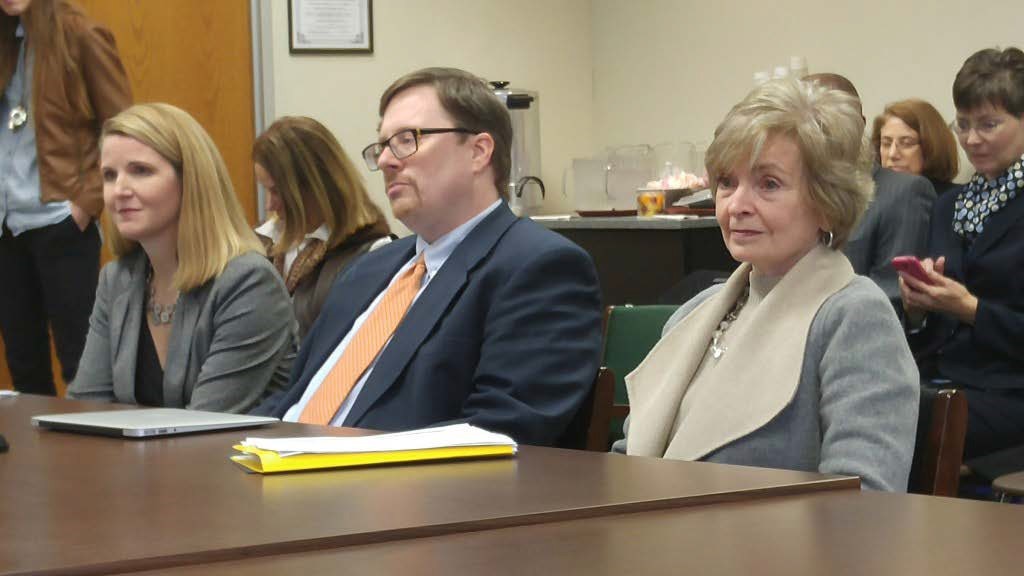
NEWS: CJ EXCLUSIVES Legislators Get Mixed Bag of Teacher PayProposals Atkinson’s call for 10-percent hike draws cool reception Legislators Get Mixed Bag of Teacher Pay Proposals – Carolina Journal From left, Best NC’s Brenda Berg, the John Locke Foundation’s Terry Stoops, and state Superintendent June Atkinson prepare to discuss teacher compensation on Jan. 27 before a House committee. (CJ Photo by Barry Smith) Barry Smith in CJExclusives February 1, 2016 4:30PM Before a state House committee last Wednesday, state Superintendent of Public Instruction June Atkinson recommended that all public school teachers in North Carolina get a 10 percent boost in their pay as part of a four-part plan to increase teacher compensation. Several members of the House Select Committee on Education Strategy and Practices were skeptical of the value of across-the-board raises along with their cost. In a presentation later that day, Terry Stoops, director of research and education studies at the John Locke Foundation, said universal pay raises send the wrong signals to the best and worst classroom teachers. And in remarks the following day to the same panel, House Speaker Tim Moore, R-Cleveland, rejected the idea of a 10-percent raise. Atkinson, who is running for re-election, likened the tiers of compensation to a four-layered wedding cake. The base level of the cake must be competitive enough to be attractive, Atkinson said. “I would want North Carolina to be extremely bold and to look toward a 10 percent increase for all of our teachers,” Atkinson said. The cost for providing all teachers 10 percent raises would be around $540 million. Rep. Jonathan Jordan, R-Ashe, asked Atkinson if spending the additional money would guarantee an end to the state’s teacher compensation problems. Atkinson said that she wanted to provide the committee with cost figures. “I recognize that it is a big item,” Atkinson said. “As state superintendent you have in statute that it is my responsibility to let the needs of our schools be known. If I were in your shoes, I would be worrying about that money, too.” Also presenting to the committee Wednesday were Stoops, Trip Stallings, director of policy research at the Friday Institute for Educational Innovation at N.C. State University, and Brenda Berg, president and CEO at Best NC. Stoops said he didn’t like across-the-board raises because they encourage bad teachers to remain on the job. “When you raise salaries across the board, both your best teachers and your worst teachers receive that salary, you are incentivizing the bad teachers to stay in the profession because they’re assuming that the across-the-board pay increase is what they will keep receiving, regardless of how they are performing,” Stoops said. “This creates a situation where we are essentially allowing those poor teachers to stay in the profession, and not really rewarding our most effective teachers.” Stoops said having a performance-based pay or differentiated pay would allow the best teachers to receive the compensation they deserve. Atkinson said the second layer of compensation requires identifying a certain percentage of teachers to be designated as teacher leaders, who would get additional pay for their roles. These teachers could be instructional coaches, peer evaluators, or grade level coordinators, among other things, she said. A third layer would boost compensation to attract teachers to low performing schools. The fourth layer would provide bonuses for teachers at schools that exceed anticipated growth, Atkinson said. Stallings said that differential pay is complex and cautioned against having a one-size-fits all approach to such salary boosts. He said that there is “very little evidence” of an impact on student performance when the focus is on pay-for-performance only. “What works in Charlotte is probably not going to work in Bertie County,” Stallings said. Stoops said that the purpose for having differential pay is teacher retention. He also said that teachers leave their job for various reasons, not just pay. “It’s not just compensation,” Stoops said. “It’s personal circumstances. They don’t like their principal. They think the school district is too big. The working conditions are terrible. They don’t have the books that they need, or the labor market is somehow enticing them to move on to another field.” Berg, from BEST NC, a nonprofit coalition of business leaders promoting improvements in public schools, said there a national crisis is brewing because millennials don’t want to go into the teaching profession. “Compensation is a piece of the puzzle,” Berg said. But she suggested that there is a need to treat teachers more like professionals. Berg offered some suggestions, such as providing scholarships or repaying student loans to teachers who get their degrees in North Carolina and agree to work hereafterward. “We need to elevate our respect for teachers,” Berg said. Rep. Paul “Skip” Stam, R-Wake, also suggested that the state no longer consider individual teachers’ salaries public records. “I think that’s the main reason that so many of they say they don’t want a differentiated performance pay because of envy and jealousy,” Stam said. “They don’t want their friend down the hall to know that they’re making $2,000 more than they are.” Even though Moore rejected Atkinson’s proposal for a 10-percent raise, Stoops said he expected this year’s short session of the General Assembly to enact a smaller across-the-board pay increase. “The amount of that pay raise will depend on the revenue outlook and the pressures from other budgetary areas,” Stoops said. “I would say 5 percent would be the ceiling.” categories: Education (PreK-12), K-12 Education, Spending & Taxes tags: ncga, teacher pay Click here to view the Legislators Get Mixed Bag of Teacher Pay Proposals PDF