
School Expenditures in NC During the COVID-19 Pandemic
Published 2024 | BEST NC
To address both the funding and academic challenges caused by the COVID-19 pandemic, the federal government issued over $190.5 billion in Elementary and Secondary School Emergency Funds (ESSER), of which $5.6 billion was distributed to North Carolina schools.
ESSER Funds and Per Pupil Expenditures
Made in three allotments, ESSER provided state and local education agencies with one-time funds to support schools and school programming during the pandemic and subsequent learning recovery efforts. The last of this funding, known as ESSER III, was distributed at the end of 2021 as part of the American Rescue Plan. All ESSER funding must be spent by the end of September 2024 and, although these funds were always understood to be one-time funds, there are concerns about a looming “fiscal cliff” and a potential negative impact on students when funding returns to typical levels.
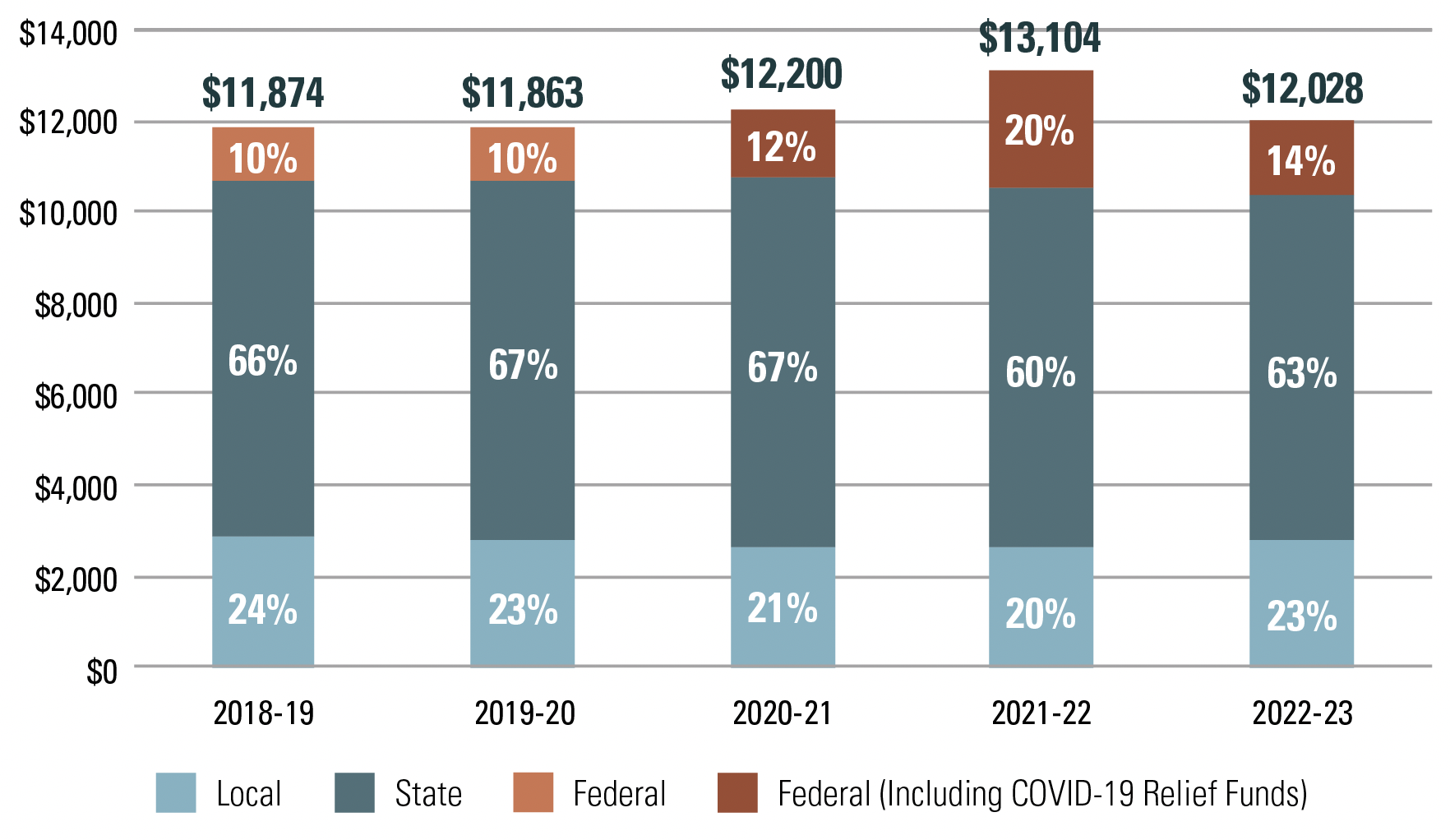
Beginning in 2020–21, the influx of federal COVID relief funding increased the percentage of North Carolina public school funding that came from the federal government. Typically, federal funds account for 10% of all school funding. This percentage peaked at 20% in 2021–22, before decreasing to 14% in 2022–23.
Figure 1: K-12 Public Education per Pupil Expenditures, Inflation-Adjusted to 2023 Dollars, by Source (2018–19 to 2022–23)
|
While state per pupil education expenditures have increased every year since 2015, state spending has not kept up with the pace of inflation. As a result, inflation-adjusted state per pupil expenditures have decreased 3% since 2018–19, the school year immediately prior to the pandemic. Inflation-adjusted decreases in state per pupil education funding, in addition to the expiration of federal COVID relief funds, may cause resource challenges for schools in the years ahead. |
In addition to funds allocated directly to LEAs, North Carolina allocated $19.5 Million for services, including Communities in Schools, the YMCA, United Way, and others. |
Expenditure of COVID Relief Funding
The North Carolina Department of Public Instruction (NC DPI) has created an interactive dashboard to track expenditures of COVID relief funding, including funding from ESSER, the COVID Recovery Fund (CRF), the Governor’s Emergency Education Relief Fund (GEER), and state funding. Figure 2 examines school and district expenditures by category, illustrating the way funding priorities have shifted over time.
Figure 2: COVID-19 Relief Funds Spending by K-12 Public School Units, by Category (2019–20 to 2023–24)
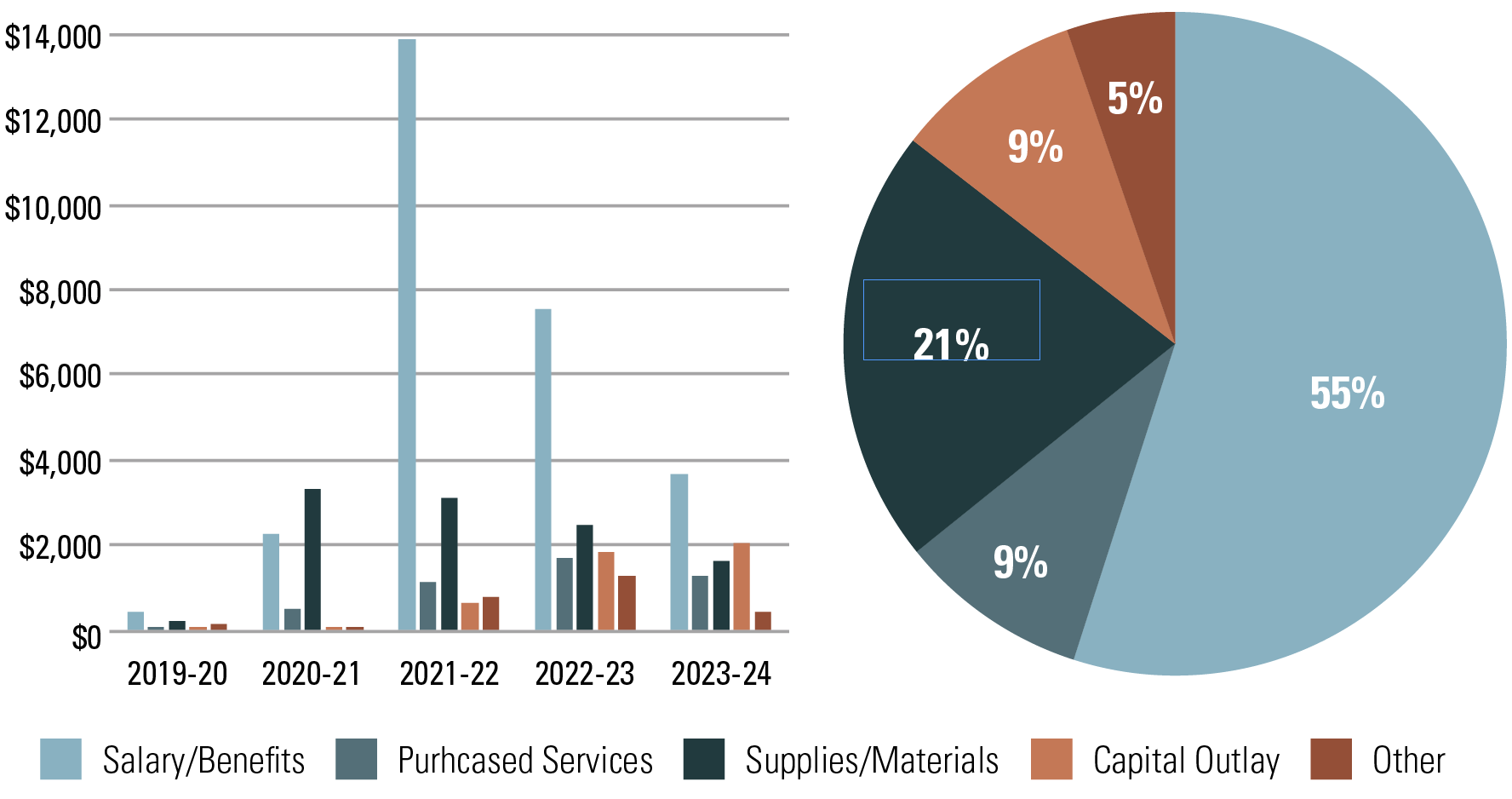
The majority of COVID relief funding (55%) has been spent on salaries and benefits for school staff with approximately 20% of all funding used to supplement educator contracts in the form of one-time bonus pay, mostly in 2021–22. While salaries and incentives for educators remained the top expense in 2022–23 and 2023–24, many districts have begun to allocate a greater portion of funding towards Capital Outlay (i.e., facilities) to update and maintain infrastructure in school buildings.
As of April 2024, 40 LEAs have 10% or more of their COVID relief funding remaining, while 75 LEAs have less than 10% remaining, including three districts which have spent all of their COVID relief funding.
Looking Ahead
In order to understand how ESSER funds have contributed to learning recovery and academic improvement, NC DPI’s Office of Learning Recovery and Acceleration (OLR) will continue to investigate the outcomes of programs and policies that were supported by ESSER funding. By evaluating the return on investment, policymakers can better understand how educational supports utilized during the pandemic can be leveraged to improve student outcomes in the future.
OESE ARP ESSER – State and Local Educational Agency (LEA)/School District Plans; ESSER Funding Cliff Toolkit (February 2024); NC DPI Allotment and Expenditure Data Visualization (4/2/24); NC DPI Statistical Profile, Table 23
About This Series
This post is part of BEST NC’s 2024 Facts & Figures: Education in North Carolina Spotlight On: series. View the full report at NCEdFacts.org or visit BESTNC.org.