

Restart Schools in North Carolina
Published 2024 | BEST NC
|
Restart Schools are continually low-performing schools that have been granted certain operational flexibilities to improve student outcomes. To qualify, a school must have a School Performance Grade of D or F and a School Growth status of Met or Did Not Meet Expected Growth in at least two of the prior three school years. Under state statute, Restart Schools have flexibility in areas such as teacher licensure, the teacher salary schedule, class size, and school calendar. There are currently 148 Restart Schools in North Carolina. |
On average, students 7% closer to their expected pre-pandemic |
Data from DPI reveal that the longer a school has had Restart Flexibility, the more likely they are to meet or exceed academic gain expectations, as defined by the State Board of Education. For instance, in the 2021–22 school year, 87% of schools that had Restart status for five years met or exceeded academic gain expectations, compared with 59% of schools that had Restart Flexibility for just one year. This positive impact also extended to Restart schools’ ability to recover from the pandemic, where Restart schools have outperformed their other continually low-performing school peers. Comparing to the prior year, Restart students experienced 5% and 4% more recovery than their non-Restart peers in Math and ELA, respectively.
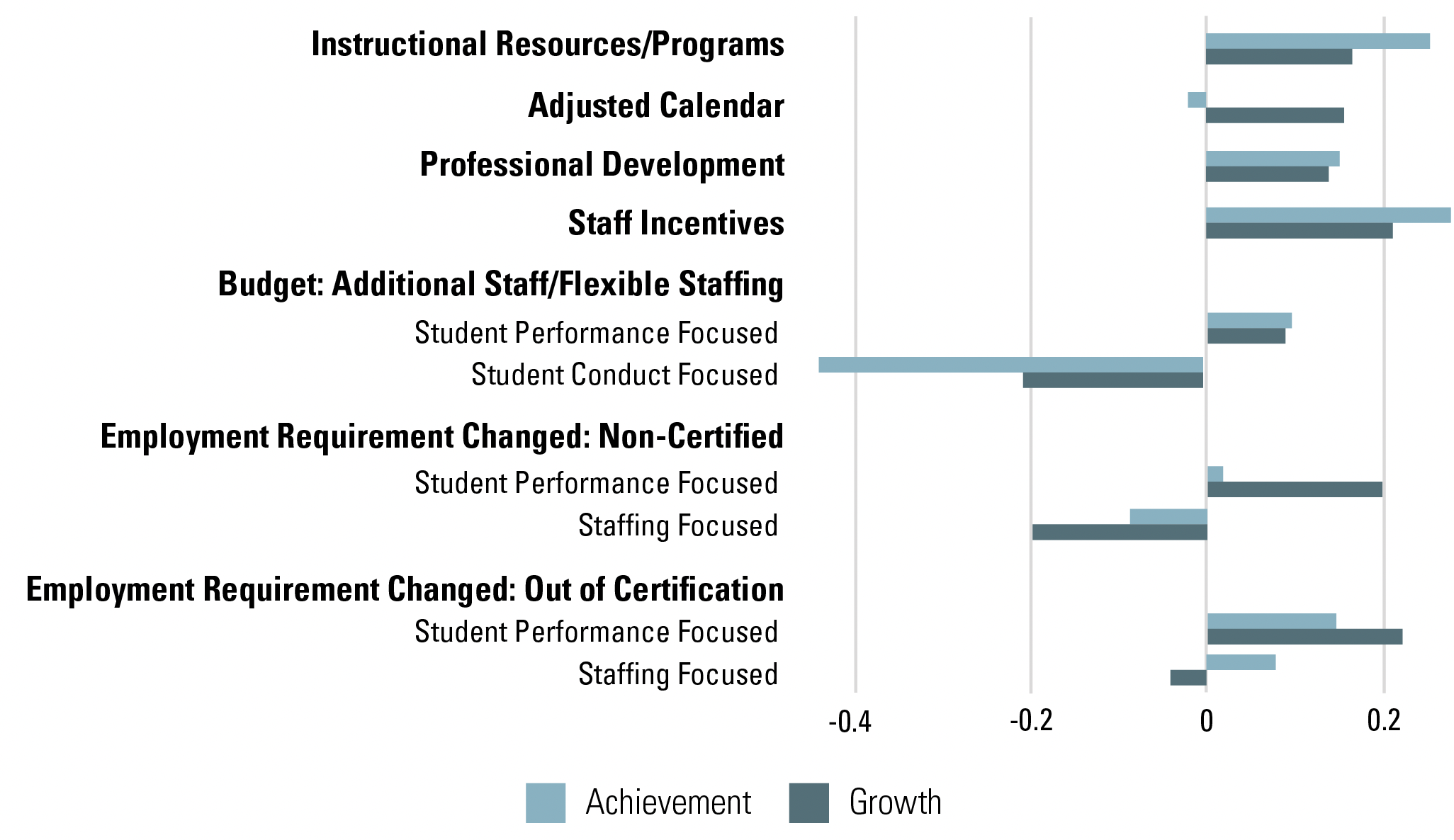
A 2024 report on Restart Schools found that school administrators deployed 81 unique strategies to improve student outcomes. The most common strategy was to utilize budget flexibility (142 schools) with 75% of those using budget flexibility to hire additional staff. Importantly, the report found that strategies focused on improving student performance had a greater positive impact on student achievement and growth, as compared to strategies focused on student conduct and school staffing.
Figure 1: Effect of Research Strategies on Student Achievement and Growth (2023)
This report examined only the 2022–23 school year. In the years to come, it will be important to continue to track efforts to improve Restart School performance and, specifically, track the strategies that are most effective for students.
NC Statute § 115C-105.37B; NC State Board Policy Manual; NC DPI Office of Learning Recovery & Acceleration — Restart, Learning Loss, and Recovery; NC DPI — Restart Annual Report Summary, August 2023; NC DPI — Restart Pathways: Variations and Test Score Associations
About This Series
This post is part of BEST NC’s 2024 Facts & Figures: Education in North Carolina Spotlight On: series. View the full report at NCEdFacts.org or visit BESTNC.org.