Don Curtis Interview with Brenda Berg – Carolina Newsmakers
North Carolina Teachers and State Employee Retirement System and Health Benefits

Note: This blog post features a brief from page 26 of our 2018 Facts & Figures publication, contextualizing North Carolina education data with a short description of an historical feature or a critical issue in North Carolina. Read more and find further information at www.NCEdFacts.org. All full-time employees in North Carolina public schools participate in the state’s Teachers and State Employees Retirement System (TSERS). TSERS provides qualifying employees a guaranteed salary and individual health benefits upon retirement from state government. In North Carolina, employees vest in TSERS after five years of service. Employees may retire with unreduced benefits after 30 years at any age, after 25 years of service at age 60 or older, or after five years at age 65 or older. Teachers contribute 6% of their pre-tax salary to TSERS, a rate that has been consistent since 1975. Nearly all states maintain a defined benefit (pension) plan for teachers and other state employees; in North Carolina and 29 other states, all teachers also participate in social security. TSERS is roughly comparable to the national median state plan and significantly more generous than the private sector average. Retiree health benefits in North Carolina are significantly more generous than the national median state plan and the private sector. Active state employee premiums for individual health care coverage are more generous than most other state plans and the private sector, but less generous than average for family plans. Source: North Carolina TSERS Handbook, NCGA Fiscal Research Division – Comparison of the Value of Employee Benefits
K-12 Education Finance in North Carolina

Note: This blog post features a brief from page 42 of our 2018 Facts & Figures publication, contextualizing North Carolina education data with a short description of an historical feature or a critical issue in North Carolina. Read more at www.NCEdFacts.org. In North Carolina and nationwide, public education is financed through federal, state, and local expenditures. Nearly two-thirds of total K-12 public education funding in North Carolina comes from the state through position, dollar and category allotments (such as allotments for teachers, principals, teacher assistants, textbooks, classroom materials, and transportation). Districts received additional funding from the state based on student learning needs (such as for children with disabilities, English language learners, and economically disadvantaged students). The state also provides supplemental funding to low-wealth counties (68 across the state) and small counties (27). Combining state funding allotments, a first grade student with no special learning needs would receive $5,861 in state funding; an economically disadvantaged first grade student with limited English proficiency and special learning needs in a small, low-wealth county would receive $17,279 in state education funding. Roughly 11% of K-12 public education funding in North Carolina comes from the Federal government. Federal funds mainly support child nutrition, students with disabilities, and students from low-income households. Source: NC DPI 2017 Highlights of the Public School Budget K-12 Education Finance In addition to state and federal funds, local North Carolina counties provide additional funding to supplement state support for K-12 school operations; and provide funds to build, furnish, and maintain K-12 school buildings. Local dollars fund nearly 28,000 positions in K-12 public schools, including 7,315 service workers, 6,313 teachers, 1,937 teacher assistants, and 756 assistant principals across the state. Local funds for school operations range from $849 per pupil in Robeson County to $6,151 in Chapel-Hill/Carrboro City Schools. Source: NC DPI Annual Expenditure Report by LEA
Shamrock Gardens Elementary School: A Blueprint for Educator Innovation
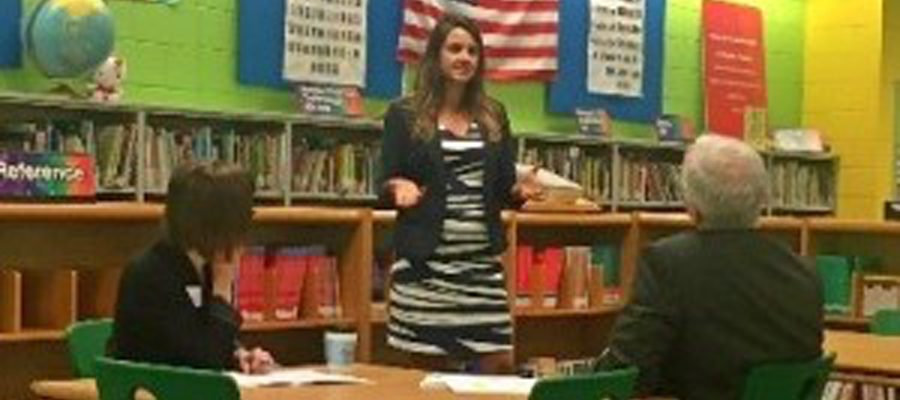
May 2017, By Brenda Berg, CEO, BEST NC. For several years, a primary focus of BEST NC’s student-focused advocacy work has been around the importance of having strong, well-supported educators in every classroom from; pre-K to higher education. Without great educators, anything else we advocate for is unlikely to work. That’s why we developed our primary advocacy priority, which we call Educator Innovation.
To Help New Teachers
[vc_row][vc_column width=”1/1″][vc_hidrop] Imagine this scene at a college career fair: As potential job seekers mill about, they notice one recruiting poster that stands out: “Come work in a hierarchical organization where your voice will be underappreciated, where you will have few opportunities for professional collaboration, and your career choices are essentially the same as they were 50 years ago!” The representative at this display begs the soon-to-be graduates to come to her table, saying, “Wait! You will be relentlessly evaluated by systems that don’t accurately measure your true worth, you will have long hours, and the pay is low!” Of course, I exaggerate. But not my much. The U.S. Department of Education’s Teacher Shortage Area reportfor 2015-16 highlights the fact that school districts across the country are having significant difficulty finding and keeping new teachers. And while much has been written about why we are not able to find enough qualified people to teach our next generation of citizens and leaders, we seem destined to continue down a path towards what is truly a national crisis. In addition to the examples I alluded to in my imaginary example above, the reality of inconsistent administrative support, excessive paperwork, pressures of state testing, and inadequate funding are obviously having a major impact on our ability to attract and retain new teachers. Over the past year, I have had the privilege of participating in a number of initiatives that are taking a much needed look at this chronic problem, both for my state of North Carolina, as well as on a national level. This includes working with a team from the Center for Teaching Qualityon recommendations about alternatives to my state’s compensation model, using my role as a TeachStrong Ambassador to highlight ways to modernize and elevate the teaching profession, and most recently, participating in an Innovation Lab hosted by BEST NC, where education stakeholders from across the country were asked to reimagine the PK-12 teacher pipeline. While each of these initiatives was different in overall scope and detail, one overarching outcome was striking: We will never attract and retain enough high quality teachers by simply relying on outdated models that are misaligned with the expectations of the Millennial generation, especially as we move to a gigeconomy. Individuals with the capacity and skill to be highly effective teachers will readily choose to enter and then stay in this profession when they are not only paid a competitive wage, but when they are valued for what they bring to the table from day one; when they have ready access to formal and informal leadership opportunities through which they can take advantage of incentives to foster peer-collaboration and shared expertise; and when there exists a culture of empowerment to drive innovation and creativity throughout every classroom in every school. These are the characteristics of any highly successful organization and it’s well past the time that we should expect them to be embedded in the DNA of every school in this country. Call me naive, but I firmly believe that if we can boldly move away from the top-down models that were designed for a different era and embrace what has been proven to work dynamic organizations both in and out of education, then we will indeed begin bringing more new teachers into a profession that so desperately needs them. It would put a whole new twist on my hypothetical career fair. Sign me up! Ben Owens spent 20 years as an engineer in industry before becoming a math and physics teacher at Tri- County Early College High School in the Murphy, N.C. He is the 2016 North Carolina Science Technology & Mathematics Center’s 9-16 Outstanding Educator, a 2014 Hope Street Group National Teacher Fellow, TeachStrong Ambassador, a Virtual Community Organizer for the Center for Teaching Quality, and a member of the Bill & Melinda Gates Foundation Teacher Advisory Council. Click here to view To Help New Teachers PDF [/vc_hidrop][/vc_column][/vc_row]
2016 Excellence Education Innovation Lab
Reimagining the Pipeline: Preparing PK-12 Teachers for Excellence. Thought leaders from around the state and nation gather to imagine innovative solutions for teacher recruitment and retention in North Carolina.