
Principal Pay in North Carolina
Note: This blog post features a brief from page 30 of our 2018 Facts & Figures publication, contextualizing North Carolina education data with a short description of an historical feature or a critical issue in North Carolina. Read more at www.NCEdFacts.org. In recent years, principal pay in North Carolina ranked last in the Southeast and near the bottom nationally. In 2017, the North Carolina General Assembly transformed the state salary schedule for principals with an investment of $24M, or an average raise of approximately nine percent. The previous statewide schedule was based on each principals’ years of experience, level of education, and the number of teachers in the school they led. Annual state-funded pay ranged from $52,656 to $111,984, with an average of $64,416 in 2017. The updated schedule is based on the size of the school and the principal’s growth status (derived from students’ performance on standardized End-of-Course and End-of-Grade exams). Principals are also eligible for two stackable bonuses based on their school-level growth scores and school performance grades: Source: North Carolina General Assembly – 2017 Appropriations Act
Statement from BEST NC on Principal Pay

Cary, NC – This year, North Carolina made the largest investment in state history in principal salaries through an updated salary schedule and bonus opportunities. The impetus was an average principal salary ranking at the bottom of the Southeast and among the lowest in the nation and increasing recognition that that North Carolina’s way of paying principals was outdated and convoluted.
Ranked 49th in principal pay
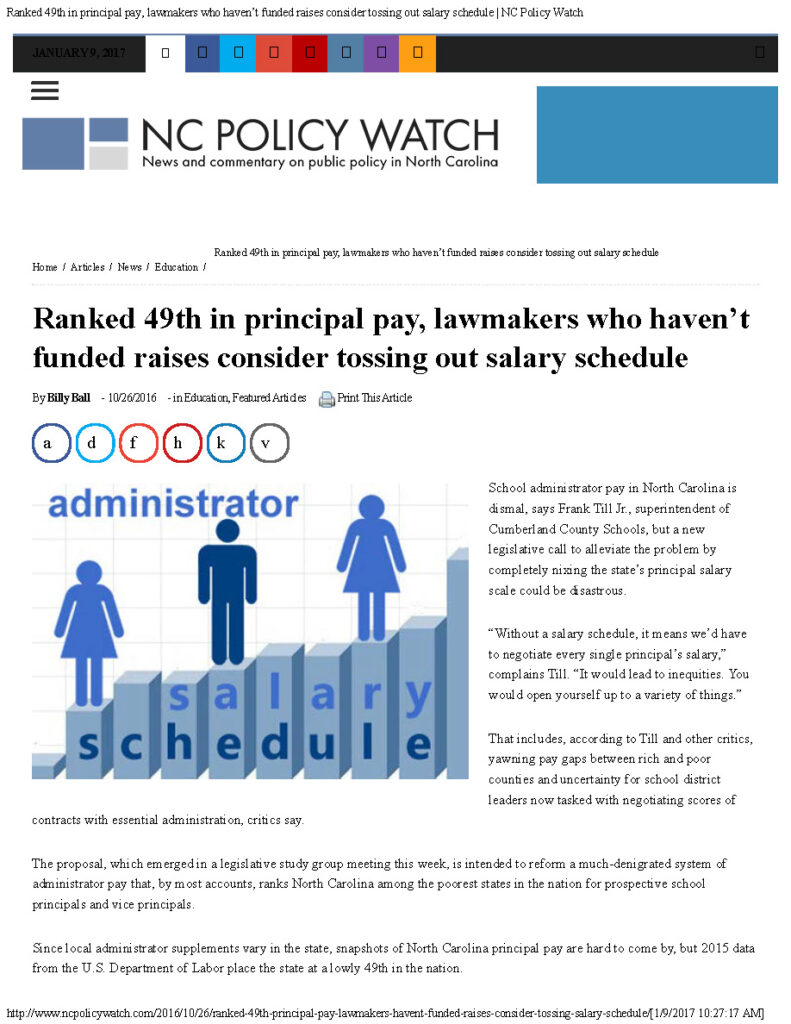
[vc_row][vc_column width=”1/1″][vc_hidrop] School administrator pay in North Carolina is dismal, says Frank Till Jr., superintendent of Cumberland County Schools, but a new legislative call to alleviate the problem by completely nixing the state’s principal salary scale could be disastrous. “Without a salary schedule, it means we’d have to negotiate every single principal’s salary,” complains Till. “It would lead to inequities. You would open yourself up to a variety of things.” That includes, according to Till and other critics, yawning pay gaps between rich and poor counties and uncertainty for school district leaders now tasked with negotiating scores of The proposal, which emerged in a legislative study group meeting this week, is intended to reform a much-denigrated system of administrator pay that, by most accounts, ranks North Carolina among the poorest states in the nation for prospective school principals and vice principals. Since local administrator supplements vary in the state, snapshots of North Carolina principal pay are hard to come by, but 2015 data from the U.S. Department of Labor place the state at a lowly 49th in the nation. The mean administrator pay in North Carolina—about $68,000—trails all of the state’s neighbors in the southeast, according to the federal department. Yet with much of the general public’s focus on teacher pay, it’s perhaps one of the most overlooked crises for North Carolina schools, advocates say. Republican Sen. Jerry Tillman, a former school administrator who represents Randolph and Moore counties in the General Assembly, sponsored legislation in 2015 that would have funneled millions into boosted principal pay and bonuses for high- performing administrators, but that legislation stalled. And this year, GOP lawmakers once again opted out of raises for school administrators, but they did commission a study group co- chaired by Tillman to suggest fxes. The group’s frst solution, unveiled at the study group’s meeting in Raleigh this week, is a multi- pronged proposal that completely axes the state’s oft-maligned principal salary scale, provides so-called “gap funding” for administrators in poorer school districts and creates a pot of money for principal bonuses. Under the proposal, state leaders would provide a set pool of funding for administrator pay, but it would be left to districts to negotiate pay with principals. It’s a concept that received a chilly reception from a panel of school administrative leaders who spoke to the legislative study group this week. In addition, legislators would also look to revamp the scale for assistant principals. Advocates have pointed out that, due to the state’s outdated pay schedule, some assistant principals could earn less than the teachers they oversee. Till is among the most outspoken critics of the new proposal. The Cumberland County Schools chief points out that, in his rural district, offcials would be charged with negotiating contracts for 87 different principals. In larger counties such as Wake and Mecklenburg, which manage hundreds of schools, the burden would be even larger, administrators said. And, across the state, the lack of a state-mandated foor for principal pay could lead to growing inequalities across districts and a spike in employment complaints and lawsuits. “Board members could suddenly start negotiating salaries with their friends,” Till told Policy Watch this week. “It would be about who you know and what you know. It’s just a slippery slope that you don’t want to go down.” GOP lawmakers have yet to commit to any course of action, but Tillman told study group members this week that he expects final proposals for the legislature to be readied by the end of the year. Katherine Joyce is executive director of the N.C. Association of School Administrators, an organization of school chiefs representing administrators in Raleigh. This week, Joyce said lawmakers are right to be concerned about the state’s dysfunctional system of administrator pay. “There needs to be adequate incentive to get teachers to leave the classroom if they want to take on more responsibility,” said Joyce. After all, administrators are vital to the success of a school, Joyce points out. Research suggests that effective classroom teachers and strong administrators are the top two drivers of student success, Joyce says, but without ample incentive, quality administrators are likely to fock out of the state for employment. “They have to go hand in hand. If we’re not investing enough in our principals, we have a problem that’s going to trickle down all the way into the classroom and affect student learning. It’s got to be a high priority for the General Assembly.” Joyce says there’s merit to some of the study group’s proposals, namely, reforming assistant principal pay and placing a focus on principal bonuses and “gap funding” for low-income districts priced out of the competition for top administrators. But the proposal lobbed in the legislative study group this week has still earned poor marks from multiple school leaders, including Joyce, chiefy because of the uncertainty created for school districts if the state dissolves its principal pay schedule. The state scale, while badly in need of boosts for long-overlooked administrators, still sets a foor for pay across North Carolina, they “School districts need some stability and a level playing feld between districts so that the bidding war out there for the really effective principals is not exacerbated,” Joyce tells Policy Watch. It’s a legitimate concern, says Till, who adds that the reform could be misleading to the general public. “By doing away with the salary schedule, (the NCGA) can say we raised the administrator pay by 5 percent, 10 percent, but what they don’t say is it’s not across the board.” Rep. Hugh Blackwell, a powerful Republican from Burke County who co-chairs the study group, questioned this week whether state leaders would be better suited to negotiate principal contracts than local leaders. Blackwell did not respond to a request for comment, but at least one defender of the new legislative proposal told Policy Watch this week that some pushback is to be expected. “Because they’re not used to negotiating in this way doesn’t mean it’s necessarily a bad idea,” […]