
North Carolina’s New Approach to Teacher Recruitment

The new North Carolina Teaching Fellows program is due to officially launch this month – and it’s a big deal. It’s an exciting opportunity for future teachers, for the students they will serve, and for North Carolina.
Lagging Math Scores Hurt North Carolina’s Global Ranking
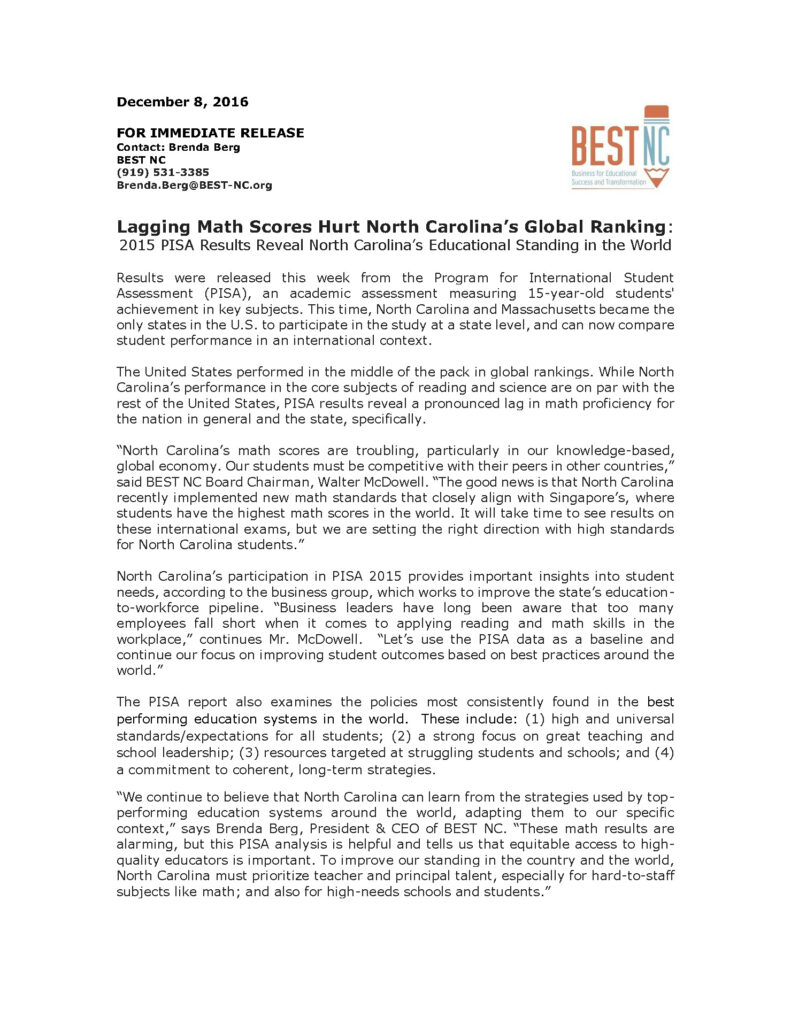
Results were released this week from the Program for International Student Assessment (PISA), an academic assessment measuring 15-year-old students’ achievement in key subjects. This time, North Carolina and Massachusetts became the only states in the U.S. top anticipate in the study at a state level, and can now compare student performance in an international context.
To Help New Teachers
[vc_row][vc_column width=”1/1″][vc_hidrop] Imagine this scene at a college career fair: As potential job seekers mill about, they notice one recruiting poster that stands out: “Come work in a hierarchical organization where your voice will be underappreciated, where you will have few opportunities for professional collaboration, and your career choices are essentially the same as they were 50 years ago!” The representative at this display begs the soon-to-be graduates to come to her table, saying, “Wait! You will be relentlessly evaluated by systems that don’t accurately measure your true worth, you will have long hours, and the pay is low!” Of course, I exaggerate. But not my much. The U.S. Department of Education’s Teacher Shortage Area reportfor 2015-16 highlights the fact that school districts across the country are having significant difficulty finding and keeping new teachers. And while much has been written about why we are not able to find enough qualified people to teach our next generation of citizens and leaders, we seem destined to continue down a path towards what is truly a national crisis. In addition to the examples I alluded to in my imaginary example above, the reality of inconsistent administrative support, excessive paperwork, pressures of state testing, and inadequate funding are obviously having a major impact on our ability to attract and retain new teachers. Over the past year, I have had the privilege of participating in a number of initiatives that are taking a much needed look at this chronic problem, both for my state of North Carolina, as well as on a national level. This includes working with a team from the Center for Teaching Qualityon recommendations about alternatives to my state’s compensation model, using my role as a TeachStrong Ambassador to highlight ways to modernize and elevate the teaching profession, and most recently, participating in an Innovation Lab hosted by BEST NC, where education stakeholders from across the country were asked to reimagine the PK-12 teacher pipeline. While each of these initiatives was different in overall scope and detail, one overarching outcome was striking: We will never attract and retain enough high quality teachers by simply relying on outdated models that are misaligned with the expectations of the Millennial generation, especially as we move to a gigeconomy. Individuals with the capacity and skill to be highly effective teachers will readily choose to enter and then stay in this profession when they are not only paid a competitive wage, but when they are valued for what they bring to the table from day one; when they have ready access to formal and informal leadership opportunities through which they can take advantage of incentives to foster peer-collaboration and shared expertise; and when there exists a culture of empowerment to drive innovation and creativity throughout every classroom in every school. These are the characteristics of any highly successful organization and it’s well past the time that we should expect them to be embedded in the DNA of every school in this country. Call me naive, but I firmly believe that if we can boldly move away from the top-down models that were designed for a different era and embrace what has been proven to work dynamic organizations both in and out of education, then we will indeed begin bringing more new teachers into a profession that so desperately needs them. It would put a whole new twist on my hypothetical career fair. Sign me up! Ben Owens spent 20 years as an engineer in industry before becoming a math and physics teacher at Tri- County Early College High School in the Murphy, N.C. He is the 2016 North Carolina Science Technology & Mathematics Center’s 9-16 Outstanding Educator, a 2014 Hope Street Group National Teacher Fellow, TeachStrong Ambassador, a Virtual Community Organizer for the Center for Teaching Quality, and a member of the Bill & Melinda Gates Foundation Teacher Advisory Council. Click here to view To Help New Teachers PDF [/vc_hidrop][/vc_column][/vc_row]
Solutions for low-performing schools

[vc_row][vc_column width=”1/1″][vc_hidrop] The June 20 Focus article “How many failing schools are in NorthCarolina?” spent a full page splitting hairs over whether there are 80 or 135 or 299 or 415 or 500 low-performing schools in North Carolina. In fact, as more people chime in from all sides, the debate still seems to be about the numbers. Why so much debate about the number of low-performing schools in North Carolina? The fact that we have any schools in which students are failing to thrive academically is a tremendous problem both for the students and for the economy of North Carolina. We should spend our time and resources looking for solutions to serve the students in these schools. Whether there are 80 or 500 low-performing schools, the consequence is that thousands of students will either not graduate from high school or will graduate without the “sound, basic education” our state constitution promises, ill-equipped to succeed in work and life. What students in low-performing schools need more than anything else are a great teacher and principal each and every year, high expectations matched by rigorous academic opportunities and caring adults to help them tackle life’s challenges. Unfortunately, far too many students are missing at least one of these keys to success. Students in high-poverty schools are nearly half as likely as their more affluent peers to have access to teachers who are National Board Certified or rated as “highly effective.” Instead, they are nearly twice as likely to have a first-year teacher or a teacher who “needs improvement.” With every educator paid the same, regardless of where they teach or the challenges they help their students overcome, it is no wonder that our highly effective teachers and principals get “promoted out” of low-performing schools and into more affluent schools. Students in low-performing schools also have less access to challenging courses that will inspire them and set a positive course for their future. And all too often, students in low-performing schools lack a parent, coach or mentor who can help navigate their academic and personal challenges. These obstacles may seem insurmountable, but there are schools and programs that provide struggling students with a more equal opportunity to learn through high expectations, wrap-around services and strategic staffing. School systems like Charlotte-Mecklenburg and Winston-Salem Forsyth have found ways to attract some of their best teachers to teach in the schools where they are needed most. Programs such as Communities in Schools, Citizen Schools, Big Brothers/Big Sisters and the YMCA provide students with caring coaches or mentors to help them thrive in and out of the classroom. Rather than debating the numbers, we should focus on finding ways to scale successful initiatives into every low-performing school in the state. So, the question isn’t how many low- performing schools are there in North Carolina? The question is: What are we going to do about it? BRENDA BERG PRESIDENT, CEO BEST NC (BUSINESS FOR EDUCATION SUCCESS AND TRANSFORMATION IN NORTH CAROLINA) Click here to view Solutions for low-performing schools PDF [/vc_hidrop][/vc_column][/vc_row]
‘- Facts vs-facts in education debate
[vc_row][vc_column width=”1/1″][vc_hidrop] Facts vs. facts in education debate by Ferrel Guillory | February 26, 2016 Keith Poston and James Ford of the Public Schools Forum of NC. Photo Credit: Alex Granados/EdNC To provide more in-depth coverage on schools in North Carolina, EdNC will shortly launch the EdData Dashboard. Our editor, Mebane Rash, and her staff have produced a handsome, easy-to-use, and substantive “dashboard’’ that they will up-date quarterly. We trust you will find the data charts, graphs, and packages informative, enriching your perspectives on education in our state. We welcome your comments and suggestions. I often repeat the time-honored wisdom that “data without analysis is junk.” Yes, we have to put the facts down. But we also have to array facts, connect dots, and examine time lines to make the facts mean something by which to drive action. This week’s column examines the challenge of dealing with data. Elections call upon voters to compare and contrast candidates in terms of personality, policy, and partisanship, as well as ability, priorities, and values. As the education issues play out in campaign 2016 in North Carolina, voters will encounter another dimension of debate: facts fighting facts. What’s an engaged citizen to do as candidates, parties, think tanks, and advocacy groups offer an array of facts, all objectively accurate but telling conflicting stories and leading to clashing conclusions about North Carolina and its schools? There’s no easy answer, except to weigh the competing facts and assess which set of statistics offer a story that adds up to reality. Already, Gov. Pat McCrory and Lt. Gov. Dan Forest, the Republican incumbents seeking re-election, have spelled out a long list of facts in explanation and defense of the GOP record since gaining control of the governorship and the General Assembly by a veto-proof majority in 2012. The governor’s list appears under the “record of success’’ section of his campaign’s website. Forest, who as lieutenant governor serves on the State Board of Education, has emerged as a more aggressive, and charismatic, champion of the Republican message on schools. A few days ago, he stepped before the combined Wake County Republican precinct caucuses and sought to arm party activists with data-points to counter “misinformation (that) Republicans are decimating education.” Forest also has posted three education-oriented videos, one entitled “education fast facts,’’ on his campaign website and YouTube. Both the governor and lieutenant governor draw a contrast between the education budgets under former Democratic Gov. Bev Perdue and under Republicans since 2012. McCrory points to spending reductions of “almost $1 billion between 2008 and 2011.” Forest says Republicans have put “$1.5 billion back into education,” thus spending “more than ever in the history of North Carolina.” As you consider those facts do so in the context of the Great Recession of 2008-09 that produced a drastic upward spike in unemployment and a downward spike in state revenues. Whoever, Democrats or Republicans, ruled in Raleigh between 2009 and 2012 would have had to slash state spending or raise taxes or both, to produce a balanced budget as the iron-clad law provides. As the economy recovered over the past three years, Republicans have appropriated more in total dollars to K-12 education. Independent analysts and advocacy groups, some of which are critics of the current administration, offer other facts. Some draw on data from before the Great Recession. Others focus on growth in enrollment. For example, a recent report by the nonpartisan Public School Forum of North Carolina presents a state-by-state chart showing that North Carolina’s per pupil spending, adjusted for inflation, declined by $855 from fiscal 2008 to 2015, the sixth largest decline among states. The 2016 Facts and Figures publication by BEST NC, a nonprofit formed by business leaders, reports that “North Carolina ranked 46th in the country in total K-12 per-pupil spending in 2014-15 in constant dollars, but 39th in cost of living adjusted dollars.” The McCrory campaign website says that “in 2014 the average salary for teachers in North Carolina increased more than any other state in the nation.” A Forest video says the state’s previous leadership had “frozen’’ teacher pay for years, then Republicans raised teacher pay an average of 11 percent. The legislature’s website has a chart of pay raises for teachers and state employees going back to 1973-74: It shows substantial teacher pay raises before the Great Recession. Teacher pay raises averaged 8.2 percent, 5 percent, and 3 percent in the last three years of Democratic Gov. Mike Easley’s administration. Then came no pay raise for three consecutive fiscal years – “frozen’’ from 2009 to 2012 – budgets hard hit by the recession. Teachers received a 1.2 percent raise in 2012-13 and then, as the legislative staff calculated, raises ranging from .5 percent to 18.5 percent (a 7 percent average) in 2014-15. Republican legislators have targeted raises on early-career teachers, while also revising the career “step-increase’’ pay system. The most recent pay legislation gave some experienced teachers a step increase, again increased new teachers’ pay and provided a one-time $750 raise across the board. The BEST NC report has a chart comparing North Carolina teacher compensation to the national average. In 2001, the North Carolina average was $41,496, just below the national average of $43,378. The gap widened to more than $10,000 by 2014. The latest pay raise brings North Carolina up to about $50,000, still below the national average. The Public School Forum reports that North Carolina ranks 42nd among the states in teacher pay, up from 47th a year earlier. In his talk to Wake Republicans, Forest declared, “Teachers are not leaving North Carolina in droves; how many of you know that?” In one of his videos, the lieutenant governor deconstructs a state report on teacher turnover to make the point that 6.8 percent of teachers fully left the profession last year, well below the 14.9 percent turnover rate widely reported. Only one percent has gone to other states, he said. […]